Showing posts with label Vogue's Book of Etiquette. Show all posts

Friday, August 11, 2023

Etiquette for Coffee After Luncheon

If coffee is served in the living room, the only difference is that the host and the men guests may fetch the cups of coffee for the women, if the hostess is serving the coffee herself.

 Coffee after Luncheon


There are the ways that coffee is usually served after dinner, but after luncheon are small changes: At luncheon, or at the most informal dinners, where there are only one or two guests, the men often go into the living room with the women. In this case, of course, if coffee is served at the dining room table, there is no difference in the service. If it is served in the living room, the only difference is that the host and the men guests may fetch the cups of coffee for the women, if the hostess is serving the coffee herself.– From Vogue’s Book of Etiquette, 1948


🍽Etiquette Enthusiast, Maura J. Graber, is the Site Editor for the Etiquipedia© Etiquette Encyclopedia

Thursday, August 10, 2023

Etiquette for Serving Coffee for Men

“When there is no maid, coffee may be served at the table by the hostess, before the men and women separate; or, if men and women are not to be separated, it is served in the living room. If liqueurs are to be served, they are brought before the coffee cups are removed.” – Above, a 19th century maid serving coffee. 

Coffee for the Men


In the dining room, where the men have been left behind, coffee is served before the women have been given their coffee in the living room. The dining room service parallels that in the living room; for example, if the more formal version has been used in the living room it should be observed in the dining room, too, the butler coming first with the tray holding an empty cup, sugar, and cream, and the coffeepot, the footman following with the extra cups. 

The only difference between coffee service in the dining room and in the living room is that the host rarely pours the coffee himself; even when the hostess is to serve the coffee in the living room, the maid may serve the men first. When there is no maid, coffee may be served at the table by the hostess, before the men and women separate; or, if men and women are not to be separated, it is served in the living room. If liqueurs are to be served, they are brought before the coffee cups are removed.– From Vogue’s Book of Etiquette, 1948


🍽Etiquette Enthusiast, Maura J. Graber, is the Site Editor for the Etiquipedia© Etiquette Encyclopedia

Wednesday, August 9, 2023

Coffee Etiquette in Mid 20th C. America


In the Living Room 

After a semiformal or a formal dinner, coffee is not traditionally served at table. The French custom is that men and women have their coffee together in the living room, but the English custom of serving the women in the living room and the men in the dining room or library has become standard for all entertaining in America except the most informal. 

Soon after the women have left the dining room, the coffee is brought in to them. The most formal version of this system— and the one usually followed if the service has been elaborate— is that the butler or first waitress carries a small tray with the sugar, the cream, one cup, and the coffeepot. The footman or second waitress follows with a tray of empty cups. The butler goes first to the most important woman guest, saying, "Coffee, Madam?" and offering the tray. He fills the cup; the guest helps herself to sugar and cream, and takes the cup.

A slight variation of this is to have the sugar and cream on the big tray with the empty cups. The butler inquires as to each guest's preference, pours the coffee, puts the cup on his small tray and offers it to the guest.

The second way of serving in the living room is managed by the waitress or butler alone. All the cups– five are usually the maximum possible – and the sugar and cream are balanced on a tray on one hand. The coffee is poured from a pot held in the other hand, and each guest helps himself to sugar and cream.

Still a third way– but, again, somewhat contrary to good service– is to have the butler bring a tray of filled cups, with the sugar and cream; each guest helps herself. Finally, and this is probably used more than any other– the complete coffee tray, with empty cups, coffeepot, sugar and cream, is brought in and set down on a low table in front of the hostess. After asking each guest what she likes in the way of sugar and cream, the filled cups are passed to the women by the hostess, or each guest comes up to take her cup for herself. – From Vogue’s Book of Etiquette, 1948


🍽Etiquette Enthusiast, Maura J. Graber, is the Site Editor for the Etiquipedia© Etiquette Encyclopedia

Thursday, August 11, 2022

Etiquette of Serving Water

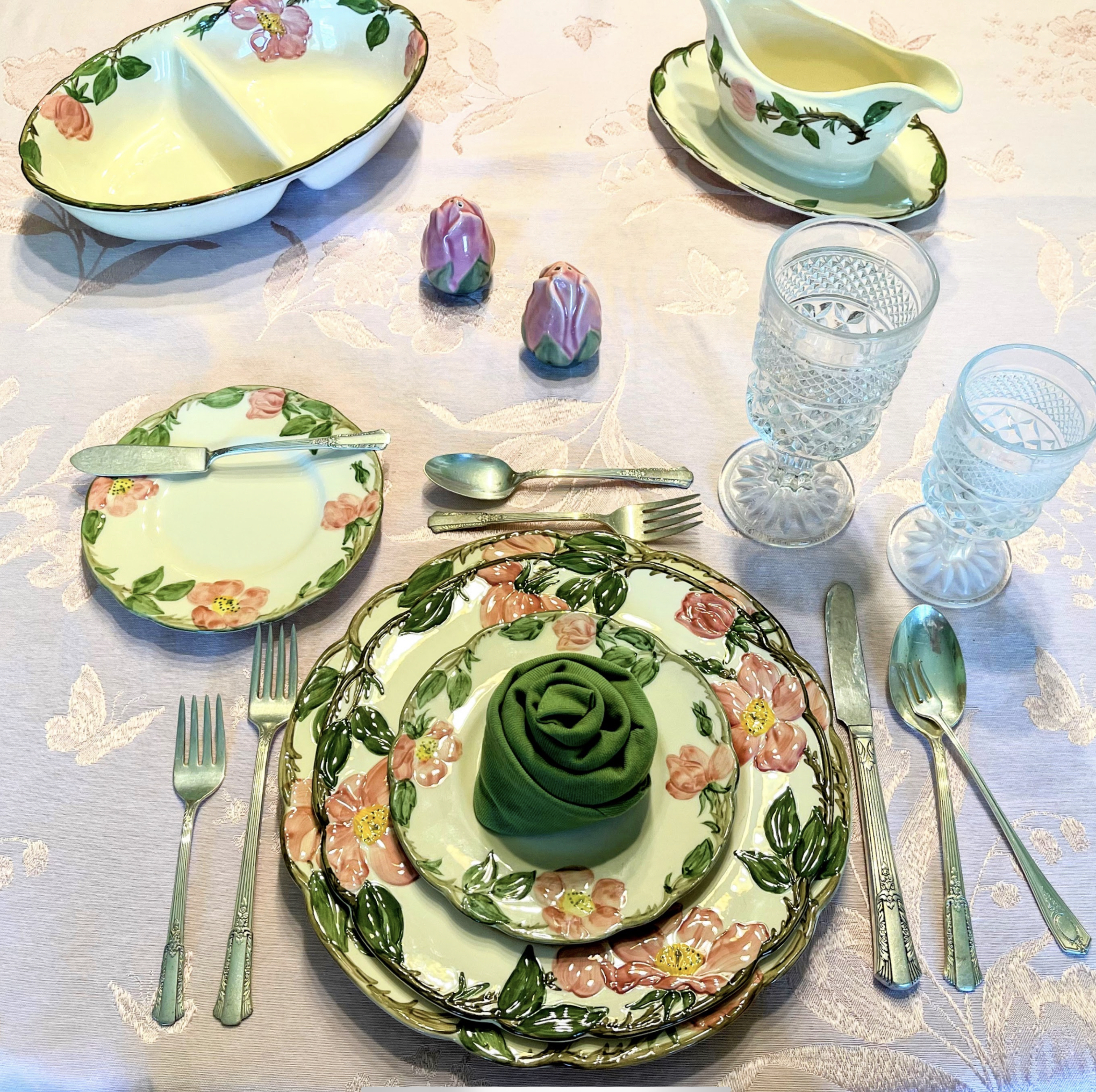
A mid-20th century place setting, with plates and flatware from the 1940’s. The plates are in the highly popular, 1941 “Desert Rose” pattern by Franciscan, and the grille-sized flatware by Wm. Rogers, is in the 1940, “Treasure” pattern.
Grille-sized flatware was designed with longer handles for the knives, dinner forks and salad forks. It enjoyed brief popularity and was also called “Vogue” or “Viande” flatware. Designers felt that the longer handles made the flatware easier to use.
The “water glass”, or “water goblet”, is properly placed above the dinner knife. Water specific glasses weren’t made for the dining table 
until 1851, when the Corning Glass company catalog first offered a “water glass” in their glassware line.

The customs attached to the serving of water are widely different from those of other drinks. Water is the only drink which, whether at the dining-room table or in the living room, can always be poured before it is served. As we have said in the chapter “Setting the Table,” under the most elaborate system of service, water is not poured until the guests are seated at the dining-room table. But, as a matter of widely accepted practice, the water glasses are usually filled before the guests come into the room, and refilled from a pitcher as soon as any considerable quantity has been drunk.

Water served in the living room is brought in filled tumblers on a small tray; stemmed water goblets belong only on the dining-room table. It is perfectly cor rect, of course, to leave a pitcher of water in the living room or hall, on a tray with empty glasses, but whenever a guest asks for water, except in the dining room, it may always be brought already poured in a tumbler on a small tray.— From “Vogue’s Book of Etiquette,” 1948


🍽Etiquette Enthusiast, Maura J. Graber, is the Site Editor for the Etiquipedia© Etiquette Encyclopedia
Sunday, July 10, 2022

Etiquette of Dress for a Butler


At the head of the pantry department is the butler who, in very large house holds, has a very important position. In America, where housekeepers are even more rare than butlers, butlers often engage and dismiss all the rest of the staff.

Note: it is a primary rule of appearance that butlers and footmen must be clean-shaven. 

Traditional and Formal Dress

Morning:

1. A dark sack suit.

2. White shirt.

3. Stiff fold collar.

4. Black four-in-hand tie.

5. Black shoes.

6. Black socks.

Luncheon time, afternoon, and teatime: 

(This is not worn in the evening.) 
1. Black dress coat (the same as that worn in the evening; see below). Or, to be most technical, a cutaway coat.

2. Gray-and-black striped trousers

3. A black double-breasted waistcoat, stiff white shirt, stiff white wing collar (or, less formally, a fold collar), and black four-in-hand tie; or black bow tie with wing collar.

4. Low black calf oxford shoes and black socks.

Dinner and the evening:

1. Stiff-bosomed white shirt, wing collar, small gold studs (as small as collar buttons)

2. White bow tie

3. Black waistcoat and tail coat.

4. Black trousers without braid or stripes.

5. Black shoes and socks.

Less formal variations (black calf oxfords and black socks are also standard with all of these):

Afternoon and Evenings: Gray-and-black striped trousers with a short black single-breasted sack coat, black waistcoat, soft white shirt and stiff fold collar, black four-in-hand tie; or

Less formally, a black alpaca coat with striped trousers worn with a soft white shirt, black waistcoat, semi-stiff collar, black four-in-hand tie.

Hot weather: Gray alpaca coat (with three buttons) with black trousers with soft white shirt and collar, black four-in-hand tie; or

White linen or duck double-breasted coat worn with black trousers, white shirt and collar and black four-in-hand tie. (This may be worn both afternoon and evening.) Another very good white coat is white linen or duck with black, or colored, collar and cuffs, which may be solid colors— the “house” color and, for evenings, a wing collar and bow tie; or, for afternoons, a fold collar or striped like a footman’s waistcoat. This coat is worn with black trousers and black four-in-hand tie. — From “Vogue’s Book of Etiquette,” 1948


🍽Etiquette Enthusiast, Maura J. Graber, is the Site Editor for the Etiquipedia© Etiquette Encyclopedia

Friday, May 4, 2018

Differing Etiquette and Continents

Europeans hold the fork in the left hand and the knife in the right and, when food is cut, it is carried to the mouth by the left hand. The knife is always in use, not only for cutting, but also for pushing and for dabbing gravy onto the potatoes and other such useful functions. There are some differences between the English and the Continentals, for though both keep forks in the left hand, the English keep the tines turned over and pile food onto the back of the fork. Beginning with meat as a platform, they may smooth on potatoes into which they press peas and then transport the whole mouthful at once.

Why are American manners different?

Because most American customs and rules of etiquette are drawn from those of Europe, any that differ are of special interest. How did the differences come about and what do they represent, if anything? I have always wondered, for example, why Americans who greet one another by kissing do so with a single kiss on one cheek, while Europeans always buss both cheeks, and sometimes do so twice, for a total of four kisses. Are we less affectionate than Europeans, or merely busier and so anxious to cut our kissing time in half? Similarly and equally inexplicably, Americans differ from Europeans in their use of the knife and fork. 

Europeans hold the fork in the left hand and the knife in the right and, when food is cut, it is carried to the mouth by the left hand. The knife is always in use, not only for cutting, but also for pushing and for dabbing gravy onto the potatoes and other such useful functions. There are some differences between the English and the Continentals, for though both keep forks in the left hand, the English keep the tines turned over and pile food onto the back of the fork. Beginning with meat as a platform, they may smooth on potatoes into which they press peas and then transport the whole mouthful at once. Other Europeans turn the tines over after cutting and push food onto the fork with a knife. But for many years American etiquette dictated that the fork must be switched to the right hand after the food is cut, and that the knife should rest on the edge of the plate. During actual eating, the left hand was supposed to lie idle on the lap. 

This cumbersome and awkward switching of hands continues today even though it was declared out of date as far back as 1948 in “Vogue’s Book of Etiquette,” written by Millicent Fenwick, who was then an associate editor of Vogue and is now the United States representative to the United Nations Food and Agricultural Organization in Rome. After describing the old rule, Mrs. Fenwick wrote, “Today, it is reversed so commonly that the left-handed method is almost preferred to the other. Both are perfectly good usage, but it is now axiomatic that whenever food is cut with a knife, the left hand can quite naturally carry it up to the mouth.” Even though the European method is smoother and more efficient, as any time-motion study would prove, most Americans persist in this “zig-zag” method, as it is described in “The New Emily Post’s Etiquette” by Elizabeth L. Post. The author suggests that Americans are reluctant to follow the European method because they feel it would be “putting on airs to adopt a foreign way of eating.” Mrs. Post advises, “I can see nothing wrong in adopting a custom that seems more practical than your own.” 

Letitia Baldrige, who revised “The Amy Vanderbilt Complete Book of Etiquette,” also considers the Continental style more “sensible.” In preparing this book, which was published in 1978, Miss Baldrige tried in vain to discover how the zig-zag method developed in the United States. “I even called the Library of Congress but they could not come up with anything,” she said. “English nannies,” she continued, “always teach children to pile food up on the back of the fork because that is the quickest way to get the meal over with. Also, the food tastes delicious that way.” (Miss Baldrige also said she had been told that double kissing was meant to bless both sides of the brain.) 

Perhaps in the early days of our country, the change in rules was a populist protest against royalists. Or, as a European friend suggested, onehanded eating may be a holdover from frontier days, when it was necessary to keep one hand at the ready for self defense. Left-handed Americans have, perhaps, the best of both worlds. Those I know hold the fork in the right hand, cut with the knife in the left hand and eat without changing hands. – By Mimi Sheraton, N.Y. Times News Service, 1983


Etiquette Enthusiast, Maura J Graber,is the Site Editor for the Etiquipedia© Etiquette Encyclopedia

Tuesday, September 30, 2014

Etiquette is More Than Just Manners

Etiquette beyond this field, is now concerned with inanimate objects and ways of handling them -- silver, glass, writing paper, and many more. 
Etiquette is an important subject because it is concerned with human beings and their relations to one another. It is a system for the complex business of living in a community. Like life and people, it is full of paradoxes. Etiquette is based on tradition, and yet it can change. Its ramifications are trivialities, but its roots are in great principles. It is part of the web of customs, beliefs, laws, and morals which sustains and restrains every society of men.

When we apply this definition to our daily life, we can understand the changes etiquette has undergone. The origin of the word 'etiquette' was supposedly the 'ticket' of entrance to court ceremonies in France, on which rules of court behavior were written; and for us, the primary point of etiquette is still human relations. But now almost every degree of relationship is included in its scope. Reaching out beyond this field, it is now concerned with inanimate objects and ways of handling them -- silver, glass, writing paper, and many more. It prescribes the procedure of family events such as weddings and christenings and in minute detail it covers the smallest technicalities, such as how to address a letter or eat an artichoke.

Etiquette is a big subject, but it's no secret. And this is significant of the revolutionary change in its character. In the last 20 years, particularly in America, etiquette has become less arbitrary and more democratic, because it has discarded the old source of its authority and taken up a new one. The old sanction for its rules was, 'The inner circle (or the 'best' people) behave this way.' Its new standards of behavior are based on what millions of people have accepted as right or wrong. There's no longer any question of admission 'by ticket only.' It's a forum for citizens, open to anyone who cares about the amenities of living. Good behavior is everybody's business, and good taste can be everyone's goal.

The simplest proof of this change are its casualty list. Pretentiousness, which was once considered quite understandable, is now laughable if not pathetic. Condescension has disappeared. And 'noblesse oblige,' which might have been translated, 'Aristocrats acknowledge the responsibilities of privilege,' now reads, 'Citizens admit the responsibilities of freedom.' These are the general outlines of the change.

From 1948's
Vogue's Book of Etiquette:

A Complete Guide to Traditional Forms and Modern Usage by Millicent Fenwick, Associate Editor of Vogue