Showing posts with label Etiquette and Servants. Show all posts

Friday, August 26, 2022

Etiquette for Greeting Servants

Housekeepers are often dignified by being called “Mrs. Jackson” or “Miss Lang” by the staff and their employers, as is the cook, very often, in a house with a large staff. 


If you are a familiar of the house you are visiting you may say, “Good afternoon, Perkins,” to the butler or houseman who opens the door and greet by name other servants you recognize if you wish. Housemen and butlers are usually addressed by their surnames, chauffeurs preferably by their surnames but often by their proper names (never nicknames). 

Maids and cooks are “Ella,” “Katherine,” or “Katie,” whichever they prefer, although in some formal households the woman servants are called, English fashion, “Murphy,” “Keene,” etc…

Chinese men servants are called by their last names, which, Chinese fashion, are always given first. A man who tells you his name is Fu Wang expects to be called Fu, his last name. 

Housekeepers are often dignified by being called “Mrs. Jackson” or “Miss Lang” by the staff and their employers, as is the cook, very often, in a house with a large staff. 

To the staff the butler is always “Mr. Perkins,” for he is the household's executive officer. A chef is “Chef” or else is referred to by his surname alone. A French chef is usually "Monsieur Robert" (his first name). — Amy Vanderbilt’s New Complete Book of Etiquette - The Guide to Gracious Living, 1952


🍽Etiquette Enthusiast, Maura J. Graber, is the Site Editor for the Etiquipedia© Etiquette Encyclopedia

Friday, August 19, 2022

On Meals and Dining of 1905

At noon the family sits down to a simple breakfast—fruit, broiled chicken, creamed potatoes, hot bread and coffee, for example. The maid has few dishes to wash, is not too tired to enjoy her afternoon off, and gets away two or three hours earlier than her less fortunate sisters. Also she remains where she is hired—which has its advantages. Only a light lunch is needed in the evening which the mistress may serve, leaving the dishes to be washed in the morning.

There is an old saying to the effect that “all may eat, but ladies and gentlemen dine.” The difference lies more in the preparation and manner of serving than in the food itself, and whether her evening meal is a banquet or a repast of the lunch-counter sort rests wholly with the housewife.

We pause long enough to pay our disrespects to that barbarous institution known in America as the Sunday Dinner. On six days in the week, the average business man eats a light luncheon or none at all. On the seventh day, at an unaccustomed hour, he eats a heavy meal, goes to sleep shortly afterward, and wonders why Monday is a “blue day.”

Our uncivilized Sundays are responsible for our Monday morning headaches and for the gloom which, in many a household, does not wear off until Tuesday morning. If Sunday were a day of fasting instead of a day of feasting, Monday might be radiant occasionally instead of riotous or revolutionary.

We make Sunday a hard day for the women of the household, especially the servants, and the imperial liver appertaining to the Head of the Establishment balks sometimes at the strain. The American Sunday Dinner is one cause of the American Servant Problem—and everybody knows what that is.

In more than one household, a twelve or one o’clock breakfast has proved both hygienic and satisfactory. Coffee and rolls are served to those who want them at eight or nine o’clock, if they come into the dining-room. At noon the family sits down to a simple breakfast—fruit, broiled chicken, creamed potatoes, hot bread and coffee, for example. The maid has few dishes to wash, is not too tired to enjoy her afternoon off, and gets away two or three hours earlier than her less fortunate sisters. Also she remains where she is hired—which has its advantages. Only a light lunch is needed in the evening which the mistress may serve, leaving the dishes to be washed in the morning.

Owing to the aforesaid American Servant Problem an increasing number of women do their own housework—not from choice, but from stern necessity. This book is intended for the woman in a small house or apartment, who is her own cook, who earnestly desires to do her duty by her family, yet be something more than a wearied and soul-sickened drudge; who has to look after her dimes and nickels, if not her pennies, and who wants more than the weekly “afternoon off” accorded to the stronger women who undertake domestic tasks.

Simplicity—and, as a general rule, economy—has been the standard by which each recipe has been judged. All are within the capabilities of the most inexperienced cook, who is willing to follow directions, and, in the case of such variable materials as flour and eggs, trust, now and then, to her own judgment.
 — From, “The Myrtle Reed Cook Book,” 1905


🍽Etiquette Enthusiast, Maura J. Graber, is the Site Editor for the Etiquipedia© Etiquette Encyclopedia

Monday, January 10, 2022

Gilded Age Help “Without Beer”

They eat very little meat, most of it salt; the cheapest kind of fish, and then they have potatoes and greens and puddings with treacle; and they are provided with beer, unless in engaging servants it is stipulated that the engagement is “without beer.”

Keeping House In London

An American taking a house in London will learn that she will have to keep more servants in the old country than in the new. These servants are trained, and one who is willing to engage to do many things, is usually willing to take such a position because she is incompetent in everything. 

A small family there would keep a cook, a chambermaid and a waitress. The washing would be put out, and a charwoman would be called in once a week to help with the general cleaning and clearing up. A very good cook can be had for one hundred dollars a year, a chambermaid for sixty dollars, and a smart waitress for eighty dollars. The charwoman will be paid two shillings, or fifty cents a day, and given her beer and food. The washing for such a family will cost from three to four dollars a week. 

In America, such a family would have two women — one a cook, who would also wash and iron, and another as chambermaid and waitress. The servants we have here do more, but they do it more roughly, and are totally deficient in that silent subservience which makes the trained English domestic perform the usual household duties with automatic celerity. 

Generally, you have to have a greater number of servants there than here, but wages are less, and the feeding costs less. There, the servants do not expect to eat just what is provided for the family. Not at all. When the marketing is done special things are bought for the servants, and they have a table for their own, the meals being served at a different hour, and the quality of food very much less in cost. They eat very little meat, most of it salt; the cheapest kind of fish, and then they have potatoes and greens and puddings with treacle; and they are provided with beer, unless in engaging servants it is stipulated that the engagement is “without beer.”— John Gilmer Speed, 1892


Etiquette Enthusiast, Maura J. Graber, is the Site Editor for the Etiquipedia© Etiquette Encyclopedia


Saturday, October 2, 2021

Dressing Gilded Age Cooks and Kitchen Help

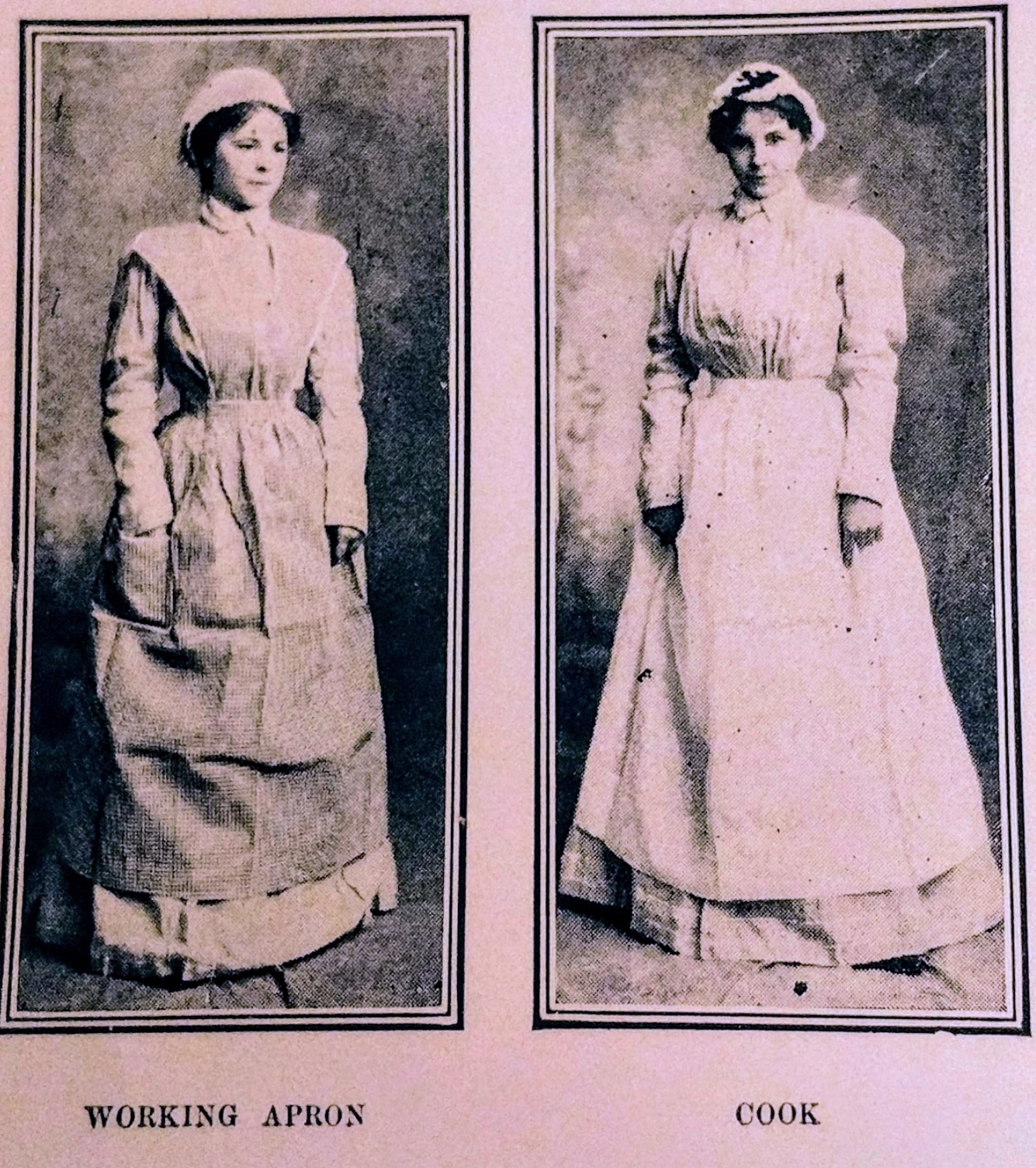
“The dress was the final piece of clothing; it would still have had a high neckline in the 1890s-no low scoop-and long sleeves that had to be pushed up for cooking. Fabric colors were solid and muted: a light blue or gray, perhaps. The final touches were sensible shoes, perhaps boots, hair pushed into a mobcap or cook's cap, and a spotless apron. (Women almost never cut their hair and therefore a cap was necessary. In fact, a short-haired cook applying for a job would be regarded with suspicion. A woman had her hair cut for just two reasons: to remove lice or to sell hair for money.) According to a 1904 House Beautiful article, outfits were often changed mid-afternoon to provide a more formal appearance for the evening.”

In a large private household, the kitchen maid was always the first to rise, cleaning the stove, firing it, scrubbing the floor, making tea, and then bringing a cup to the cook, who might request help in getting dressed. The first article of clothing donned in the morning was a set of split drawers followed by a camisole: cotton in the summer, wool in the winter. The lady of the household, however, wore a one-piece version that was made of silk or extremely fine cotton, so thin that it could pass through her wedding ring, much like a handkerchief. This distinction in the quality of clothing between employer and cook was continued within the household hierar chy: kitchen and housemaids wore even coarser fabrics than the cook. The same inequality was also true between households of different social sta tus: a wealthy family provided better garments for its cook than did one of merely middle-class stature.

Next were the wool stockings, held up by ribbons or, toward the end of the nineteenth century, elasticized garters. The cook would then slip on a petticoat: red flannel in the winter, cotton in the summer. The corset was next, loosely laced and ending above the hips so that the cook would bend easily while working. (Her mistress wore a tightly laced corset to appear as narrow-waisted as possible; a thin cook was never a good sign. Corsets also provided bust support since brassieres were not invented until the 1920s.) The stays were made of a springlike steel, rather than whalebone, another contribution of the Industrial Revolution. One inevitably wonders how one tightened a corset when dressing alone. One clever solution was to install a metal ring on the wall of a servant's bedroom. The wearer would tie the corset strings to the ring and simply walk away to tighten it. A cook was likely to wear a corset made of coarse material and there fore a sleeveless corset cover was often slipped on next; this protected the petticoat or dress that rubbed up against it from chafing and wear. 

The dress was the final piece of clothing; it would still have had a high neckline in the 1890s-no low scoop-and long sleeves that had to be pushed up for cooking. Fabric colors were solid and muted: a light blue or gray, perhaps. The final touches were sensible shoes, perhaps boots, hair pushed into a mobcap or cook's cap, and a spotless apron. (Women almost never cut their hair and therefore a cap was necessary. In fact, a short-haired cook applying for a job would be regarded with suspicion. A woman had her hair cut for just two reasons: to remove lice or to sell hair for money.) According to a 1904 House Beautiful article, outfits were often changed mid-afternoon to provide a more formal appearance for the evening.

As the century progressed, however, social equality became the cry of the working class and so the workmen, maids, and cooks often chose clothing that mimicked that of their employers. Harper's Bazaar noted this trend in 1867, pointing out that crinoline and a flowing train of silk have no place next to a red hot stove or dirty kitchen floor. Instead, they promoted looser, more practical clothing, preferring the flowing blouse of the French workman to the tight-fitting coats and pants often worn by the lower classes in imitation of their masters. This smacked of putting the working class in their place, however, as in this printed admonition: "Let her take the advice of the tasteful, who will tell her that the rude freshness of natu ral appears to the greatest advantage in a plain setting."

The pay was modest-a few hundred dollars per year-although cooks in wealthy households were at the high end of the scale and were usually treated well, since a good cook was hard to come by: poaching within one's social circle was not uncommon. (Cooks had their own menu books collections of personal recipes and the mistress of the household would choose among them to create menus.) Life with a middle-class family, however, was often a nightmare; the mistress of the house often had little experience with managing servants, so they were often poorly treated and paid. To get by, then, the cook had her own bag of tricks. When interviewing for employment, she would ask if she could choose the tradesmen. This was crucial, since she often asked purveyors to mark up their prices, paying her the difference. She would also inquire as to the dispensation of the pan drippings and candle ends, both of which could be sold for ready money. On the other hand, servants, including cooks, had their quarterly pay docked if they broke a plate or burned the pudding. In some cases, the servant owed the household money at payday.

As for washing, undergarments, including petticoats, would be laundered either commercially or in-house, but dresses would only be spot cleaned, since they were usually made of finer, more expensive material and could not withstand constant soap and water. One could purchase "double-motion" hand-cranked washing machines, fashioned from galva nized iron and white cedar tubs. Also for sale were endless designs for racks to dry clothes outside (including one model that attached to a window frame), wash benches, ironing tables, ironing boards, and bosom boards, designed specifically for ironing shirts.

By the early 1900s, however, a private home was often no longer staffed by numerous household servants but reduced to employing just one all purpose maidservant. In the 1904 The Expert Maid-Servant, the mistress of the household is cautioned that cooking would be just one of the maid servant's many duties and therefore one had to inquire whether the potential employee understood plain cooking and could follow a simple recipe. “More elaborate accomplishments can rarely be looked for in a maid-of-all-work.” By 1920, after the devastation of the First World War and the influenza epidemic, and the increased availability of factory and other nondomestic jobs, the era of the well-staffed Victorian household was at an end both here and in England. – From Christopher Kimball’s book, “Fannie’s Last Supper”


Etiquette Enthusiast, Maura J. Graber, is the Site Editor for the Etiquipedia© Etiquette Encyclopedia

Wednesday, July 21, 2021

Etiquette and English Maids in America

The English maid’s cap has ceased to be sine qua non of the English maid which it is regarded on this side of the water.
 
– Photo Source Pinterest

The maid’s cap has got into the English courts. A servant sued her employer for wages after dismissal, because she would not wear caps. They learned Q.C. admitted that the subject was a very delicate one, and seemed to be ever a cause of complaint between mistresses and maids. It was finally decided that the refusal to wear caps per se was not sufficient ground to discharge a servant out of time. The particular case in question took on some other phases, but this part of the decision implies, by inference, that the cap has ceased to be sine qua non of the English maid which it is regarded on this side of the water.

It is certain, as many housekeepers will testify, that the English maid, supposedly admirably trained and accustomed to service, gives more trouble on American soil than servants of other nationalities. She exaggerates the freedom of America, and takes not only liberty but license without restraint. Such of them as serve in the houses of our very rich countrymen are not open to this criticism; they are clever enough to show a deference to the wealth about them, if they do not feel it, but those English maids that drift into the average American household are, for the most part, intolerable in speech and manner. —The New York Times, 1895


Etiquette Enthusiast, Maura J. Graber, is the Site Editor for the Etiquipedia© Etiquette Encyclopedia

Sunday, March 28, 2021

Polite Treatment of Domestic Servants

Servants treated with suitable regard, are attentive, zealous and grateful, and consequently every thing is done with propriety and affection. Who does not know the charm and value of this?


Domestic propriety, which is at once a duty of justice, religion and humanity, is also a source of peace and pleasure. Servants treated with suitable regard, are attentive, zealous and grateful, and consequently every thing is done with propriety and affection. Who does not know the charm and value of this?

Duties of this class require that you should never command your domestics with hauteur and harshness. Every time that they render you a service, it claims an expression, a gesture, or at least a look of thankfulness; it requires that you should be still more affectionate towards the domestics of your acquaintances, and especially towards those of your friends, whom you ought always to treat kindly. 

As to your own domestics, you should carefully beware of addressing to them any confidential or even useless conversation, for fear of rendering them insolent or familiar; but propriety requires you to listen to them with kindness, and give them salutary advice when it is for their interest.

It commands us also to show them indulgence frequently, in order to be able, when there is cause, to reprove them with firmness, without being obliged to have recourse to the false energy of anger.

The ton of domestics ordinarily announces that of their masters. Never suffer them to remain seated while answering distinguished persons who ask for you. Take care that they do it always in a civil and polite manner; let them lose no time, if there is occasion, in relieving your visitors of their over-shoes, umbrellas, cloaks, etc... let them go before, to save your visitors the trouble of opening and shutting the door. 

When an announcement is made, let them inform themselves respectfully of the name of the person, and pronounce it while holding open for them the door of your room. If you are not there, let them offer a seat, requesting the guests to wait a moment while they go to call you.

When visitors take leave, domestics ought to manifest a promptness in opening the outer door; they should hold the door by the handle, while you converse with the person whom you reconduct; they should present them respectfully with whatever garments they may have thrown off, and aid them in again putting them on; and should, if occasion requires, light them to the door, going slowly behind them.

Accustom your domestics never to appear before you too poorly, or too much dressed; never to sit in your presence, especially while waiting upon the table; not to enter into conversation; never to answer by signs, or in coarse terms.

It is only among the badly educated people of the small towns that they say, the 'maid,' the 'boy,' the 'domestic,' the 'servant;' and among the proud, ill-bred fashionables, who ape grandeur; the 'lackey,' the 'valet,' 'my people;' well-bred persons simply say, the 'nurse,' the 'cook,' the 'chamber-maid,' etc... and what is still better, they designate their domestics by their Christian names.— Elisabeth Celnart, 1833


Etiquette Enthusiast, Maura J. Graber, is the Site Editor for the Etiquipedia© Etiquette Encyclopedia

Tuesday, November 17, 2020

A Gilded Age Servant Problem

The habit of calling servants “the girls” and “helps” has had not a little to do with the demoralization of domestics in this country. They insist there are no servants in the United States, and the deference due to superiors in the ‘old countries’ is not to be exacted here. Now, what we want are honest, efficient servants, with a sufficient quantity of neat dresses and undergarments to render them tidy and respectable looking. At many boarding schools, each girl is obliged to bring a stated number of good undergarments. Why not exact the same from servants? 


Understanding the Importance of Undergarments and Proper Training


To the Editor of the New-York Times: The excellent article in the TIMES on “Servants” has encouraged me to speak. I have been anxiously expecting to see it followed up by other hints, and thus prepare the way for action. Every household is suffering more or loss from the want of good, efficient servants, not “helps.” Farmers in the country employ these, when they get their equals, or the sons and daughters of their neighbors to assist them.


The habit of calling servants “the girls” and “helps” has had not a little to do with the demoralization of domestics in this country. They insist there are no servants in the United States, and the deference due to superiors in the ‘old countries’ is not to be exacted here. Now, what we want are honest, efficient servants, with a sufficient quantity of neat dresses and undergarments to render them tidy and respectable looking. At many boarding schools, each girl is obliged to bring a stated number of good undergarments. Why not exact the same from servants?


And in yesterday morning's TIMES we see by the address of Reverend H.W. Beecher, that there are 30,000 unfortunate women in the city of New York, many of them brought to that condition for want of proper employment or training for work. Again, we hear of thousands of thousands out of employment, and also that household after household is without its usual complement of servants, either because it cannot afford to pay the enormous wages required, or supply its domestics with the luxuries they require; or, what is often the case, the heads of households are in despair as to where to turn to look for honest women to do their work properly.


Answering advertisements, all can tell you who have tried it, no matter how much trouble one is put to to hunt them up, is almost always unsatisfactory for one reason or another. And intelligence offices, what are they but places where women congregate to gossip and insult ladies who come after them by their arrogance and exactions? If a good girl goes into one, she is soon spoiled by the rest, who dictate to her what she must do, and what she must not. The keepers of the offices are often, if not always, the fosters and encouragers of discontent, as it fills their pockets with money and the offices with women.


Cannot some enterprising person bring about a better state of things? Domestics themselves would certainly be benefited, for under the present state of affairs they are far from being a happy class of creatures; they drift from pillar to post, and finally die, never having reached any position of trust or esteem. - From a Subscriber — The New York Times, April 1870


Etiquette Enthusiast, Maura J Graber, is the Site Editor for the Etiquipedia© Etiquette Encyclopedia

Saturday, June 27, 2020

More English Servant Etiquette

The English servants are good-looking, neat and constitutional flunkeys and flunkeyesses. They are very shrewd, and have their class rules as well defined as any trade union. Downing Street does not possess more pigeon-holes and red tape than a mansion of the wealthy. An upper house-maid would die at the stake before she would do a bit of work that came within the province of the under house-maid.

Swell Servants in London

Says a London correspondent of the Cincinnati Commercial: “Although all hopes of recovering the jewels ot Lady Dudley has vanished—their real value was £30,000 there is still a good deal of speculation about their disappearance, and a pretty general belief that some of his lordship's servants must have been at least an accomplice in the transaction. It is difficult to believe that a box of such value intrusted to the care of servants could have disappeared in a railway station from unwilling bauds, or that an outside thief could have known so much about the movements of the family, as to have been on the spot at the precise moment. However this may be, there is no doubt that the English nobility, have a way of employing servants which offers grand opportunities to rogues, in most cases the outside of the servants is the chief thing. 


If the coachman or footman is looking in his livery and of the required dimensions, his character is not inquired into. A well known Duke recently advertised for a footman of exactly five feet eleven and a half inches, whose sole business it would be to stand at tbe back of his coach beside another of like station. A youth, now in the employ of a lady of my acquaintance, applied for the advertised position, and says that his character was not asked for— he was taken into the servants’ hall and measured, and dismissed for lacking the half inch demanded by the Duke. There is a passion tor tallness in servants, and of one noble family, at least, it is a rule to admit no man servant under six feet. There are six of these eminent personages in their fine mansions. The English servants are good-looking, neat and constitutional flunkeys and flunkeyesses. They are very shrewd, and have their class rules as well defined as any trade union. Downing Street does not possess more pigeon-holes and red tape than a mansion of the wealthy. An upper house-maid would die at the stake before she would do a bit of work that came within the province of the under house-maid.

A swell butler would throw up his position in the face of the Lord Chancellor himself if he were expected to black his own boots. There are many boys of thirteen kept in brass buttons, and in many an instance the sole duty of this boy is to brush the clothes and boots of tbe butler, the master of the house having his own separate valet. Of course, it is not pride which has made the inflexible laws of etiquette among these servants, which they refuse to step out of; an official groove or function. It is the determination of their class to preserve the conventional number the servants required for any first class household. They particularly dislike servants from other countries, especially the Germans, because; if well paid and well treated they will do anything requested of them. — Sacramento Daily Union, 1875


Etiquette Enthusiast, Maura J Graber, is the Site Editor for the Etiquipedia© Etiquette Encyclopedia

Below Stairs’ Etiquette

Many don’t realize that the pecking order and social hierarchy in the servants’ hall was just as rigid as that of that of the Lords and Ladies of the manor. There was a natural expectation that one’s manners would be commensurate with one’s position in service.

The Case of Muggins, Who Wished She Were Dead

The terrors of etiquette below stairs! There once strayed into employ a housemaid whose career hitherto had been confined to lodging houses. Upstairs she always looked frightened, and her face had a great attraction for “smuts,” but she was very willing and very competent. “It is not for me to ask madam to send Muggins away, but the rest of us will go if Muggins stays. I don't know where she has lived out before, but she drinks out of her saucer and does not even know that we expect her to be down in our sitting room at half past 4:00, dressed in her black and ready to pour out the servants tea.” 

Of course I gave Muggins notice, recognizing that the lodging house was her proper sphere, and in the month that followed, I knew she suffered martyrdom. She used to wipe her eyes stealthily, and as she was not proud, I showed her some sympathy. “They ain't nice to me downstairs like you are, ma’am,” she sobbed, “though I'm doing my best. Cook says she won’t wipe up the dishes for the likes of me.” “Never mind, Muggins. You’ll be going soon, and, after all, you have learned a good deal here.” I consoled her. “I wish,” said Muggins. “I was dead.” —Mrs. John Lane, Harper’s Bazar, 1905


Etiquette Enthusiast, Maura J Graber, is the Site Editor for the Etiquipedia© Etiquette Encyclopedia

Thursday, June 25, 2020

Etiquette Regarding Servants

An early 19th century magazine advertisement for American maids’ outfits. —“A Housekeeper, a Lady’s Maid and a Head Nurse belong to the hierarchy of a household. A Lady’s Maid wears no cap and when in attendance on her Lady, is expected to be well, but quietly dressed, in black or some sober coloring. Her wages are from $150 to $200 a year, with the reversion of her employer’s wardrobe.” 

Servants in England 
There Are Fixed Forms of  Etiquette Governing Their Treatment

While mistresses and housemaids in this country are struggling to solve the vexed “servant problem” they do not appear to take into consideration the fixed forms of etiquette governing the treatment of servants in England, which probably do much toward promoting mutual understanding between the servants and the served over there. 

A Housekeeper, a Lady’s Maid and a Head Nurse belong to the hierarchy of a household. A Lady’s Maid wears no cap and when in attendance on her Lady, is expected to be well, but quietly dressed, in black or some sober coloring. Her wages are from $150 to $200 a year, with the reversion of her employer’s wardrobe. 

An English maid is always called by surname, “Smith” or “Jones,” but a foreign maid’s first name is used, “Marie” or “Françoise.” A Lady speaking of her maid to other upper servants, such as the Butler or the Housekeeper, would style her “Smith” or “Marie,” but when mentioning her to Housemaids or Footmen, she would he careful to allude to her as “Miss Smith” or “Mlle. Marie.”- New York American, 1905


Etiquette Enthusiast, Maura J. Graber, is the Site Editor for the Etiquipedia© Etiquette Encyclopedia


Monday, June 8, 2020

Conduct for Keeping Good Servants

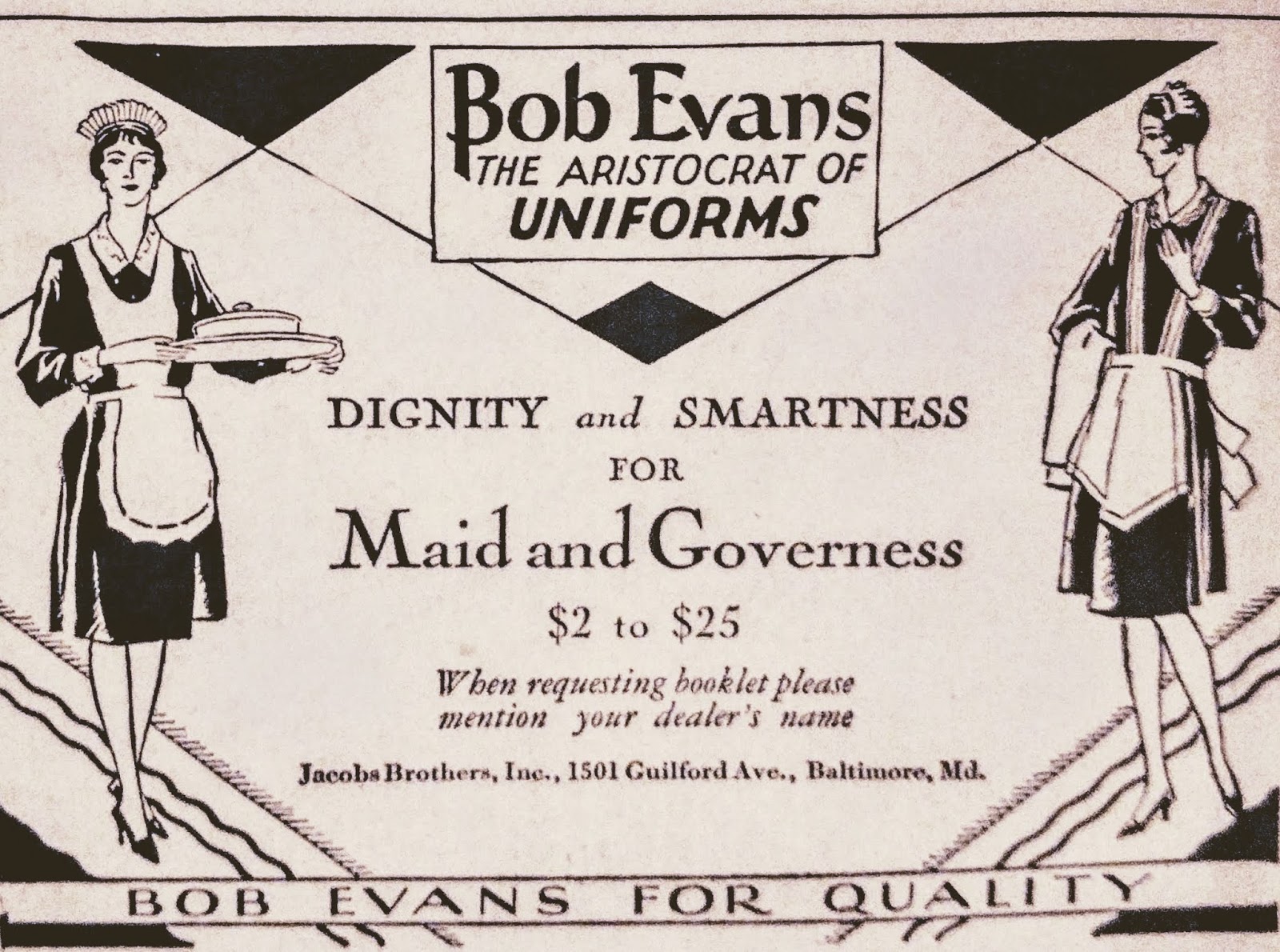
The proper costumes for a Chambermaid and a Lady’s Maid... It is not just a servant whose conduct needs to be superior. It is important for the mistress of the home to model exemplary behavior to those she employs. – “Let your servant observe in your conduct just the qualities and virtues that you would desire they should possess and practice toward you. Be liberal with food. Housework is a very hungry calling, so don’t grudge your servants a share of the various dainties you press upon your family and visitors.”


How to Secure Good Servants 

Just try to remember that servants have feelings as well as yourself. When their work is done, give them a word of praise, so that they see that you appreciate  their efforts, and see to i
t that they have time to do their mending and to get out a little for a change of scene. Borne mistresses do not realize how dreary the common round of a domestic servant is. Let your servant observe in your conduct just the qualities and virtues that you would desire they should possess and practice toward you. 

Be liberal with food. Housework is a very hungry calling, so don't grudge your servants a share of the various dainties you press upon your family and visitors. Don’t expect your servant to execute half a dozen errands for you when she is out for her own pleasure. She doesn't like it; neither does her sweetheart. Remember when you engage a maid, that you are making a contract. State clearly the duties which you expect her to perform and in this way avoid contention arising afterward from misunderstandings. 

Show every kindness to your servant, but from the first be firm in correcting things you dislike, then she will see that you are mistress and not attempt that undue liberty which later on is so difficult to check. Give your servant a reasonable stated time “out,” and if you will help her to start out, in good time you will find that she will more readily come in on time. If it is your fault that she is late going out, it is hardly fair to blame her for being late in returning.

Never accept notice from a servant in a huff nor give one notice when you are angry with her. A mistress is often unjust when she is angry. Allow yourself sufficient time to think the matter over calmly before deciding whether notice is to be given or not. A few kind words and a bit of good advice from a mistress, will go ten times further toward making a good maid, than all the grumbling in the world. Remember a servant is not a machine, but that she is a human being with varying moods and failings like her mistress. – San Diego Union, 1910


Etiquette Enthusiast, Maura J Graber, is the Site Editor for the Etiquipedia© Etiquette Encyclopedia

Tuesday, September 10, 2019

Relaxing Etiquette, Not Standards

Where is the deadline of decorum to be drawn??? “Relax the etiquette of home life, of social life, and forget that it is necessary to be formally introduced before speaking to your next door neighbor. There are pleasant acquaintances to be made everywhere, and if you miss them it is your your own fault...  It never hurt anybody to be affable. One often meets women who scorn to do such favors as passing the salt and pepper at a public table, when no waiter is at hand.”
 Above, a stunning, silver and crystal, Edwardian era condiment and cruet set.
Photo source, Pinterest

Betty Bradeen’s Daily Chat 

Vacation time is the time to relax in more ways than one. Relax the etiquette of home life, of social life, and forget that it is necessary to be formally introduced before speaking to your next door neighbor. There are pleasant acquaintances to be made everywhere, and if you miss them it is your your own fault. Promiscuous acquaintances are not desirable, but that class is not usually found in wholesome neighborhoods—it is found in big cities, on trains and boats and in other public places, and no wise woman seeks it. 

A great deal of censure fell to the share of a clergyman's wife when a new appointment took him to a small, but cultivated city. He won lasting popularity because he filled his role perfectly and treated all of his parishioners with the deference due those who paid his salary. He was more adaptable than his wife, who been brought up rather fashionably and gave more attention to money and smartness than her husband’s position warranted. A single call, demanded by etiquette, was all that some of the plainer members of the flock received and complaints came naturally from the neglected ones. It never hurt anybody to be affable. One often meets women who scorn to do such favors as passing the salt and pepper at a public table, when no waiter is at hand. 

Every man will donate a seat to a handsomely dressed woman—the true gentleman makes no distinction, but respects womanhood as a whole. One of the most fashionable women I ever met is adored by her servants because she treats them with consideration. She is sympathetic with their troubles and interested in joys. A maid who served her for 10 years is remembered every Christmas with a check for $l0, although the woman left her five years ago. There is a vast difference between spoiling employes and treating them kindly. In the former case, shiftlessness is passed over —in the latter men and women are expected to earn their money. It may be hard to pull them up to the demands of cold weather living, but nothing is lost by relaxing the system a trifle during the vacation season. All new acquaintances do not turn out satisfactorily, but there is the likelihood of never meeting them again. The world is large enough to swallow many disagreeables. 

If there are any women who are treading the beaten track to which they have become familiar in earlier seasons, they are not good to themselves. They may have to work just as  hard through the day, but they might relax at night. They could make a fresh toilet, the simpler the better, and spend the evening outdoors, preferably in pleasant company. Housewives can give up all but necessary serving and read and rest as do the women who board away from home. Hard and fast rules are not for mid-summer — there is genuine sport in seeking novelties, and as many of them as possible. There is nothing like a touch of roughness to tone up a jaded taste if one reaches such a state. – Betty Bradeen, 1910


Etiquette Enthusiast, Maura J Graber, is the Site Editor for the Etiquipedia© Etiquette Encyclopedia  

Friday, August 2, 2019

Evolving Careers of Household Servants

The True Evolution of High-End Household Staffing 
Since the “Downton Era”
Footmen at the fictional manor house, “Downton Abbey” 
Photo source, Nick Briggs—Carnival Film & Television Ltd.


Downton Abbey’s drama is driven by the relationship between the downstairs world of the scrappy servants and the aristocratic family upstairs. But how has the real-life version of that dynamic evolved over the past century? Kevin Johnson—a former footman at the British Embassy in Paris, a past employee of modern aristocrats and current owner of the Green Baize Door, an upscale British staffing agency—weighs in.

Have the customs and standards that audiences see on Downton Abbey continued to this day?

Yes. In fact, I would go as far as to say that with modern gadgetry and equipment, some households now strive to deliver even higher levels of service. From silver polishes and electronic gadgetry to floor-polishing machines and clothes steamers, technology has helped immeasurably. Every department—Kitchen, Food and Beverage Service, Housekeeping and Garden—is reaching new heights. This is especially true on yachts, where there is a clear intention to elevate the level of service to an art form.

Why yachts in particular?


It’s an enigma. They’re not houses, so one might think the level of service would be lower than in a home, but it’s become a game for the crew to outshine their client’s friends or competitors.

How?

Stewardesses service cabins and bathrooms every time a guest uses a space, changing the D. Porthault linen sheets three times a day if necessary. Deckhands will be up at 4:30 a.m. to scrub down everything in sight so that it’s gleaming when the client wakes up for breakfast, while chefs will have everything available all of the time. That means that provisioning will often have no budget—and certain ingredients will be flown in on the client’s private jet. One of my previous employers instructed his pilot to hide a whole leg of Parma ham and several Sicilian air-dried sausages by sitting on them while the aircraft was inspected by US customs. That’s how important it was to have the finest ham available on his yacht!

Back in the ’20s and ’30s, lower-class children were sent into great houses to be hall boys and kitchen maids and worked their way up. How does it work now?

Palaces and embassies play their part in training staff, but grand hotels and Michelin-starred restaurants are also responsible for providing the industry with new recruits. And people still start as bellhops or kitchen porters. I know of one gentleman, Raja, a Jordanian with no formal education, who started work in a Five-Star hotel in Amman as a bellboy. Twenty years later, after a lot of hard work and a hell of a lot of determination—mixed with infectious enthusiasm for his job—he is now a palace manager in Saudi Arabia.


Obviously, a butler on an estate in the 1920s and 1930s would often have his job for life. Is there more turn-around now than there was back in the day?

Yes. It is unusual for staff to stay beyond 10 years, but it must also be remembered that few if any employers in the U.K. willingly provide pensions, so while some employers complain that staff do not stay in their positions as they used to, staff are now forced to consider other jobs.

How realistic is Downton Abbey in its depiction of these relationships?

I would argue that they’re way too informal and not entirely based on what happened in British households in that period. While elements of the story line are quite factual, it makes me chuckle to see the lady of the house in the kitchen with the chef talking about menus, or gossiping with her maid as she prepares for dinner—if only because these things don’t happen today, so they certainly would not have happened in the 1920s or earlier. –BY J.I. BAKER / LIFE BOOKS , JANUARY 11, 2016


Etiquette Enthusiast, Maura J Graber, is the Site Editor for the Etiquipedia© Etiquette Encyclopedia 

Tuesday, June 18, 2019

Treating Servants Fairly

Not all servants in the early 20th century were as well-treated or content as those characters which were depicted in television’s “Downton Abbey.” Some common courtesy and thoughtfulness of treatment by the employers would have gone a long way in the lives of those who lived in servitude.

Thoughtlessness on Part of Some Employers

There is a thoughtless group of people who ignore servants as though they might be articles of furniture instead of live things, who can feel and see and suffer mental, as well as physical, pain. This is a social class who suffer thoughtlessly inflicted pain and humiliation, with the general attitude of those who inflict it being that their feelings don’t count —if they have any. 


“I am writing of the servant class, the Bridgets and the Mary Anns. You notice I write the Ann without a final “e" the little finish which sets a gulf between the socially important and their less fortunate sisters. The particular Bridget who wrote what follows is an educated foreign woman whose education is plainly evident in her handwriting and her thinking. How would you like to be such a woman and earn your living working for some of the people whom she describes? 
‘For my class it’s take it on the chin, grin or beat it and no job. To be sure I’m British. I served in one home eight years which seems to prove that I was treated humanely. I remember the lovely room I had and often compared it with the Bridget’s quarters given me, to a long succession of dumps I’ve occupied here. I thought of it recently as I retired in my servant’s room better described as a pig sty.’ 
Walls of Room Dirty...
‘It was small, dark and had dirty walls which could be cleaned up for the cost of about $4. But when approached on the subject my mistress said ‘no.’ She considered herself a socialite but some of her neighbors called her ‘alley cat.’ And I guess she earned that. 
One former employer still owes me for two years back wages. I took it to the small claims court but find all you get there is a judgment. The court makes no effort to enforce its findings. So it’s up to me to do my own collecting. 
At another place of squatting I found the parents two drunks. The trimmings were all attached, and there was street fighting with the officers at 3 a. m. ‘Papa’ met me in the hall as he was coming in and he was wearing his real birthday suit so I packed and moved. Many maids I know have wonderful references but stay in a place only a little while.’ 
Considers Folks Funny...
‘Do you blame them? I am middle-aged and homeless but an experienced needle-woman—and so, although I hate it—l’m on relief.  And my former employers are among those who complain against the luxury I am supposed to enjoy. I should, have been content with a Bridget’s lot.  Ain’t’ folks funny?’

 Funny? No. It’s more like “thoughtless and careless.” – From an article by Estelle Lawton Lindsey, 1936


Etiquette Enthusiast, Maura J Graber, is the Site Editor for the Etiquipedia© Etiquette Encyclopedia 

Monday, May 13, 2019

Etiquette and Cuisinier Aristocracy

18th C. Negus Port Punch – “At the commencement of the evening, it appeared to me that a haughty reserve and proud etiquette prevailed throughout the brilliant society; but as the evening advanced, and negus and punch were imbibed by the vigorous dancers, a more familiar language and an easier attitude possessed both ladies and gentlemen. 

Parisian High Life Below Stairs 

The Paris correspondent of the London Morning Post describes a “magnificent” ball which took place in the Sal Valentino, known as the annual cook’s ball:
The aristocracy of the kitchen, and the more beautiful women of the halle, together with the knights of the cassero e, mustered strongly. It is no exaggeration to say, that the toilettes of the ladies wore worthy of the most aristocratic salons of Paris, and diamonds and precious stones abounded, leading me to conclude that the culinary art in Paris must be very handsomely remunerated. Some of the more beautiful women of the fish market wore jewelry which must have cost thousands of francs. Quadrilles of honor were formed by the kings and princes of high life below stairs, who chose for their partners, the more renowned female aristocracy of the monde-cuisiniere. At the commencement of the evening, it appeared to me that a haughty reserve and proud etiquette prevailed throughout the brilliant society; but as the evening advanced, and negus and punch were imbibed by the vigorous dancers, a more familiar language and an easier attitude possessed both ladies and gentlemen. 
The cavaliers were dressed precisely in the same white cravat, white gloves, and embroidered shirt sublimity which forms the characteristic appearance of other noblemen of another class. It was pleasant to join in the refreshing conversation of the belles of this ball. Instead of the namby-pamby nonsense of other aristocratic circles, it was interesting to hear one’s quadrille partner, after the dance was over, indulging in a vigorous abuse of this or that noble family, the phrases heing sprinkled with epithets singularly expressive. I came to the conclusion that all classes of society are very much alike, in that all indulge in scandal, detraction and abuse when they are natural. It was not until 3 o'clock that the carriages of the company blocked up the Rue St. Honoré and the servants of the guests arrived, and gradually beckoned away the dancing company. The utmost hilarity and good breeding prevailed, and I do not believe the kitchen staff of any other nation of the world could have contributed so well-dressed so well-educated and so polite a society. It only wanted the presence of the Emperor and Empress to make this soirée as brilliant as any given at the Court of the Tullieries. – Daily Alta, 1868


Etiquette Enthusiast, Maura J Graber, is the Site Editor for the Etiquipedia© Etiquette Encyclopedia

Saturday, April 1, 2017

Etiquette and Swell Servants

 There is no doubt that the English nobility, have a way of employing servants which offers grand opportunities to rogues. 

The Swell Servants in England

''Although all hopes of recovering the jewels of Lady Dudley has vanished—their real value was £30,000 there is still a good deal of speculation about their disappearance, and a pretty general belief that some of His Lordship's servants must have been at least an accomplice in the transaction. It is difficult to believe that a box of such value entrusted to the care of servants could have disappeared in a railway station from unwilling hands, or that an outside thief could have known so much about the movements of the family as to have been on the spot at the precise moment. However this may be, there is no doubt that the English nobility, have a way of employing servants which offers grand opportunities to rogues.

In most cases the outside of the servants is the chief thing. If the coachman or footman is good-looking in his livery and of the required dimensions, his character is not inquired into. A well known Duke recently advertised for a footman of exactly five feet eleven and a half inches, whose sole business it would be to stand at the back of his coach beside another of like station. A youth, now in the employ of a lady of my acquaintance, applied for the advertised position, and says that his character was not asked for— he was taken into the servants' hall , and measured, and dismissed for lacking the half inch demanded by the Duke.

There is a passion tor tallness in servants, and of one noble family, at least, it is a rule to admit no man servant under six feet. There are six of these eminent personages in their fine mansions. The English servants are good-looking, neat and constitutional flunkeys and flunkeyesses. They are very shrewd, and have their class rules as well defined as any trade union. Downing street does not possess more pigeon-holes and red tape than a mansion of the wealthy. 

An upper house-maid would die at the stake before she would do a bit of work that came within the province of the under house-maid. A swell butler would throw up his position in the face of the Lord Chancellor himself if he were expected to black his own boots. There are many boys of thirteen kept in brass buttons, and in many an instance the sole duty of this boy is to brush the clothes and boots of the butler, the master of the house having his own separate valet.

Of course, it is not pride which has made the inflexible laws of etiquette among these servants, which they refuse to step out of an official groove or function. It is the determination of their class to preserve the conventional number of the servants required for any first-class household. They particularly dislike servants from other countries, especially the Germans, because if well paid, and well treated, they will do anything requested of them."— London Correspondent of the Cincinnati Commercial, 1875


Etiquette Enthusiast, Maura J Graber, is the Site Editor for the Etiquipedia© Etiquette Encyclopedia

Sunday, June 19, 2016

An Upstairs-Downstairs Etiquette Snafu

Not all cooks were keen to teach their skills to any of those living “upstairs” —When a servant is engaged, he enters the house for the first time through the front door. After that he regards the back door as his sole means of entrance and exit.
Mistress Fined for Invading Her Own Kitchen! 

LONDON, July 17.—There is no etiquette so strict as that which dominates London life “below stairs.” With all the upheavals of the world war, the dignity of cooks and butlers remains unassailed. 

A case was recently heard in the court wherein a cook took offense because the mistress invaded the kitchen and insisted on cooking some mutton chops herself. The insulted culinary queen immediately gave notice, and in this she was joined by her husband, the butler. Whereupon the mistress locked the back door and thus got herself sued for “wrongful imprisonment.” 

During the hearing of the case the judged asked why, if the mistress had only locked the back door, did not the couple go out by the front. The cook and butler nearly collapsed at the suggestion. “That,” said the butler, painfully surprised at the judge’s ignorance, “is against all kitchen etiquette. When a servant is engaged, he enters the house for the first time through the front door. After that he regards the back door as his sole means of entrance and exit. No self-respecting servant would dream of leaving his employer’s house by the front door!”

On inquiry, it was found that the etiquette ruling such matters was a very real thing to the circle of overlords and underlings of the kitchen, and the aggrieved pair were allowed £5 damages. — Los Angeles Herald, 1920

Etiquette Enthusiast, Maura J Graber, is the Site Editor for the Etiquipedia© Etiquette Encyclopedia

Friday, June 3, 2016

Japanese Etiquette

Bowing when one is seated on the soft mats of a Japanese house (by far the politest method) is much more complicated. 
Why the Japanese Are Called
 the “French of the East”
 👘⛩🗾🎏👘⛩🗾🎏

They Even Pass Beyond the Gauls in Their Excess of Formality

The Japanese are called the French of the East, and their complicated system of etiquette is indeed not unworthy of the most polished nation of Europe. The old-time ceremonies were long and laborious, and have to a great extent disappeared with the present busy era. But the every-day etiquette still remains, and many of the forms are pretty and quaint, and especially interesting to the foreign traveler in Japan as being so peculiarly oriental. 


It is especially curious to see how even the lowest classes, the coolies and the jinricksha men, keep up a form of etiquette among themselves and are exceedingly polite and ceremonious while pulling their two-wheeled vehicles or pursuing the lowest trades in the humble walks of life. 

One from the West would hardly expect to find a coolie bowing profoundly and apologizing to another in the most courteous of language for some mishap, or shouting out some expression of sympathy when a heavy burden was being carried or pushed along, and yet these are common, everyday occurrences in Tokyo.

In learning the etiquette of Japan a stranger will always do well to remember that self-abasement and humility to the extreme must be the guiding principle on which all actions are to be ruled. In America it is often the duty of a guest to accept little courtesies from his host, not because he thinks it is due him as a superior, but because he is simply the guest, and he receives them as a kindness which hospitality extends to him, and which he cannot refuse without appearing ungracious. 

In Japan the laws of hospitality for the host are no less rigid than in America, To welcome the coming and speed the parting, to entertain with the best that one has in the kindest and most friendly manner, to see that the guest lacks nothing which thoughtfulness might provide—these are rigidly the duty of the Japanese host.

The duty of the guest differs in that each separate act of courtesy, even though accepted in the end, must be met with many protests and expostulations, and must on no account be simply accepted. The extreme to which this is carried would no doubt seem tiresome to those accustomed to the free-and-easy etiquette of American life. 

Tedious Expostulations 

Every Japanese parlor has its place of honor and its honorable and less honorable side, the latter being usually toward the door leading to the other apartments, the bedrooms and the kitchen. The seat of honor is in the part removed from the door, and is in front of a raised alcove, where are placed a hanging scroll, a vase of flowers and the few ornaments which a room possesses. 

It is a matter of time, energy and many bows before a guest can be induced to take this place of honor, and it is a contest in which the host must be the victor in the end, or, if not entirely successful, he must at least persuade his guest to sit in the more honorable side of the room, so that he himself may take the humblest place on the other side. It is also a matter of importance as to who shall precede in entering a room, and much time is spent by two people, one waiting for the other and each refusing to enter first. 


In entertaining many guests the host's duties are arduous, and as each separate guest is bound to consider himself the humblest of all the company, it is no little work to persuade him to the contrary.

There is a great deal in the etiquette of bows. Handshaking is a foreign innovation, and bowing hitherto has been the only mode of salutation. When two acquaintances meet in the street a bow is made by placing the hands in front as far down as they will reach, and then bowing from the waist downward until the upper part of the body is almost at rignt angles with the lower. 


One bow is not usually sufficient at a meeting, for if words are exchanged a bow must accompany each expression of good-will and friendship. Bowing when one is seated on the soft mats of a Japanese house (by far the politest method) is much more complicated. One is not expected to hurry through as in the street, and there is no excuse for the omissions of all the formal phrases of courtesy, each of which must be accompanied by bows made with the hands placed on the floor and the head bent down to them. 


There must always be an exchange of congratulations on the continued good health of the families, thanks for past kindnesses or favor shown by any member of one family to the other, and very often a visit is accompanied by a gift, which is formally presented and accepted.
 —Sacramento Daily Union, 1897


Etiquette Enthusiast, Maura J Graber, is the Site Editor for the Etiquipedia© Etiquette Encyclopedia 

Saturday, May 7, 2016

Etiquette and One's Servants

Nell Ashley, Writing from a Reform School, Tells What Maids Endure from Sons and Husbands of the Fashionable Women Who Employ Them

What Shall Be Done to the House Sheik?

No one seems able to tell us why is it that a girl who goes into domestic service is looked down upon by folks inside and outside the home, while the girl who takes a business position if regarded with respect. While homemakers are theorizing about the scarcity of help, Nell Ashley, a high-school girl who became a personal maid in a rich home in order to save enough money to take a business course, comes right out with the facts. 


The true story of her experiences, published in February Smart Set reveals that there is need of a course in etiquette to teach men members of wealthy households, that the maids employed by their wives and mothers, are not there to satisfy their flirtatious desires. Here are interesting extracts from this disillusioned girl’s expose: 

“My mother, who had been a chorus girl, died when I was five years old. My Aunt Millie adopted me. She, herself, was a domestic servant. I graduated from High School when I was sixteen. That summer my aunt got me a position as chambermaid in the palatial country home of a New York millionaire. 

“It was hard work. My mistress was one of those women who are always having trouble with her servants, and in addition to my own duties, I often had to act as personal maid, parlor maid and kitchen girl. But I didn’t mind hard work, I was buoyed up by the prospect of entering business school in the fall.

“Toward the end of my vacation, the oldest son arrived. He was a student at Yale. He was nothing to write home about; a jolly, good-natured boy, full of the devil. He liked to tease me because I blushed so easy and I tried to keep out of his way as much as possible. 

“One morning as I was making his bed, he returned unexpectedly to get something. Suddenly he seized me in his arms and said jokingly, ‘Come on now, let me see you blush. Goldilocks!

Just at that moment his mother appeared in the doorway. ‘What does this mean?’ she demanded angrily. ‘You disgraceful creature! Pack your trunk and leave this house immediately.’ Bewildered, dazed, overcome with embarrassment, I stood motionless. ‘Have you no shame?’ She hissed the words, venomously like an angry snake, or a vicious cat. The young man protested halfheartedly. It wasn’t her fault, Mother—really —

And it wasn’t. It was just as I have told you. But I have never been ready with a quick answer. I am stupid like that. And her sudden attack made me dumb. My tongue was paralyzed with fear. What do you mean, lying here when I tell you to get out?' she screamed. The charming, perfectly poised society leader was a raging cat. Her friends wouldn’t have known her. 

You ungrateful baggage! Wait until I tell your aunt about this. I will see that she commits you to an institution! “While I was packing, tears blinding my eyes, I heard a piece of paper being shoved under the door. It was a note from Mr. Harry, folded around a fifty dollar bill. Sorry, Goldilocks, I can’t make mother listen to reason. it read. In case you have nowhere to go, you can probably find a room at West 50th Street. Ask for Miss Brandon. She’s a friend of mine. Be sure and let me know your address anyhow.

“I didn't hesitate to take that fifty dollars—my wages were being paid to my aunt, and I didn't have a cent of my own. Had I had time to think the matter over, I might have acted differently. As it was, I was terrified at the prospect of being sent to a ‘home.’ I took a train for New York.’ 

Miss Ashley proceeds to relate how her victimization sent her to a reform school, when she was prepared for domestic service, which led to a fresh round of humiliation. — Madera Tribune, 1925


Etiquette Enthusiast, Maura J Graber, is the Site Editor for the Etiquipedia© Etiquette Encyclopedia