Showing posts with label British Dining Etiquette. Show all posts

Friday, June 12, 2026

Good Table Manners are Globally Fun

“Everyone likes to be social when they dine. The French have carried this to the extreme and aim for an air of style and elegance. A French meal can be a “masterpiece,” reports Mrs. Stewart. She says there is complete attention to detail with an “interweaving” of fine food, good company, sparkling conversation, beautiful service, fresh flowers, and the ever present wines.”

Global Manners Make Foreign Food More Fun!

The kimono-clad waitress bows slightly and offers you a moist towel on a rattan tray. Uncertainty sets in. Now what? Moisten your mandible? Clean your clavicle? According to Marjabelle Stewart, mentor of manners, the moist towels, called “oshibori”and found in Japanese restaurants, are for cleaning the hands before dining.

Mrs. Stewart is an expert on global globbling in good taste. She spent many years among foreign dignitaries in Washington, D.C., teaching the elite to eat with elan. Working with the chief of protocol, she advised families, who would be traveling abroad in an official capacity, on the proper manners for all kinds of occasions with a foreign flavor. Author of. several etiquette books, Mrs. Stewart is now emissary for the frozen potato people.

According to Mrs. Stewart, ethnic etiquette isn't only for the elite, however. Along with those who breakfast in Belgium, lunch in Liberia and sup in Spain, are millions who are discovering the delights of dining with a foreign flair in their own home towns. The ethnic eatery is the place to be seen. “And,” says Mrs. Stewart, “you’ll feel most comfortable if you’re seen partaking properly. What’s polite in Poughkeepsie could be rude in Rumania.”

For instance, in a Japanese restaurant it is considered correct to hold the rice bowl close to your mouth and, of course, to use chopsticks to carry the food to your waiting lips.

If you find yourself actually in Japan, be sure to say “Thank you” before and after the meal. You are expected to remove your shoes if there is a tatami (woven straw) mat on the floor, says Mrs. Stewart. In rural Japan the diner must keep eating all that is offered, even if he is full. And in all of Japan, slurping noises when eating indicate enjoyment.

A Dutch “aardappellepel” or a potato spoon. It’s for serving potatoes. It is round with a lip on each side so designed to keep the potatoes from falling onto the table when they are being served.

Mrs. Stewart reports that Continental manners are being seen more and more here in the States. “It's not at all unusual,” she says, “to see diners holding their forks in their left hands and their knives in their right hands, and eating with their left hands as they do in Europe.” Europeans also keep their right hands on the table, at about wrist length, instead of on their laps, which is considered rude.

If you are in a European eatery, don't expect to find a glass of water. You must ask for the water and the ice. But why bother? The wine that is served is bound to be delicious!

In Germany and Austria you’ll get a sandwich served on a little wooden board. Don't pick it up - use your knife and fork. Europeans eat nothing with their fingers… not even french fries. (“Of course,”  asserts Mrs. Stewart, “in the United States, any way you eat a french fry is all right.”)

In Holland, or in Dutch restaurants in this country, you will find a fish fork and fish knife. The short, flat fork has three large tines. The wide, tapered knife is excellent for removing fish bones.

Another Dutch specialty is a potato spoon which is round with a lip on each side so designed to keep the potatoes from falling onto the table. Mrs. Stewart would like to see the potato spoon used in this country.

“No one should chance dropping a tater tot,” she said.

In Ethiopia, as in other Arab countries, one eats from a communal pot with the right hand. Since the left hand is used for sanitary purposes, this custom is adhered to strictly. Not too many years ago, an Ethiopian who ate with his left hand was punished by having his right (eating) hand cut off. He would then starve to death. And you thought your Mother was strict!

Our own state of Hawaii also has a dish eaten with fingers from a communal potpoi. Poi is a glutinous substance made from taro root. It is eaten by putting the index and middle finger in the pot and licking them off. Sharing poi is a very social thing to do ... much like eating fondue, which is. a Swiss dish.

Everyone likes to be social when they dine. The French have carried this to the extreme and aim for an air of style and elegance. A French meal can be a “masterpiece,” reports Mrs. Stewart. She says there is complete attention to detail with an “interweaving” of fine food, good company, sparkling conversation, beautiful service, fresh flowers, and the ever present wines.

However, a guest in a French home or restaurant need not be intimidated by the array of wine glasses and silverware.

Mrs. Stewart says, "The fork and large spoon at the top of the plate are for dessert. When the meal begins, start by using the silverware farthest from your plate and work your way in. Your dinner fork will be removed with your dinner plate. Your dinner knife should be left resting on the small crystal or silver knife holder and used again for the cheese course."

Even in a private home in France, there may be three or four wine glasses per left hand is used for sanitary purposes, this custom is adhered to strict- ly. Not too many years ago, an Ethiopian who ate with his left hand was punished by having his right (eating) hand cut off. He would then starve to death. And you thought your Mother was strict!

Our own state of Hawaii also has a dish eaten with fingers from a communal potpoi. Poi is a glutinous substance made from taro root. It is eaten by putting the index and middle finger in the pot and licking them off. Sharing poi is a very social thing to do ... much like eating fondue, which is. a Swiss dish.

Everyone likes to be social when they dine. The French have carried this to the extreme and aim for an air of style and elegance. A French meal can be a "masterpiece," reports Mrs. Stewart. She says there is complete attention to detail with an “interweaving” of fine food, good company, sparkling conversation, beautiful service, fresh flowers, and the ever present wines.

However, a guest in a French home or restaurant need not be intimidated by the array of wine glasses and silverware.

Mrs. Stewart says, “The fork and large spoon at the top of the plate are for dessert. When the meal begins, start by using the silverware farthest from your plate and work your way in. Your dinner fork will be removed with your dinner plate. Your dinner knife should be left resting on the small crystal or silver knife holder and used again for the cheese course.”

Even in a private home in France, there may be three or four wine glasses per person. Mrs. Stewart says, “In a French home it is considered rude to leave wine in a glass. However, it is perfectly permissible to signal the butler that you've had enough.

‘If you find yourself confused, watch what your hostess does,” advises Mrs. Stewart, “and just follow her lead.”

Course after course, the French meal goes on. It is not unusual for the meal to continue for 2½ hours. It is perfectly all right to smoke between the courses cigarettes only, no cigars and pipes.

Following dinner in France, the guests adjourn to the salon (living room) for coffee, brandy and bon bons. After an especially large meal, with many wines, cold orange juice is also served just before the guests depart.

Interestingly, the English divide the sexes after dinner. The men remain in the dining room for port and cigars while the ladies retire to the living room for coffee. In France, the men and women stay together for coffee and liquers.

Mrs. Stewart further advises that one never tips the maids who serve dinner in a European home, but, if you are a guest overnight, you are expected to leave a small tip on the dresser. — Rancho Cucamonga Times, 1978


🍽️Etiquette Enthusiast, Maura J. Graber of The RSVP Institute of Etiquette, is the Site Editor of the Etiquipedia© Etiquette Encyclopedia

Saturday, August 3, 2024

Table Etiquette In England of 1876

Poor M. St. Beuve…. Forever known for his poor table manners. It is alleged that during an impressive ceremonial, he spread his napkin over both his knees; he crushed the shells of two boiled eggs which he had eaten; he had asked for a second service of chicken; he touched the bones of the chicken with his fingers; he said “thank you” to one of the servants; he left his knife and fork on the cloth; he peeled a pear latitudinally instead of longitudinally, and, worst of all, he sniffed his wine before drinking it. — Charles Augustin Sainte-Beuve, French writer (1804 - 1869). Image date circa 1860’s — Public Domain Photo


Olive Logan is compensating the country for sending her husband as Consul to Cardiff by some frank confessions of experience in English society. She has got as far as the dinner-table, and tells us how the English conduct themselves in that trying ordeal. They do not vary much from ourselves, of course, though in some respects they improve on the old New England regime. 

Punctuality in the guests at the dinner is imperative; he who goes before the hour is advised to prolong his walk or even sit in his carriage before the door until the proper moment, while he who goes late is advised to turn back home again. This regulation is certainly very considerate to the hostess. At table the guest who is helped first does not wait for his fellows to be helped before falling to. This seems less decorous and only consistent with a state of society where the servants are numerous enough to nearly equalize the moment of service to all the guests. 

At the same time it is aggravating to the guest already served to hang over his savory portion while a slow host deals round the board. We are reminded in this connection of one ancient New England practice which ought to be generally abandoned, and that is the service of the invited guests at the family table before the children. Infancy (God bless it!) has a healthful appetite, or ought to have, and deserves the attention.

The next rule of the English is excellent, and that is that the guest, if he be offered “the last on the plate,” should take it without scruple. Of course this is the true courtesy, for to refuse it presumes that the hostess cannot fill up again, and, if by accident she cannot, subjects her to the further annoying consciousness of not having satisfied her guests even to the extent to which she had it in her power.

These things are of the kernel of good manners, not the shuck. They concern the ease of mind and comfort of the guest and host. Not so the trifles in which the “Almanac de Savoir-Vivre” charges Saint Beuve with negligence. The accusation is that the great essayist who devoted his life to give a literary association to washing-day was guilty of no less than eight offenses at the Emperor Napoleon's dinner table. 

He spread his napkin over both knees instead of half unfolding and draping one therein; he omitted to crush the egg-shells he left; “he asked for more” chicken and “touched the bones with his fingers;” he thanked a servant; he left his knife and fork on the cloth, instead of upon his plate; peeled a pear cross-wise and offered half to a lady, and, finally, sniffed his wine before drinking! 

An unmannerly dog, in the opinion of the “Almanac,” this essayist of Monday, who had ventured to assert that a man of genius could not have bad manners. We confess we do not “catch as to all the points.” Why should the Emperor insist on the pulverization of the egg-shells on the one hand, and, on the other, on the inviolateness of the chicken bones? Did he suspect the Imperial commissioners of the Tuileries hennery of dealing in second hand egg-shells, and thus corrupting the morals of young pullets, who should have produced their own? 

And as to the bones on the other hand, did his Majesty know a soup-house around the corner where, if they were not well picked, a smart bit could be realized on them for the privy purse? And the napkin– but when we think of Napoleon's napkins we associate with them a dingy little auction room in the Rue – the Winter of 1871, and a rock of democrats from across the sea, and those bidding off the fine linens wrought with an ‘N’ surmounted with the Imperial coronet. Whatever became of the egg-shells, the Empire has been crushed. Vanity of vanities, saith the preacher. – Philadelphia Republican, 1876


 🍽Etiquette Enthusiast, Maura J. Graber, is the Site Editor or the Etiquipedia© Etiquette Encyclopedia 
Friday, April 21, 2023

Etiquette, Cutlery and Peas

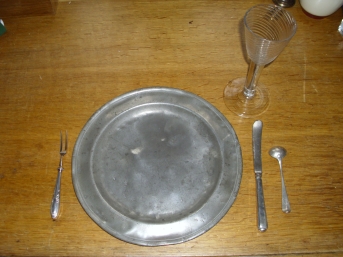
A typical Eighteenth century place setting 

Historical Reconstructions – Cutlery and Peas

In a recent blog my brother raised the question of why do we eat peas by pressing them on the back of the fork? To answer this question we need to consider the history of both forks and peas!

First peas, this useful vegetable has been cultivated in Britain for hundreds of years, but before the eighteenth century they were not eaten green. They were harvested and dried and formed an important source of carbohydrate in the diet. Whole dried peas, or pea flour, were cooked in a variety of ways. A very common dish was peas pudding or peas pottage, this had the advantage that it could be cooked then eaten cold, it would ‘come again’ as the saying was, become even tastier when it had been allowed to rest in the pot for a few days. Hence the rhyme

Peas pottage hot, Peas pottage cold, 

Peas pottage in the pot nine days old.

Some like it hot, Some like it cold, 

Some like it in the pot nine days old.

Then, during the eighteenth century, potatoes were grown widely and took over from peas as the main source of vegetable carbohydrate in the diet, whilst new varieties of peas were developed and eaten green, especially with duck. But how did you eat these new, tiny, vegetables?

Forks had only become widespread in Britain in the late seventeenth century, but they were two pronged. This pair of tines made them very effective at picking up pieces of meat and vegetable that can be pierced, but not really peas. So how were peas eaten, I had long puzzled over that, ever since I first saw a set of eighteenth century cutlery, then I found a wonderful passage in Cranford (written in 1851) which explained everything. The young narrator had been taken on a visit to an old fashioned farmer, they sat down for dinner;

When the ducks and green peas came, we looked at each other in dismay; we had only two-pronged, black-handled forks. It is true the steel was as bright as silver; but what were we to do? Miss Matty picked up her peas, one by one, on the point of the prongs, much as Aminé ate her grains of rice after her previous feast with the Ghoul. Miss Pole sighed over her delicate young peas as she left them on one side of her plate untasted, for they would drop between the prongs. I looked at my host: the peas were going wholesale into his capacious mouth, shovelled up by his large round-ended knife. I saw, I imitated, I survived! My friends, in spite of my precedent, could not muster up courage enough to do an ungenteel thing; and, if Mr Holbrook had not been so heartily hungry, he would probably have seen that the good peas went away almost untouched.

A two tined fork, probably continental

This is possible, after a little practice I found that it is easy to use a rounded ended eighteenth century knife to lift peas up to the mouth. However the diner has to lean forward to eat the food, and this is not that comfortable in the costume of the period, tight waistcoats and jackets for the men and stays for the women tend to encourage an upright stance. Over time additional prongs were added to the fork to give the three or four tined version we use today. A tidier, more effective, indeed more genteel, method was developed. By pressing the peas on the fork the cutlery could remain in the hand all the time, and there would be no need to alter the angle at which it was held. Food could be combined before it was placed in the mouth, a piece of duck as well as peas for example. Also it meant that there was now no need to put the knife in the mouth, this rapidly became something that ‘is not done’, indeed some people have expressed shock and horror at the idea that Jane Austen might have put her dinner knife in her mouth .

Round ended knife, British but marks very worn, Spoon is English from 1807

Across the Atlantic, peas had been eaten on the knife as they had in Britain, however it seems that there they didn’t take up the new fashion. The multi-tined fork arrived but, until well into the nineteenth century, eating with the knife was still common practice in the United States, to the horror of visitors such as Charles Dickens. Eventually Americans learned just to use the knife for cutting and spreading, and took to using the fork to scoop up peas and other food. Tossing the fork from hand to hand as one early twentieth century commentator said.

So that was one change that affected the way we ate two hundred years ago. There are others, when you look at the way the place was laid you might be able to spot a few, and I will consider these in my next post. — Reprinted with permission from Gordon Lepard. com via The Curious Archaeologist 


🍽Etiquette Enthusiast, Maura J. Graber, is the Site Editor for the Etiquipedia© Etiquette Encyclopedia

Saturday, March 28, 2020

Finger-Bowls Won’t Replace Napkins

He is doing this incorrectly– One is only supposed to dip the fingers of one hand at a time into the bowl, and then, the other. Never should one dip both of their hands into the finger bowl at one time.

The practice, which has been attempted in England, of doing away with the use of table napkins, is not likely to prevail here to any extent soon. The idea in not using napkins, is that table manners should be so perfect, that the fingers will be as daintily clean at the close of a meal, as at the beginning. But we still have here the woman who finds it necessary not only to dip her fingers in the finger bowl, but to moisten her lips from it, and she is usually a lady in other respects. It is a practice only a shade more reprehensible than that of the woman who uses her drinking glass for a finger bowl. The individual who needs further ablutions than the ordinary use of the finger bowl will give, should take to a bib, and be relegated to the care of a nurse. – Sacramento Daily Union 1898


Etiquette Enthusiast, Maura J Graber, is the Site Editor for the Etiquipedia© Etiquette Encyclopedia

Wednesday, August 7, 2019

Etiquette of British Food–French Style

In England, a fish knife is always served with fish. You will take it for a butter knife, but as you will look in vain for the butter, you are safe in using it for fish. Bread is served as an article of food and is not used as a pusher. The fork is always kept in the left hand, not juggled from one hand to the other. Vegetables, including peas, are mashed on the back of it with a knife. Small knives and forks are served with all fruits. Under no circumstances is fruit desecrated by a touch of the fingers. A fork and dessert spoon are served with all desserts. You push the confection on the spoon with the fork and proceed as usual. - Above, an early 1900’s British-made, individual fish knife and fish fork. The fish knife blade is designed so that anyone unfamiliar with this set otherwise, would understand it is for eating fish.


To Be a Gentleman Abroad...
The Way One Must Eat in England and Dress in France 

In polite society in England, a fish knife is always served with fish. You will take it for a butter knife, but as you will look in vain for the butter, you are safe in using it for fish. Bread is served as an article of food and is not used as a pusher. The fork is always kept in the left hand, not juggled from one hand to the other. Vegetables, including peas, are mashed on the back of it with a knife. Small knives and forks are served with all fruits. Under no circumstances is fruit desecrated by a touch of the fingers. A fork and dessert spoon are served with all desserts. You push the confection on the spoon with the fork and proceed as usual. Tea, coffee and cocoa are not sipped with a spoon. A teaspoon is to stir with. After it has served that purpose, its little mission is over, and it reposes placidly on the saucer. 
When you have finished with them, the knife and fork are placed on the plate directly in front of you. While dining, under no circumstances allow them to rest half on the plate and half on the table. You may be called a ‘‘rower” if you do. 

Bread is broken with one hand only, the left one usually. All vegetables, excepting asparagus, are served on the dinner plate. You will look for the birds bath tubs in vain. You may break all the Ten Commandments, but by observing the above and taking a daily tub you will pass for a gentleman. By failure in any one of these details you will find yourself utterly déclassé. In England all social etiquette that is not English, is vulgar. When you reach France, however, you may relapse into all your little home comforts. You may pick your teeth and manicure your nails in a restaurant, and you can eat anything you like with your fingers. You may omit your daily tub and patronize the “parfumerie.” But if you wish to be a gentleman you must wear smart clothes, smart clothes consisting chiefly of gayly colored waistcoats, socks and ties. The most important man in France is the hotel concierge. He possesses the “open sesame” of all things. After you have paid your respects to him in due form, you may consider yourself one of the initiated. – New York Sun, 1913


Etiquette Enthusiast, is the Site Editor for the Etiquipedia© Etiquette Encyclopedia 

Tuesday, September 19, 2017

A Toothpick Etiquette Lesson

It is narrow and provincial to despise people for their disregard of certain small rules of etiquette. The things we despise them for, which may be glaring errors in Seattle or New York, may be again, as like as not, the correct thing in Paris and London

 A Visit to London and a Little Lesson In Etiquette

“I ran over for a short visit to London,” said a globe trotter. “On the boat was a pretty widow from Altona who disgusted and amused all hands one day by saying; 'I am surprised that a fast and expensive boat like this should fail to supply us with toothpicks."
  She thought toothpicks indispensable, like napkins or forks. For thinking so, we set her down as a hecker. 

But wait. I dined during my visit in London at Prince's, in Piccadilly and at the Savoy, in the room that overlooks the embankment and the river, and at the Carlton, where I paid a dollar for a plate of soup, and at all of these restaurants, which are admittedly the finest, the smartest and the most fashionable in the world. At all of them there were toothpicks on the table, each toothpick done up in a sterilized envelope.' This taught me a lesson. It taught me that it is narrow and provincial to despise people for their disregard of certain small rules of etiquette. The things we despise them for, which may be glaring errors in Seattle or New York, may be again, as like as not, the correct thing in Paris and London.”— New York Press, 1906


Etiquette Enthusiast, Maura J. Graber, is the Site Editor for the Etiquipedia© Etiquette Encyclopedia 

Monday, August 15, 2016

Elizabethan Table Etiquette

“More polite in eating than the French, devouring less bread, but more meat, which they roast in perfection...”

Paul Hentzner, who was in England at the end of the reign of Elizabeth I, remarks of the people whom he saw that “they are more polite in eating than the French, devouring less bread, but more meat, which they roast in perfection. They put a good deal of sugar in their drink.”

In his “Court and Country,” 1618, Nicholas Breton gives an instructive account of the strict rules which were drawn up for observance in great households at that time, and says that the gentlemen who attended on great Lords and Ladies had enough to do to carry these orders out. 


Not a trencher must be laid or a napkin folded awry; not a dish misplaced; not a capon carved or a rabbit unlaced contrary to the usual practice; not a glass filled or a cup uncovered save at the appointed moment: everybody must stand, speak, and look according to regulation. –  William Carew Hazlitt's, “Old Cookery Books and Ancient Cuisine.”

Etiquette Enthusiast, Maura J Graber, is the Site Editor for the Etiquipedia© Etiquette Encyclopedia

Saturday, September 5, 2015

British Royal Etiquette History and Dining


ROYALTY OF OLD BIG EATERS 


Feast at Court of King Richard II Called for Vast Amount of Food


England in the Canterbury days ate much in the French style. Spoons and fingers were good manners and carving was new-fangled. If it was, in fact, practiced to any extent at all. 


Richard II and the Duke of Lancaster once dined in London with the Bishop of Durham. The King, the Duke and the Bishop and their retinues and guests called for 120 sheep, 14 salted oxen and 2 fresh, 1,240 pigs, 12 boars, 210 geese, 720 hens, 50 capons "of hie geze" and eight dozen other capons, 50 swans and 100 dozen pigeons; rabbits and curlews by the score, 11,000 eggs, 12 gallons of cream and 120 gallons of milk.
The usual forms of address for a King for much of the "Plantagenet era" in England were ‘your highness’ and ‘your Grace’. Richard II introduced the terms ‘your majesty’ and ‘your high majesty’ to the court vocabulary, having had a grander and more elaborate vision of kingship than his predecessors.
During the King's later reign, there are accounts of Richard II sitting in splendor on his throne after dinner, while glaring around the room at the courtiers assembled there. It is said that, whomever his gaze rested upon was to fall to their knees in humble appreciation of his royal awesomeness. Eventually wearing thin, in 1399 Richard was deposed by his cousin, Henry Bolingbroke, who took the throne as Henry IV, which abruptly ended an unbroken succession of Plantagenet kings since the 12th century.
Such was a royal feast, says the Detroit News, and every day, whether fast day or eating day, had four meals. Breakfast at seven, dinner at ten in the morning, supper at four and livery at eight. The hour of dinner is said to show the development of cooking in any given country. But there were Chaucerian refinements, nevertheless, aside from dishes of flowers; permissible foods imitating the form of meats on fast days, hen eggs being counterfeited and clever things such as making two capons out of one by skinning it and stuffing the skin. 


There were, besides, the points of etiquette; a pig for a lord should be endored. His cabbage thickened with egg, not crumbs; a pike served whole to a Lord, but cut for the commonality. And mint sauce has a pedigree reaching to Edward I. – From Detroit News as reprinted in Sausalito News, 1924


Etiquette Enthusiast, Maura J. Graber, is the Site Moderator for Etiquipedia© Etiquette Encyclopedia

Tuesday, March 3, 2015

Early 16th C. Etiquette and Virtue

The Schoole of Vertue was a popular book on manners and morals for children, published in 1582.


First, say this prayer: “O God! enable us to follow virtue. Defend us this day. Let us abound with virtues, flee from vice, and go forward in good doing to our live’s end.”
Repeat the Lord’s Prayer night and morning.
 

How to wash and dress yourself:

Don’t sleep too long.
Rise early; cast up your bed, and don’t let it lie.
Go down, salute your parents, wash your hands, comb your head, brush your cap and put it on.
Tie on your shirt-collar, fasten your girdle, rub your breeches, clean your shoes, wipe your nose on a napkin, pare your nails, clean your ears, wash your teeth.
Have your torn clothes mended, or new ones obtained.
Get your satchell and books, and haste to School, taking too pen, paper, and ink, which are necessary for use at school.
Then start off.

How to behave going to, and at, School:

Take off your cap to those you meet; give way to passers by.
Call your playmates on your road.
At School salute your master, and the scholars.
Go straight to your place, undo your satchell, take out your books and learn your lesson; stick well to your books.
If you don’t work, you’ll repent it when you grow up.
Who could now speak of famous deeds of old, had not Letters preserved them?
Work hard then, and you’ll be thought worthy to serve the state.
Men of low birth win honour by Learning, and then are doubly happy.
When you doubt, ask to be told.
Wish well to those who warn you.
On your way home walk two and two orderly (for which men will praise you); don’t run in heaps like a swarm of bees like boys do now.)
Don’t whoop or hallow as in fox-hunting don’t chatter, or stare at every new fangle, but walk soberly, taking your cap off to all, and being gentle.
Do no man harm; speak fair words.
On reaching home salute your parents reverently.

How to wait at table:

Look your parents in the face, hold up your hands, and say Grace before meate.
Grace before Meat.
Make a low curtesy; wish your parents’ food may do ’em good.
If you are big enough, bring the food to table.
Don’t fill dishes so full as to spill them on your parents’ dress, or they’ll be angry.
Have spare trenchers ready for guests.
See there’s plenty of everything wanted.
Empty the Voiders often.
Be at hand if any one calls.
 
When the meat is over, clear the table:
1. cover the salt,
2. have a tray by you to carry things off on,
3. put the trenchers, &c., in one Voider,
4. sweep the crumbs into another,
5. set a clean trencher before every one,
6. put on Cheese, Fruit, Biscuits, and
7. serve Wine, Ale or Beer.
 
When these are finished, clear the table, and fold up the cloth.
Then spread a clean towel, bring bason and jug, and when your parents are ready to wash, and when your parents are ready to wash, pour out the water.
Clear the table; make a low curtsey.

How to behave at your own dinner:

Let your betters sit above you.
See others served first, then wait a while before eating.
Take salt with your knife, cut your bread, don’t fill your spoon too full, or sup your pottage.
Have your knife sharp.
Don’t smack your lips or gnaw your bones: avoid such beastliness.
Keep your fingers clean, wipe your mouth before drinking.
Don’t jabber or stuff.
Silence hurts no one, and is fitted for a child at table.
Don’t pick your teeth, or spit too much.
Behave properly.
Don’t laugh too much.
Learn all the good manners you can.
They are better than playing the fiddle, though that’s no harm, but necessary; yet manners are more important.
 

How to behave at Church:

Pray kneeling or standing.Confess your sins to God.
He knows your disease.
Ask in faith, and what you ask you shall have; He is more merciful than pen can tell.
Behave nicely in church, and don’t talk or chatter.
Behave reverently; the House of Prayer is not to be made a fair.
Avoid dicing and carding.
Delight in Knowledge, Virtue, and Learning.
Happy is he who cultivates Virtue.
Cursed is he who forsakes it.
Let reason rule you, and subdue your lusts.
These ills come from gambling: strife, murder, theft, cursing and swearing.
 

How to behave when conversing:

Understand a question before you answer it; let a man tell all his tale.
Then bow to him, look him in the face, and answer sensibly, not staring about or laughing, but audibly and distinctly, your words in due order, or you’ll straggle off, or stutter, or stammer, which is a foul crime.
Always keep your head uncovered.
Better unfed than untaught.
 

How to take a Message:

Listen to it well; don’t go away not knowing it.
Then hurry away, give the message; get the answer, return home, and tell it to your master exactly as it was told to you.

Against Anger, etc...

The slave of Anger must fall.
Anger’s deeds are strange to wise men.
A hasty man is always in trouble.
Take no revenge, but forgive.
Envy no one.
An ill body breeds debate.

The Fruits of Charity, etc...

Charity seeketh not her own, but bears patiently.
Love incites to Mercy.
Patience teaches forbearance.
Pray God to give thee Charity and Patience, to lead thee to Virtue’s School, and thence to Eternal Bliss.

Against Swearing:

Take not God’s name in vain, or He will plague thee.
Beware of His wrath, and live well in thy vocation.
What is the good of swearing?
It kindles God’s wrath against thee.
God’s law forbids swearing, and so does the counsel of Philosophers.

Against filthy talking:

Never talk dirt.
For every word we shall give account at the Day of Doom, and be judged according to our deeds.
Let lewd livers then fear.
Keep your tongue from vain talking.

Against Lying:

To speak the truth needs no study, therefore always practise it and speak it.
Shame is the reward of lying.
Always speak the truth.
Who can trust a liar?
If a lie saves you once, it deceives you thrice.
                       
                              From Francis Segar, 1582


🍽Etiquette Enthusiast, Maura J. Graber of The RSVP Institute of Etiquette, is the Site Editor for the Etiquipedia© Etiquette Encyclopedia


Etiquette History of British Army Mess-Rooms

The mess in particular constituted a very great expense. This mess, which the Emperor Napoleon III established in the regiments of the Garde Impiriale, following the example of the English army, which he greatly admired, is not only a place where men meet for their meals, but a club, and very often a club of the most elegant description, maintaining the highest standard of excellence as to surroundings, cuisine, and personnel. The government pays a portion of the furnishings, but all the rest, — the silverware, the china, glass, etc. — is the property of the Mess, and is administered by a committee of three officers.
THE English army before the war was a very aristocratic institution. The law of 1871, passed after the Franco-Prussian War, had suppressed the purchase of officers' commissions — before that time the authorized price for com- missions varied from £450, for an Ensigncy in the Infantry, to £7,250 for a commission of Lieutenant-Colonel in the Life Guards — the Royal Warrant abolishing the system of purchase had substituted that of entrance examinations, but, as a general thing, the corps of officers was recruited from the same social class as in the day of Thackeray's novels, partly from the nobility, whose members generally remained but a short time; partly from old military families, true guardians of glorious traditions; and partly also from among the sons of rich parvenus of commerce and industry, who, as in the, day of Vanity Fair, rose, in wearing the King's uniform, many rounds of the social ladder.

The number of officers who had risen from the ranks was very few, and for the most part, were the sons of prominent families who upon their entrance were named for "special recommendation." Even in later years, when the standard for military studies was very high, officers led an expensive existence. The costliness of the mess, the up-keep of polo ponies and hunters, the luxury of the uniforms, the elegancies of the social life, obliged an officer to spend a great deal more than his pay, arid it was practically impossible for an officer to serve, especially in some of the crack regiments, who was not possessed of large personal resources.

The mess in particular constituted a very great expense. This mess, which the Emperor Napoleon III established in the regiments of the Garde Impiriale, following the example of the English army, which he greatly admired, is not only a place where men meet for their meals, but a club, and very often a club of the most elegant description, maintaining the highest standard of excellence as to surroundings, cuisine, and personnel. The establishment is furnished by the state, and comprises, at least, a dining-room, the "Mess Room," a reception-room, the "ante-room," a billiard-room, a wine-cellar, and all the official apartments necessary for service. The government pays a portion of the furnishings, but all the rest, — the silverware, the china, glass, etc. — is the property of the Mess, and is administered by a committee of three officers.

Each newly-admitted officer pays, as in a club, an entrance fee, and annual dues. The government provides a yearly amount for the upkeep of the Mess. The expenses of each officer are paid monthly. The fittings of the mess of certain regiments are magnificent, the furnishings very handsome, the silver superb, and the wine-cellars of the first quality.

The Mess of the Horse Guards and of the Life Guards, of the Foot Guards, and of many other corps that I could name, are in no way inferior in elegance and perfection of style to the most exclusive and expensive clubs of any country. The officers — I speak of times of peace — always at dinner are in " mess kit," the special uniform for Mess, very elegant, heavily braided with gold upon the" particular color of the regiment — a uniform entirely different from that worn for service, or for parade. Besides the " King's Rules," which prescribe the functioning and administration of the Mess, there exist customs peculiar to the different corps, to which not only members of the Mess, but their guests as well, must strictly conform.

There is a great deal of entertaining at Mess: there are "Inspection Nights," and "Regimental Guest Nights," when the visitors are guests of the regiment or corps, and also "Guest Nights" when individual members may entertain. This question of entertaining is considered very important. Dining in Mess "is a Parade." All officers must dine in Mess on "Guest Night," unless very excellent reasons are given for being absent, but on "Inspection Night," or "Regimental Guest Night," they are obliged to be present, and may not excuse themselves. 

The intimate relationship which the war has established between the French officers and their comrades of the English army is the cause of many invitations, which will become more and more frequent now that the establishment of peace, and the maintenance of British regiments on French soil for an indefinite period, permit closer friendships; civilians are already, and will in future be still more, in receipt of invitations to Mess from the English officers. Now the esprit de corps, the old customs, the usages and privileges of the different corps are carefully and jealously observed by our allies. The new army has inherited them, and is as exacting in regard to them as the old. 

The war has admitted to the various regiments a very considerable number of men who have received commissions, but who have had previously no idea of military traditions or customs. To assist newcomers — "Warts" as they call the latest- arrived Second-Lieutenants in military slang — Lieutenant-Colonel E. G. Mackenzie, Staff Officer, Royal Fusifiers, has written a little pamphlet called Notes on Mess Etiquette. It should be of interest to all prospective Mess guests. We will give a few short extracts from it. Certainly those who are to have the honour of being entertained by our brave allies and friends will be glad to know of usages and customs, the omission of which would render them conspicuous or ridiculous. They will be happy "to know the ropes," as General Sir Bindon Blood said in his introduction to the little book in question, and with its aid to avoid "a bad break" (or la faucheuse gaffe). 

To give an idea of the rules and customs of certain corps, we may cite the fashion in the Royal Marines of drinking the King's health. The Royal Marines, whose device is "Per mare, per terram," are divided into two corps: the Royal Marine Artillery, and the Royal Marine Light Infantry. These are the crack corps, proud of a glorious history. There are also certain other regiments of infantry which were raised originally as "marines." These corps insist upon every custom which may recall this fact, and among them all the King's health is drunk, as in the Royal Marines, that is to say the corps remaining seated, while, in all other army corps the men rise and drink standing. This custom goes back to the days of three-deck vessels, when the rooms of the middle deck, among which was the dining- hall, had very low ceilings, where it would be difficult to stand. 

Evil tongues pretend that the custom came also from the fact that after dinner the rolling and pitching caused certain convives to find themselves more comfortable seated. The guest who was ignorant of this custom, but only knew in a general way that in the army everybody arose when the vice-president said: "Gentlemen, the King!" would be embarrassed to discover that he was the only person standing. 

The King's health is not proposed at all dinners, it is proposed only on "Band Night," or "Guest Night," when the band of the regiment plays. The King's health is drunk in the following manner: when the repast is ended, the president — before whom the wine is usually placed until it is circulated and poured — rises and says: "Mr. Vice, the King." The wine then makes the circuit of the table and all the glasses are filled. 

Under no condition may any one drink or even raise his glass until the toast is proposed. When all the glasses are filled the vice-president rises in his turn and says: "Gentlemen, the King." The band then plays "God Save the King." All the company rises, holding in the right hand the full glass. In certain regiments the officers respond: "The King ! God bless him !" after which everyone is seated. : On ordinary evenings the men may leave the table after the wine has been once around, on others it is the custom to wait until the senior officer rises, but on "Guest Night" no one may rise before the senior officer. In some regiments it is the rule that no officer shall leave the Menu until all the guests have left. 

The president and vice-president of the Mess are not necessarily the two officers of highest rank. It is a weekly service, taken in turn. During the week the men are "in roster" they take the places respectively at the head and foot of the table. The president is responsible for the conduct of the officers at Mess, and gives the orders to bring the coffee, the cigars, and cigarettes. The vice-president is always the last to leave the table, at least unless he has received from the president special permission to rise, in which case the president himself will remain until the last. 

The officers must be in the ante-room — the room adjoining the Mess-Room, at least five minutes before the bugle sounds the last call to dinner. Smoking is not permitted in the ante-room for an entire half-hour before dinner. When dinner is announced the senior officer present, passes out first, followed by all the others. If there is a guest present, the officer who is his host passes out first with him, if there are several guests, the oldest officer present passes out first with his, and the others follow with theirs according to age. An officer arriving late must excuse himself to either the president or the vice-president, whichever is nearest to his place. It is not permitted to smoke in the Mess-Room before the end of dinner. In certain Mess-Rooms the president or the senior officer gives the permission to smoke. No one is ever allowed to smoke a pipe. 

Each man in his mess pays for what he drinks. "Treating" is considered very bad form, though of course the expenses of a guest are charged to his host. In each Mess there is a "wine book," in which is entered every day the charge of each officer for wines and liquors. If there is a claim through error, it must be addressed directly to the president of the Mess Commission. When a stranger enters the ante-room it is the custom for all officers present to rise and salute. He is usually offered a drink and a cigarette, this expense being carried by the general account under the heading "Mess Guests." 

Never may the name of a lady be mentioned at mess; never may a bet be made there, nor may one ever "talk shop." In time of peace officers dress for dinner in "Mess Kit," with the exception of the "Orderly Officer," who is usually in service undress blue. Today an officer of the Regular Army, or an officer coming from the Regulars, may wear the undress blue every day after six o'clock. In most Mess-Rooms officers wear long trousers for dinner. If, for any reason, an officer is in breeches, he must excuse himself to the senior officer present in the ante-room, before dinner, for not being in proper dress. If a guest is himself an officer, he should, of course, be in uniform, but if he is a civilian he should wear a dress coat and a white tie. It would be extremely bad form for a guest to present himself in a " dinner- jacket" (which they call in Paris "smoking-jacket," the English always asking "Why smoking?" the "smoking- jacket" being a dressing gown) with a black tie- With the exception of the Officer of the Day, officers dining at mess do not wear the belt. It is always worn on special guest nights, or on inspection nights, or other formal occasions, but when an officer comes to dine at a mess as guest, the custom is that he should wear the belt. 

It is quite usual for a Mess to nominate officers of other corps, and even civilians* honorary members. In this case the committee addresses to the one so honored a letter or a printed card, asking him to consider himself an honorary member of the Mess during his stay in the district. To this invitation the rule is to reply with a note, written in the third person, thanking the chief of the corps and his officers for their courtesy, and assuring them that the writer will be happy to avail himself of the privilege. But all this does not mean that the invited member shall use the mess as though he were a member in reality. It is a simple formal courtesy; any one taking the invitation literally, and coming regularly to dine at the mess would be considered very badly informed. When one speaks to an officer, or of an officer, one designates him by his, rank: Major X., Captain Z., but when it is a subaltern, that is, a Lieutenant, or a Second-Lieutenant, one calls him Mr. Y., and not Lieutenant Y. The same rule holds in addressing a letter. We write: Captain Z. and Y. Esq. 

It is forbidden to bring dogs to the Mess. In most regiments a fine of five shillings is imposed on the owner of a dog found within the precincts of the Mess. No matter if you have at your side the most magnificent sabre in the world, a precious "arm of honor," etc., never think of drawing it from its scabbard in the Mess, even to display it. You would be loaded with fines from every corner of the room. When the wine is passed around the table it is well to remember always to pass it "as the hands of the clock move," that is, from left to right. It would be a grave fault to fail in this matter. It is a good rule, when invited to dine at a Mess, always to ask one's host if his regiment has special customs, for, I repeat, most regiments are very jealous of their privileges and traditions, and it is a matter of simple courtesy to inform one's self, and observe them.


By Frank Levray , Le Correspondent. — Translation, Lotus Magazine.
Etiquette Enthusiast, Maura J. Graber, is the Site Editor for the Etiquipedia© Etiquette Encyclopedia 

Friday, January 16, 2015

Old Etiquette "Don'ts" for Dining, That Are Still Good Today

It is always a law of politeness to incommode one's self rather than incommode others...
Don't leave your knife and fork on your plate when you send it for a second supply. (This rule is disputed by the English. The logic of the question, however, proves the correctness of the rule for it is not easy to place food up on the plate already occupied by a knife and fork. It is always a law of politeness to incommode one's self rather than incommode others, so the problem of what to do with your dinner tools should be your own problem, rather than that of the hosts. The handles of knives and forks are leaded so that the blades or tines will not soil the cloth when rested upon the table. Or, one may with a little skill hold his knife and fork without awkwardness.)

Don't reject bits of bone or other substances by spitting them back into the plate. Quietly eject them upon your fork, holding it to your lips and place them up on the plate. Fruit stones may be removed with the fingers.

Don't trowel butter across an unbroken slice of bread.
Don't bite your bread: break it with your hand.

Don't trowel butter across an unbroken slice of bread.

Don't stretch across another's plate to reach anything.

Don't apply to your neighbor to pass articles when the servant is at hand.

Don't finger articles: don't play with your napkin or your goblet or your fork or with anything.

Don't mop your face or beard with a napkin. Draw it across your lips neatly.

Don't forget that the lady sitting at your side...
Don't turn your back to one person for the purpose of talking with another; don't talk across the one seated next to you.

Don't forget that the lady sitting at your side has the first claim upon your attention. A lady at your side must not be neglected, whether you have been introduced to her or not.

Don't talk when your mouth is full.

–From “Don't: A Manual of Mistakes and Improprieties more or less prevalent in Conduct and Speech,” by Oliver Bell Bunce 1884


Etiquette Enthusiast, Maura J. Graber, is the Site Editor for the Etiquipedia© Etiquette Encyclopedia

Wednesday, April 2, 2014

Downton Abbey Etiquette Errors – Popular Period Drama

Downton’s etiquette errors give Countess the vapours: Stately home hostess reveals blunders in period drama dining scenes 


Countess of Carnarvon highly critical of Downton‘s manners
  • Series ‘fails to set tables correctly and don't have enough servants’ 
  • The Countess runs Highclere Castle where Downton is filmed 
  • It is enough to make a butler lose his composure, for Downton Abbey has been accused of basic etiquette errors – by the lady of the house. 
Downton Abbey makes major faux pas at dinner time
All wrong: The set-up for the dinners on the popular ITV show are incorrect according to Lady Carnarvon of Highclere 

The Countess of Carnarvon, the mistress of Highclere Castle where the series is filmed, has criticised the ITV1 drama’s repeated faux pas.

Among them, says Lady Carnarvon – who writes a blog in which she reveals how a stately home should really be run – are the incorrect setting of the table for dinner and the lack of servants. 
A correct Highclere Castle place setting
It’s the little details,’ she says. ‘Glasses are back to front and things are set wrong.

‘Setting up the table is an art. Knives, forks and spoons are set from the outside in, beginning with the bread knife and working through each course to cheese.

‘A pat of butter is impressed with the intertwined Cs and coronet and placed in front of each guest.

‘The wine glasses and water tumbler are arranged to the top right of each setting. Downton prefer a different arrangement.

‘I don’t want to step on people’s toes so I’ve tried a few times to  say, “Do you know you’re setting the table wrong?” I do feel, after  all, that it’s my dining table and obviously we wouldn’t set it like that.


Lady of the manor, Fiona, 8th Countess of Carnarvon, writes a blog about her life running Highclere Castle

‘They look at me blankly and I sort of try once more and then I give up… and now I try not to look because it’s easier.’

Other tips from Lady Carnarvon, whose husband the 8th Earl of Carnarvon owns Highclere, near Newbury in Berkshire, include butlers wearing white gloves to keep fingerprints off the glasses.

She has previously said a stately home of Downton Abbey’s size would, in the early 20th century when the programme is set, have had up to 60 domestic staff.

At the end of the third series, the fictional Crawley family had only about a dozen servants. Her observations will delight  the small group of Downton  fans that takes to the internet  after each episode to point out anachronisms.

But Lady Carnarvon perhaps cannot afford to be too critical of the show – one of the most popular period dramas ever – the fourth series of which begins on ITV1 this month.

For its success has had a dramatic impact on the lives of those living inside the ‘real’ Downton.

The fictional Earl of Grantham has struggled to keep hold of  his ancestral home and, before Downton hit our screens, the  Earl and Countess of Carnarvon admitted their estate needed £11.75million repairs, including £1.8million of urgent work on the main house.

Ravaged by damp and rot, at least 50 rooms were uninhabitable and stone turrets were in disrepair.

But after their friend, the show’s writer and producer Julian Fellowes, asked if he could film at Highclere, it has become one of the UK’s best-known stately homes.

Up to 1,200 visitors a day descend in the summer, enabling the owners to begin major repairs. 

A spokeswoman for Carnival Films said: 'The team behind Downton Abbey applies the highest production values and the programme's historical advisor is on hand at all times to ensure that all elements of the production - including the set design, costumes and any props used - are as authentic as possible and in keeping with what was considered appropriate at the time.

‘As the drama is a fictional series, the two footmen depicted are representative of a larger number of staff that would have existed at the time.’


Originally printed in the Daily Mail


🍽️Etiquette Enthusiast, Maura J. Graber of The RSVP Institute of Etiquette, is the Site Editor of the Etiquipedia© Etiquette Encyclopedia