Showing posts with label 1st Etiquette Encyclopedia. Show all posts

Tuesday, September 26, 2023

Attire and Etiquette for Billiards, 1918

Smoking is customary in the billiard-room, and ladies who are considerate will not object to it, though the courteous man will be careful to ask their consent. – A billiard room in a grand Gilded Age era mansion. Image source, Instagram
Billiards

In clubs and private houses where ladies are present and the lights are lit, evening dress with the dinner jacket is the most suitable and convenient dress for men billiard players. If there are no ladies about, coats are generally dispensed with.

Smoking is customary in the billiard-room, and ladies who are considerate will not object to it, though the courteous man will be careful to ask their consent.

No one should enter a billiard-room while a game is in progress, except between the strokes. Loud talking on the part of the spectators, or conduct of any kind which is liable to distract the attention of the players, is distinctly bad form.– From Emily Holt’s “Encyclopaedia of Etiquette,” 1918


 🍽Etiquette Enthusiast, Maura J. Graber, is the Site Editor for the Etiquipedia© Etiquette Encyclopedia

Monday, September 25, 2023

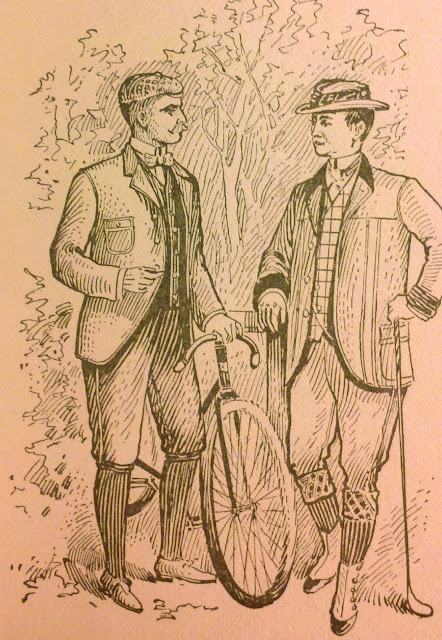
Correct Dress for Cycling Men of 1918

Gray golf stockings, tastefully variegated with touches of black, white and sober blue, or brown hose with very fine crisscrossing lines in yellow and red, now predominate.

Bicycling Attire for Men

THOSE still faithful to the bicycle wear in cool spring and autumn weather, a complete suit-coat, waistcoat, and knickerbockers-of serviceable gray or brown tweed, the coat cut very like an English pea-jacket, or what we prefer in America to call a "lounging coat." Gray golf stockings, tastefully variegated with touches of black, white and sober blue, or brown hose with very fine crisscrossing lines in yellow and red, now predominate. High or half-high laced shoes of black or brown leather dress the feet in good taste. But as this is too heavy an attire for mid-summer weather, it gives place, in June, July, August, and September, to a suit of Russian crash, heavy brown linen, khaki serge, or light-weight flannel. – From Emily Holt’s “Encyclopaedia of Etiquette,” 1918


 🍽Etiquette Enthusiast, Maura J. Graber, is the Site Editor for the Etiquipedia© Etiquette Encyclopedia

Tuesday, May 12, 2015

The First Etiquette Encyclopedia

For the most part, Emily Post’s book, “Etiquette” is Emily Holt’s “Encyclopedia of Etiquette” reworked and slightly updated...

According to a “New Yorker” article, “Emily Holt’s popular ‘Encyclopaedia of Etiquette,’ first published in 1901, was more than five hundred pages. By contrast, Emily Post said that she wanted to write a small book, a ‘sensible book,’ because ‘the whole subject can be reduced to a few simple rules.’ Post worked on ‘Etiquette’ for nearly two years... Somewhere along the way, Post either changed her mind or simply lost sight of her original goal. By the time she was finished, ‘Etiquette’ ran to two hundred and fifty thousand words, took up more than six hundred pages, and was even larger than Holt’s ‘Encyclopaedia.’For the most part, Post’s book is Holt’s ‘Encyclopedia’ reworked and slightly updated.” ~2008, The New Yorker

Encyclopaedia of Etiquette

The general impression of so-called books of manners is that to have a copy in one's possession means that he or she is deficient in the qualities that go to guests: rules for dancing a german and leading cotillions: proper form in connection with weddings, theatre parties, visiting and house parties, receptions, musicales, garden parties, funerals and christenings.
The latter part of the book is devoted to some words to bachelors on the lines society dictates their hospitalities shall be conducted: the proper dress and etiquette to be followed in writing, driving, golfing, and bicycling: a few rules on correspondence: and last, hints for the dress and duties of servants and the social position of children.

The volume is supplemented by an alphabetical index for convenient reference and has nine half-tone reproductions of photograph especially taken to explain the text in relation to dinners, weddings and liveries. (Published by McClure, Philadelphia & Co., New York.
Price $2.) –
Originally published in the San Francisco Call March 17, 1901 under "Writers of Books"


Etiquette Enthusiast, Maura J. Graber, is the Site Editor for the Etiquipedia© Etiquette Encyclopedia