Showing posts with label Bridal Etiquette. Show all posts

Saturday, June 8, 2024

1990’s Wedding Etiquette

The 1990’s ushered in a host of new trends and non-traditional themes in American weddings. Numerous magazines featured wedding and bridal etiquette tips — When speaking on new etiquette for weddings, Elizabeth Post said at the time, “People check in etiquette books to see what is considered proper and then modify it to suit themselves.”
Wedding etiquette, once practically carved in stone, is now written on the wind. Just for starters, the bridal couple may have been living together before the wedding. The groom may have selected a woman as his honor attendant while the “maid” of honor is a man. The bride may walk down the aisle on the arms of both her father and her stepfather, or with her mother. The wedding service may be conducted by two members of the clergy, each of a different denomination.

“The nicest thing that has happened is that weddings have become more individual,” says Elizabeth Post, granddaughter of Emily Post, who kept earlier generations’ manners in order. “We have many more choices today. People check in etiquette books to see what is considered proper and then modify it to suit themselves,” says Post, who recently revised “Emily Post's Complete Book of Wedding Etiquette.”

Still, she discerns a growing interest in observing the forms, after an era in which many people wanted to eliminate them in the interest of spontaneity and freedom. “Compared to the 1970s and the 1960s, people want more structure, but without returning to the formality that characterized the Victorian age,” says Post.

Or as Annie Chervin Edwards, who was married in South Salem, NY last spring, puts it: “I didn't want my wedding to be stuffy, but I didn't want anything to be in bad taste, either. Although she didn't plan on observing traditions such as having a receiving line, she says that one materialized naturally after the ceremony as guests came up to congratulate the couple and their parents.

“Etiquette today is changing to accommodate feelings, which is only right, since it evolved as ritualized courtesy which is a form of kindness,” says Barbara Tober, editor of Bride's Magazine. Some practices now considered appropriate once either frowned on, or not considered, include sharing expenses between both sets of parents, closing the bar early or even doing without alcoholic beverages altogether, inviting live-in mates as well as spouses of friends, and addressing invitations to a husband and wife who don't share the same last name, Bride’s reports.

A common question: Who gives the bride away? “Tradition says it's her own father's prerogative, but this can lead to hurt feelings if she has been living with her mother and stepfather for many years. Many brides are writing to ask if their mother can give them away. I say yes even though there may be some raised eyebrows if that is what the bride would like. A mother's place traditionally is in the front row, but if a stepmother has been more important in the bride’s or groom’s life, she is the one who should be given this seat of honor,” says Post. —Associated Press, 1991


  🍽 Etiquette Enthusiast, Maura J. Graber, is the Site Editor for the Etiquipedia© Etiquette Encyclopedia

Saturday, September 2, 2023

10 More Etiquette Tips of 1940

    The salt and pepper shakers should be removed from the dinner table on a tray with the rest of the food from the preceding course, before the dessert is brought in.

    1. The salt and pepper shakers should be removed from the dinner table on a tray with the rest of the food from the preceding course, before the dessert is brought in.
    2. You may serve the guests first or not at your dinner, as you wish. However, if the dish being served is unusual, or if the guests may not know how much of it to take, a good idea is for the hostess to be served first and the guests can follow her example. 
    3. The general rule (with American dining) when serving a meal is that everything is served and removed from the left except beverages and extra silver, which are placed at the right.
    4. When two men are dining in a restaurant, each gives his order to the waiter, even it one is the guest of the other.
    5. If a girl and man are waiting for a cab, the girl should let the man hail it when it comes.
    6. Children should be cautioned about blocking the sidewalks with their roller skating, marble playing, rope skipping and other activities. or of bumping into passing adults. It is never too early to teach youngsters consideration for others the foundation of good citizenship. 
    7. Listen to your own voice and intonations. It is not only pleasing, but it is good manners to speak pleasantly in a low, quiet voice, which can be acquired if you will but watch your tones and lower those high notes to make them clearly audible but pleasantly low pitched. A pleasant cordial voice will help you win friends.
    8. When leaving a large tea or reception it is not necessary to go to the receiving line and say goodbye before leaving. 
    9. A mother does not give a bridal shower for a daughter, or a sister for her sister. If mother or sister wish to entertain for the bride-to-be. They may provide material for something for the new home, like tea towels or napkins, and let the guests work on them, but not expect said guests to bring gifts.
    10. On the wedding day, the bride either leaves her engagement ring at home or wears it on her right hand, as the wedding ring should not be put on over the engagement ring. 


    From the “Grab Bag” feature in the Imperial Valley Press, 1940


    🍽Etiquette Enthusiast, Maura J. Graber, is the Site Editor for the Etiquipedia© Etiquette Encyclopedia

    Sunday, October 18, 2020

    Etiquette for the June Bride


    Don't fail to write your own notes. The habit some girls have of shifting this responsibility to their bridesmaids is rude, and gives rise to many ridiculous blunders. Don't make your notes perfunctory and stereotyped. A bride often makes a bad impression by her wedding notes to strangers, that it takes years to efface. Be grateful without being gushing. Don't gage your gratitude by the value of the gift sent. Nothing more quickly shows lack of breeding. Besides, it is stupid, as you can never tell when your friends will compare your notes. 
    Mrs. Edsel B. Ford's bridal party, 1916 —Photo source, Pinterest  


    Here are some Don’ts for the June Bride:
    • Don't fail to have an open air wedding if your grounds permit. This is the one month of the year for that loveliest of wedding ceremonies. 
    • Don't be terrified lest your outdoor ceremony will be ruined by rain. Have all your arrangements made to be married indoors; you will probably break the hoodoo of the unprepared and draw sunshine.
    • Don't get a more elaborate trousseau than you need. Better hold over part of your money and get your handsomest frocks in the Fall, when you will need them more.
    • Don't be a procrastinator in ordering your trousseau Last minute fittings do not make for a beauteous bride, particularly on hot June days.
    • Don't spend a fortune in decorations— if you cannot afford it Nothing is lovelier than the June garden flowers at a wedding, and your girl friends should have taste enough to arrange them artistically. 
    • Don't invite more than your house— in case of rain— or your church can accommodate comfortably. A “jam” on a hot June day is torment.
    • Don't lack a system in receiving and answering your wedding presents. See that your name and address of the sender, also the place where the gift is bought, is marked in an alphabeted book, as each package is opened. Check off each name as soon as a note of thanks is written.
    • Don't use your calling card for your “thank you” notes. It is wretched form. A wedding gift demands a gracious and grateful answer in the first person.
    • Don't fail to write your own notes. The habit some girls have of shifting this responsibility to their bridesmaids is rude, and gives rise to many ridiculous blunders.
    • Don't make your notes perfunctory and stereotyped. A bride often makes a bad impression by her wedding notes to strangers, that it takes years to efface. Be grateful without being gushing. 
    • Don't gage your gratitude by the value of the gift sent. Nothing more quickly shows lack of breeding. Besides, it is stupid, as you can never tell when your friends will compare your notes. 
    • Don't fail to mention the name of your fiancé in writing your notes of thanks. The gifts are sent to you both, though they belong to the bride. 
    • Don't exhaust yourself note-writing. Keep up your notes as well as you can, by daily writing, but stop for at least 2 days before the wedding. Moderate delays are excusable; long delays the height of rudeness.
    • Don't write wedding notes on shabby paper or hotel paper. Have correspondence cards or fine linen paper, with your monogram, preferably. 
    • Don't be guilty of the execrable form of criticizing wedding gifts. think what you please, but please keep your comments unsaid. Don't cut loose, even to your dearest confidant — she'll think none the better of you and may tell.
    • Don't stint on rest in the last days before the wedding. Let the family work, if you will not go in for simplicity. It's a bride’s privilege to look fresh and as beautiful as you can. When overtired it is bound to show. 
    • Don't go into matrimony thoughtlessly. If you have doubts, even at the last minute that he is not the right man, better risk talk and break off the match. The notoriety and disappointment are bad, but not half so bad as a lifetime of unhappiness.
    • Don't expect the impossible in a husband. Remember, you are marrying a man, not a hero in a novel. If he has faults, is not up to your ideal, he is doubtless thinking the same of you. Love much and learn to make allowances, if you would avoid unhappiness. Your married life may not be that of your dreams, but it should be something far deeper and sweeter. — The New York Times, 1912


    Etiquette Enthusiast, Maura J. Graber, is the Site Editor for the Etiquipedia© Etiquette Encyclopedia
    Wednesday, December 4, 2019

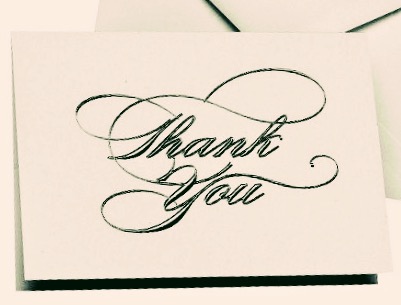
    Bridal Etiquette –‘Thank You’s

    “The stemware is truly beautiful. Though we're tempted to hold it back for state occasions, we do use it nightly.”


    Be Speedy In Saying Thanks


    When it comes to thank you notes, there's a very simple rule of etiquette. It doesn't matter so much how you phrase your note: It's the speed with which you send it off that shows your good manners, as well as your gratitude. If writing the letters looms as a huge task, plan to do just a few at a time. 

    Keep your list of gifts and your writing supplies out on the desk, or a bridge table, and use those odd times to do a few notes. Your thanks should be simple and sincere, never pretentious. Try to have the giver feel he can see his gift in your first home. You can use phrases like these: “The bud vases you sent us look lovely on our fireplace mantel.” “We christened the casserole you gave us last night, and the budget beef stew tasted delicious.” “The stemware is truly beautiful. Though we're tempted to hold it back for state occasions, we do use it nightly.” 

    These notes may be written on informal notepaper, possibly with your monogram or name engraved on the top sheet. Or simple notepaper of good quality may be used. Keep away from too highly decorated notepaper. It's fine for casual writing, but not for bridal thank yous. – San Bernardino Sun, 1970


    Etiquette Enthusiast, Maura J Graber, is the Site Editor for the Etiquipedia© Etiquette Encyclopedia

    Tuesday, December 3, 2019

    At-Home Wedding Etiquette

    The etiquette of the home wedding is nearly the same as in more pretentious affairs, but many of the formalities are dispensed with.  MarthaStewartWeddings.com recommends making the renting of a tent a priority for outdoor receptions when getting married at home. “Unless the inside of your home can accommodate all of your guests—and every part of your wedding day—you're going to need a tent, says Jackson. Getting hitched in the summer? A tent with air conditioning and fans might also be a welcome addition.” – Photo source, Pinterest


    At a home wedding the number of guests is limited. The bride wears a colored dress of light silk or a simple white one. The bridal party faces the clergyman and he faces the company. The etiquette of the home wedding is nearly the same as in more pretentious affairs, but many of the formalities are dispensed with. 

    The decoration of the home is according to the tastes of the parties most interested. The wedding refreshments are partaken of in whatever way best conduces to the comfort and enjoyment of those present. A private wedding is one at which there are none present except the contracting parties, the minister and the witnesses. – San Francisco Call, 1905


    Etiquette Enthusiast, Maura J Graber, is the Site Editor for the Etiquipedia© Etiquette Encyclopedia

    Tuesday, August 20, 2019

    Bridal Etiquette and Thanks

    In 1957, Amy Vanderbilt wrote that no one may write notes of thanks for the bride. Wrote Vanderbilt, “It is a social responsibility she alone must fulfill.” But a more modern etiquette has evolved since then, and it is refreshingly common for new spouses to assist one another in writing notes of thanks for wedding gifts they receive. We believe Amy would approve!

    Q. “What is the most frequent error that brides make?”

    A. People can smile tolerantly and forgive any little mistakes that can easily happen at a wedding or a reception. But the thing they are most often deeply hurt by is the bride’s failure to acknowledge their wedding gifts promptly and properly. It is never correct to send printed cards of thanks for wedding gifts.

    Wedding gifts should always be acknowledged with handwritten notes as soon after their receipt as possible, within 3 months at the very outside. They may be short, but they should be sincere, appreciative, and should mention the gift itself, even where literally hundreds of gifts have been received. And no one may write them for the bride. It is a social responsibility she alone must fulfill. –Amy Vanderbilt, 1957 


    Etiquette Enthusiast, Maura J Graber, is the Site Editor for the Etiquipedia© Etiquette Encyclopedia