Showing posts with label Dining Etiquette History. Show all posts

Monday, October 20, 2025

Gilded Age Etiquette History Article

Butter knives, shown above with antique butter dishes and butter forks, were new to tables in the 1830’s- 1840’s. Butter forks and butter picks came later in the 1800’s. Prior to butter knives and individual butter spreaders being introduced, it was very common for diners to butter their bread with their thumbs.


While certain forms of table etiquette may seem altogether conventional, even fantastic, the forms usually observed are founded on good sense, and adapted to general convenience. Table etiquette is not, as is often alleged, merely a matter of fashion, although some things that were in vogue a generation or two ago are no longer deemed polite. The reason is that manners and table furniture have undergone so many changes, have really so much improved, as to require a mutual readjustment.

For example, everybody was accustomed twenty or thirty years since, to use the knife to carry food to the mouth, because the fork of the day was not adapted to the purpose. Since the introduction of the four-tined silver fork, it has so entirely supplanted the knife that the usage of the latter, in that way, is not only superfluous, but is regarded as a vulgarian.

Another example is the discontinuance of the custom of turning tea or coffee from the cup into the saucer. Although small plates were frequently employed to set the cup in, they were not at all in general use; and even when they were used, the tea or coffee was likely to be spilled upon the cloth. The habit, likewise, of putting one’s knife into the butter arose from the fact that the butter-knife proper had not been thought of. Such customs as these, once necessitated by circumstances, are now obviously inappropriate.

Certain habits, however, are regulated by good taste and delicacy of feeling, and the failure to adopt them argues a lack of fine perception or social insight. One of these is eating or drinking audibly. No sensitive person can hear any one taking his soup. coffee or other liquid, without positive annoyance. Yet those who would be very unwilling to consider themselves ill bred are constantly guilty of such breaches of politeness. 

The defect is that they are not so sensitive as those with whom they come in contact. They would not be disturbed by the offence; they never imagine, therefore, that any one else can be. It is for them that rules of etiquette are particularly designed. Were their instinct correct, they would not need the rule, which, from the absence of instinct, appears to them irrational, purely arbitrary.

To rest one’s elbow on the table is more than a transgression of courtesy, it is an absolute inconvenience to one’s neighbors. All awkwardness of position, such as sitting too far back from or leaning over the table, are reckoned as rudeness, because they put others ill at ease through fear of such accidents as are liable to happen from any uncouthness.

These and kindred matters are trifles; but social life is so largely composed of trifles, that to disregard them wholly is a serious affront. We can hardly realize to what extent our satisfaction of dissatisfaction is made up of things in themselves insignificant, until their observance or nonobservance is brought directly home to us.– Scribner’s Monthly, 1884


🍽️Etiquette Enthusiast, Maura J. Graber of The RSVP Institute of Etiquette, is the Site Editor of the Etiquipedia© Etiquette Encyclopedia  

Sunday, May 18, 2025

Surprising Reasons for Etiquette Rules

One “ancient courtesy rule is the practice of breaking bread, rather than biting into a whole slice”, as it “was customary to collect table leavings for the poor.”

Centuries-Old Customs Continue To Mold Manners 

Once upon a time knights in armor opened their visors when meeting someone, to determine if they were confronted by friend or enemy. From this stems today's custom of tipping the hat. In medieval days a man walking or riding on the right had the advantage of being able to unsheathe his sword quickly with his right hand. The position of deference is still to the right of the host or hostess.

“Although their practical purpose has vanished, many such etiquette traditions continue today,” says Esther B. Aresty, whose new book, “The Best Behavior,” traces the course of good manners from antiquity to the present. Some customs that have outlived their usefulness, however, have been abandoned, such as the prohibition against cutting salad with a knife. This originated, Mrs. Aresty explains, before the advent of silver or stainless steel blades, when acid in the salad dressing would discolor knives then in use. 

But other regulations laid down centuries ago remain valid to this day, notes the author, who researched hundreds of rare old courtesy and etiquette books. The earliest was “Instructions.” written about 4,000 years ago by the Egyptian Ptahhotep.

“Deference to elders was preached in this ancient papyrus scroll and is one of the oldest rules of civilized mankind,” she points out. “Another ancient courtesy rule is the practice of breaking bread, rather than biting into a whole slice, apparently because it was customary to collect table leavings for the poor. This was even called for in the Talmud.”

Earlier books were general, stressing courtesy and human relationships rather than specific rules, Mrs, Aresty says. At the beginning of the 19th century, etiquette books, while they contained some elements of the courtesy books, became volumes of regulations.

However, Mrs. Aresty thinks that conforming to such regulations is not the basis of good manners. “You can put the forks on the right side and the knives on the left side of the plate you may confuse your guest but all you've done is violate a regulation. But if you sit at the table with curlers in your hair and don't give your guest a chance to talk, then you're guilty of bad manners.

“Anything that offends is bad manners and you can define good manners in just three words: consideration for others.” she states, “Manners are what separates the herds from the leaders, the savages from the civilized.” While admitting that today's fast-paced life necessitates more informality, she contends that elimination of the niceties, especially in the area of man-woman relationships, is a “shattering loss.”

“It's a great pleasure to be a woman and have a man look after you,” declares the author, who confesses, “I'm not a women’s lib gal. Women are emasculating men in this country and women’s lib is delivering the coup de grace.” The trim, well-groomed authority on manners of the past is particularly outspoken in her criticisms of children’s manners of the present. Noting that manners were taught in school around the turn of the century, she adds that it would be a good idea for schools to reintroduce such a program.

“You must teach manners; they're not instinctive. The public school system must become surrogate parents in many ways because children are growing up without parental supervision,” says Mrs. Aresty, the mother of a grown son and daughter. “In this country etiquette writers have always complained about the behavior of children,” she goes on. “The tantrum is an American phenomenon. In Europe you rarely see the squalling cutups that are commonplace here.”

In other ways, too, European and American manners differ, Mrs. Aresty says, though the distinction is blurring with the prevalence of international travel. “There was a long tradition in America of not being fancy and not copying European ways,” she comments. “Although the fork came into use in England in the late 17th century, in America most people shoveled food into their mouths with knives right into the 19th century. Well past the Civil War, readers were still being advised not to put the knife into the mouth when eating.”

Men were the arbiters of manners in Europe, since they had plenty of leisure and social life centered around their needs. Thus they wrote the earlier etiquette volumes; but in America women became the custodians of manners and here they wrote the books. The rules of etiquette change constantly, Mrs. Aresty points out, and what is accepted at one period can be considered wrong at another time.

“A period of primness in language began in the 18th century in England and swept from here to this country,” she relates. “Refinement meant that women at American tables would not ask for a piece of breast when fowl was served. They would say ‘I'll have a slice of bosom.’ Even table legs were known as limbs.”

Other bits of advice have remained constant. For example, Mrs. Eliza Farrar, one of the earliest American etiquette writers, warned a lady never to appear before anyone while wearing curl papers. “There is no more frightful appendage to a woman than they are,” she wrote.

In an article in Harper's Bazaar in the late 19th century, Maude Howe suggested this method for entering society: “Give liberally to charity, go on committees and meet there the educated and well-bred. Keep your eyes open to the way they do things, and soon you are able to play the game.” – By Joy Stilley, New York, 1971


🍽️Etiquette Enthusiast, Maura J. Graber, is the Site Editor for the Etiquipedia© Etiquette Encyclopedia

Monday, May 1, 2023

A Special Event with Maura J. Graber and Elizabeth Soos


To reserve your space for this free event, click here,

Site Editor, Maura J. Graber of The RSVP Institute of Etiquette, and the founder of the Etiquipedia Etiquette Encyclopedia along with Elizabeth Soos from the Auersmont School of Etiquette and Protocol, are hosting a free online session discovering the origins of dining etiquette and the unique utensils which helped etiquette evolve at the dining table.

In this session, you will learn from Maura about the early history of dining etiquette and how the use of utensils affected early dining etiquette. She will also cover the golden era of flatware design — the “Gilded Age,” training utensils for children and even “able ware” for those with physical challenges. Items shown and discussed will range from the 1600’s to modern day.

Some of what we will be discussing… 

• The Highlights and Timeline of Flatware History with Maura Graber

• Changes in Dining Etiquette Due to the Invention of the Table Fork and Travel Utensils

• The Golden Era of Flatware Design… The “Gilded Age and Edwardian Era”

• Training Utensils for Children from the 19th - 21st Century 

• Able Ware 

• Modern Etiquette Rules for Flatware

Moving to the modern era Elizabeth Soos will provide etiquette tips and tricks to ensure dining elegance with ease and confidence. 

Elizabeth will demonstrate…

• How to use a spoon correctly

• How to use a fork with elegance

• How to use a knife with ease.


When is this event happening?

The event will be on via Zoom, Saturday, 20th May 2023, 4 pm - 5 pm, Pacific Standard Time, (PST, California USA).


Will I be able to watch the event at another time?

We are recording the event and posting it via YouTube.


As a beginner, is this event suitable for me?

Beginners and welcome and we hope that you enjoy the event. 


How much is the event?

This event is free.


Questions can be sent to the Administrator prior to the event and during the presentation. Maura will answer as many as possible in the Question & Answer session following the presentation. 


Please email your questions to: theetiquettechannel@gmail.com


 🍽Etiquette Enthusiast, Maura J. Graber, is the Site Editor for the Etiquipedia© Etiquette Encyclopedia

Monday, May 23, 2022

Dining Etiquette History Bits


“Now” is always a good time to brush up on inoffensive dining habits and how they evolved. If you know how a rule came about, you will most likely remember the rule, rather than tuning it out of your mind as being ridiculous.

Let's start with the table and how it is set. Would you set your table with forks, spoons and handguns? Probably not, unless yours is some type of “theme” event which I do not want to dwell on.

The question of handguns is out of the question for those of us who consider ourselves civilized. But this was a problem European forefathers faced when it came to knives at the table.

Before forks and spoons arrived on the scene, the only implements for eating were knives and one's fingers-a problem, because knives were the weapon du jour and someone who had consumed too much grog I might take offense to another diner’s remarks during the course of the meal. And according to old literature, many people were done away with during dinner time.

Once Europe decided to become more civil, rules for knives at the table had to be created. The blades must be rounded, Cardinal Richelieu decreed, after watching dinner guests pick at their teeth with the pointed ends of their knives.

It was also decided that knives could only be used if they were necessary for a particular fare. Soft foods had to be eaten with the hands (breads, pasta before sauces were added, etc…). Knives laid at the table were to have the blades facing the plate or the diner they were set for, as opposed to facing toward another diner in an aggressive manner.

The placement of the silver, or flatware, is what everyone seems to get confused with in modern society. We still eat with the utensils farthest from the plate first and work toward the plate as we continue the meal. And the utensils above the plate are reserved for dessert, with two exceptions: the salt spoon and butter spreader.

Salt cellars are small dishes containing salt, and hopefully a salt spoon, which is a tiny thing that looks as if it belongs in a dollhouse.

And gesticulating (waving one's knife in the air) while talking was and still is frowned upon. When eating with one's hands, one finger was kept extended and out of the trencher (the bowl the food was served in) to remain free of grease. That finger could then be used to dip into the salt without tainting it. Once it was determined your fingers could touch nothing at the table except for the bread or utensils, you could no longer use your finger for the salt.

The little things are what tend to add up to one big faux pas, so I will list in order of importance the basics of the table and settings that most people find confusing:
  • Your bread plate is above your forks to the left of your plate.
  • Your glasses are the ones above your knives and spoons to the right of your plate.
  • The fork is the only utensil that can be at all three sides of the set ting: three on the left, one above, one on the right.
  • Coffee is never served with the meal if the meal is a formal one. It is only served after the meal, away from the table.
  • Nothing is to be spit into your napkin at the table. Spitting has not been allowed for at least 100 years.
  • Shoving your plate away from you to let others know you are done isn't done in polite dining.
  • The charger or service plate is customarily removed prior to the serving of the entree, but can remain on the table through to dessert.

From an article by Maura J. Graber in “Southern California Magazine,” 1993

Etiquette Enthusiast, Maura J. Graber, is the Site Editor for the Etiquipedia© Etiquette Encyclopedia

Friday, August 6, 2021

Etiquette and Elbows


Is it Appropriate to Place Your
Elbows on the Table?


Of all the hard and fast etiquette rules, placing elbows on the table is one of the most familiar ones. From an early age, children become familiar with the constant reminder, “Elbows off the table, please!”

There was even an often-sung jump rope rhyme on the subject:
“Mable, Mabel,
Strong and able,
Get your elbows off the table,
We’ve told you once,
We’ve told you twice,
We’ll never tell you more than trice.”


In our current age of informality, we tend to be more relaxed. And yet, the general rule still applies: elbows do not belong on the table.

The Practical Reasons for the Rule

Not having elbows on the table has practical and polite application. Consideration of others at the table is, of course, first and foremost.

Recently, I attended a lovely dinner gathering. The table was full of delicious food to be served home style with passing of dishes, but there were many guests seated very close-in to accommodate as many as possible. The person seated next to me sat with his elbows on the table – even during eating. This caused a space challenge for the two of us seated on either side of him as we worked to best accommodate for room.

Health-wise, elbows resting on the table means that you are leaning in and, by default, your ribs are pushed inwards. Where is your stomach? Between the spine and ribs. This hunched-over posture could very well interrupt proper digestion. A pretty good reason not to eat or “rest” with your elbows on the table.

A Little History

In days of old in Europe, it’s claimed that in the great halls where people dined at long tables, all were seated on one side of the table, and leaning on a table might cause it to tip over. Another story is that when opportunity afforded itself and people gathered close-in at long tables, there simply wasn’telbow room.

Contrary to the above, there are tales of the custom of placing arms on the table while eating. One story is that in olden times people needed to guard their food, and elbows on the table made that easier. Also, it’s reported that sailors at sea used their elbows to steady their hands in order to steady plates when weather got rough.

I suppose the bottom line is that practicality has a say in protocol.

Are Elbows on the Table Ever Okay?

Speaking of practicality, there are occasions when it may be acceptable to place your elbows on the table during a meal.

If the place for eating is noisy, sometimes you might feel the need to lean in to participate in conversation.

It may be that conversation is so intense that not leaning in (with elbows on the table) would indicate disinterest.

Elbows might be placed on the table when there is no food there – before or after ordering in a restaurant or when between courses once the plate from the previous course is cleared.

Sometimes, conversation continues at the table well after the meal is over. It would be uncomfortable to sit upright for any length of time, so for comfort’s sake, resting with arms on the table is quite fine.

During a working lunch when pads, pens, and laptops are in use alongside food served. Not the healthiest way to enjoy a meal, but another example of practicality taking precedence.I always advise using mindful discretion before becoming too relaxed. Consider what it’s like “to be on the other side of me.”

Does the dining environment call for formality?

Would you cause a space challenge for anyone seated next to you?

Do you happen to know that the host of the meal is a hard and fast rule follower?

Also consider that your body language sometimes speaks louder than spoken language. Your body language at the table informs others of your openness to conversation, your comfort with yourself, and your consideration of others.


"Oh, I would never put my elbows on the table."
~ Mary Berry, British Chef and Author


 Contributor, Candace Smith is a retired, national award-winning secondary school educator, Candace Smith teaches university students and professionals the soft skills of etiquette and protocol. She found these skills necessary in her own life after her husband received international recognition in 2002. Plunged into a new “normal” of travel and formal social gatherings with global leaders, she discovered how uncomfortable she was in many important social situations. After extensive training in etiquette and protocol, Candace realized a markedly increased confidence level in meeting and greeting and dining skills and was inspired to share these skills that will help others gain comfort and confidence in dining and networking situations. Learn more at http://www.candacesmithetiquette.com/

Etiquette. Enthusiast, Maura J Graber, is the Site Editor for the Etiquipedia© Etiquette Encyclopedia

Wednesday, May 5, 2021

Table Napkin Etiquette and History


“That article now considered almost indispensable, the table napkin, was first used only by children but was only adopted by elder members of the family about the middle of the Fifteenth century.”– ¥ouch’s Companion, 1893


Curiously enough, that article now considered almost indispensable, the table napkin, was first used only by children but was only adopted by elder members of the family about the middle of the Fifteenth century. In etiquette books of an earlier date than this, among other sage pieces of advice for children are instructions about wiping their fingers and lips with their napkins. It seems that the tablecloth was long enough to reach the floor and served the grown people in place of napkins. When they did begin to use napkins, they placed them first on the shoulder, then on the left arm, and finally tied them about the neck. —Youth's Companion, 1893


Etiquette Enthusiast, Maura J Graber, is the Site Editor for the Etiquipedia© Etiquette Encyclopedia


Wednesday, September 30, 2020

Table Manners for Fruit

Cherries, berries, strawberries (they are not actually berries), oranges, grapes, grapefruit, mangoes and lemons all had utensils specifically made for enjoying them. Many other fruits had none. Peaches, apricots, apples, pears, pineapples, papayas, kiwi, nectarines and plums are among the many fruits which were overlooked. When it came to the etiquette of eating them, the small fruit knife and fruit fork would have to suffice.
— Photo source, Etiquipedia private library


How to Eat Peaches


“The art of eating a peach” is, it appears, one of the questions of the day. According to one authority on the etiquette of the dinner table, a peach should be picked with the fork, quartered, peeled and eaten piece-meal. But, as so much manipulation would evidently leave all the juice of the fruit on the plate this method, to be palatable, requires the courage of the young lady in the story who, at her first appearance at a dinner party, raised her dessert plate with her two hands and calmly drank the sweet juice of the nectarines. The French rule of eating peaches will, therefore, be accepted with much favor, and that rule is, “D’y mordre a pleines dents.”—Pall Mall Budget, 1891


Etiquette Enthusiast, Maura J Graber, is the Site Editor for the Etiquipedia© Etiquette Encyclopedia 

Spoon History and Etiquette


“Spoons are older than forks, because nature provides them. Where people live near the sea, sea shells are often used as spoons. Gourds and sections of bamboo have been used too, and spoons are easy to carve out of wood. In a few places, as among the Native Americans of the Pacific Northwest, the “spoon” might actually be almost flat, like a paddle, because its real use was to fish out solid bits of food for the honored guest.”— Shown above, three small antique silver spoons, from left to right, a mustard spoon, salt spoon and a snuff spoon
—Photo source, Etiquipedia private library 

Tiny Bowls

What’s a spoon, really? A tiny bowl with a long handle so that we don’t have to drink clumsily from a larger bowl.

We use it for soup, but that’s just the elegant modern way to do it. The original way (which survived in rural areas well into the 19th century) was to pick up the whole bowl and chug it down. Sticklers for good usage insist that we should say we “drink” soup, rather than “eat” it, but in the old days that went without saying.

Spoons are officially intended for liquid or semi-liquid  food, so we use a spoon for pudding or ice cream (hence the expression “X could eat Y with a spoon,” meaning X considers Y a luscious treat). But we use a fork for pie, because it’s a pastry, a distinction that has infuriated many a small child who wanted to get all of a pie’s drippy fruit filling.

Spoons are older than forks, because nature provides them. Where people live near the sea, sea shells are often used as spoons. Gourds and sections of bamboo have been used too, and spoons are easy to carve out of wood. In a few places, as among the Native Americans of the Pacific Northwest, the “spoon” might actually be almost flat, like a paddle, because its real use was to fish out solid bits of food for the honored guest.

In many parts of the world, people eat out of a communal plate and even take soup from a common bowl. Obviously, this poses a risk of spreading disease.

But people have ways of getting around that. In Central Asia, for instance, the soup spoon has a remarkably wide bowl— sometimes it looks like two bowls side by side— and etiquette requires that you scoop away from you into the common bowl of soup or yogurt. So the part of the spoon that goes into the soup is not the part that goes into your mouth. Clever. — By Charles Perry, 1999


Etiquette Enthusiast, Maura J Graber, is the Site Editor for the Etiquipedia© Etiquette Encyclopedia

Tuesday, July 28, 2020

Dining History and Knife Etiquette

A silver and steel “bird” knife, which was a forerunner of the serrated-edged, steak knife
 =======================
According to Tallement Des Réaux, Richelieu was responsible for the rounding off the points on table knife blades in France in 1669, apparently to prevent their use as toothpicks, but probably also to discourage assassinations at meals. It became illegal for cutlers to make pointed dinner knives or for innkeepers to lay them on their tables. Other countries soon followed suit. Pointed knives for all diners were later to return to the dining room table, but as steak-knives, which have a special image...” 
– Margaret Visser


Ever since the 16th century there has been a taboo against pointing a knife at our faces. It is rude, of course, to point at anybody with a knife or a fork, or even a spoon; it is also very bad form to hold a knife and fork in the fists so that they stand upright. But pointing a knife at ourselves is viewed with special horror, as Norbert Elias has observed. I think that one reason for this is that we have learned only very recently not to use our knives for placing food in our mouths: we are still learning, and we therefore reinforce our decision by means of a taboo. We think we hate seeing people placing themselves even in the slightest jeopardy, but actually we fervently hope they will not spoil the new rule and let us all down by taking to eating with their knives again.

For the fact is, that people have commonly eaten food impaled on the points of their knives, or carried it to their mouth as balanced on blades; the fork is in this respect merely a variant of the knife. With the coming of forks, knife points became far less useful than they had been; their potential danger soon began in consequence to seem positively barbaric. The first steps in the subduing of the dinner knife were taken in the 17th century, when the two cutting edges of the dagger-like knife were occasionally reduced to one. The blunt side became an upper edge, which is not threatening to the fingers when they are holding knives in the polite manner.

According to Tallement Des Réaux, Richelieu was responsible for the rounding off the points on table knife blades in France in 1669, apparently to prevent their use as toothpicks, but probably also to discourage assassinations at meals. It became illegal for cutlers to make pointed dinner knives or for innkeepers to lay them on their tables. Other countries soon followed suit. Pointed knives for all diners were later to return to the dining room table, but as steak-knives, which have a special image, linked deliberately with red meat and “getting down to business” when hungry. They are still quite rustic in connotation. — Margaret Visser, The Rituals of Dinner


Etiquette Enthusiast, Maura J Graber, is the Site Editor for the Etiquipedia© Etiquette Encyclopedia

Monday, December 16, 2019

Gilded Age Etiquette for Eating Oranges

Below – An individual silver, Gilded Age orange dish, with inside “spikes” which hold the halved orange in place for graceful dining. Paired with a “Salem witch” orange spoon, with a gilded bowl to protect the sterling silver from citric acid. Salem witch spoons, by Daniel Low, are deemed by many to be the original souvenir spoons.
Specially designed orange spoons and footed orange dishes, with spikes for holding orange halves, were seen on the finest dining tables. Only those who were well-versed in etiquette knew how to use them, and eat their oranges properly.

In ancient times, Alexander the Great named what we now call “oranges,” “Median Apples” and “Persian Apples.” Considered the fruit of emperors and kings, oranges and orange groves were considered one's paradise. France's Louis XIV had his own: “His orangerie at Versailles was built in the shape of a ‘C,’ 1200 feet around, and was the scene of garden parties and masked balls.” And oranges were believed to be the “ultimate preventive” to the threat of a plague, according to physicians of the Italian Renaissance. 
Above– The inside of a footed, tilted, Gilded Age orange dish. 

Oranges were still considered a delicacy throughout most of  the Victorian era. By the 20th century, after refrigerated railroad cars were invented, oranges reached the middle-class in the United States. In the early 1900’s, people in the United States used to consume more fresh oranges than all other fresh fruits combined, with their popularity soaring during the winter holidays.  Though no longer considered a delicacy, oranges continue to hold a special place in children's Christmas stockings.


It is not customary to serve fruit as a first course at dinner, though at a lunch it is quite proper.


First in expensive sterling, then in silverplate, special spoons for oranges became popular table accoutrements.  When oranges were no longer a delicacy, and grapefruits were grown to be more palatable, a serrated edge was added to orange spoons, creating “grapefruit spoons.”

Oranges are seldom served at dinner anymore unless they are specially prepared, that is, with the skin taken off, and the sections divided, in which case the fruit is eaten from a fork.

Grape-fruit must be served ice cold. It is served in two ways: either it is cut in halves, midway between the blossom and the stem end, the seeds removed, the pulp loosened with a sharp knife, but served in the natural skin, to be eaten with a spoon; or the pulp and seeds are entirely removed from the skin with a sharp knife, and the edible part only served in deep dessert plates. Pulverized sugar should accompany grape-fruit. - From *Practical Etiquette by N.C., 1899


*Author's note : “The author is under obligation to so many persons for suggestions and advice, as well as to many authors, that it does not seem best to give a list of the same, especially as such list could be only a partial one, for many of her friends would not desire mention of their names.”
N. C. Dec. 1, 1899


Etiquette Enthusiast, Maura J Graber, is the Site Editor for the Etiquipedia© Etiquette Encyclopedia 


Wednesday, September 20, 2017

Etiquette and Moralizing Character

Petrus Alphonsi's rules for diners explained a necessity of eating only from one's own bowl, taking small bites, wiping the mouth before drinking, and emptying the mouth before speaking. – "Alfonsi's fame rests mainly on 'thirty-three tales' composed in Latin, at the beginning of the 12th century. This work is a collection of oriental tales of 'moralizing character' or manners." – Mary Ellen Snodgrass

Storyteller and moralist Petrus Alphonsi's Disciplina Clericalis, or Training for a Gentleman, (ca 1100 CE) written in the form of a dialogue between father and son, explained the rudiments of offering guests water for washing hands. Rules for diners explained a necessity of eating only from one's own bowl, taking small bites, wiping the mouth before drinking, and emptying the mouth before speaking.

Similar guidebooks reminded the polite guest never to dredge food in the salt cellar. Correct salting required lifting grains of salt by means of a clean knife blade or extracting a pinch a time with clean fingers. An Italian guide, The Treatise on Courtesy, (ca 1200 CE), of Tomasino di Circlaria (or Thomasin von Zerklaere), rooted its advice in musings on gentility and correct behavior a table. The sensible precepts set forth in and other early European books on manners has changed little up to the present time. – Encyclopedia of Kitchen History


Etiquette Enthusiast, Maura J. Graber, is the Site Editor of the Etiquipedia© Etiquette Encyclopedia 

Tuesday, February 21, 2017

Spaghetti Etiquette

Left– Old Italian artwork in background on a 1992 magazine cover, shows how pasta was once eaten properly — Today, spaghetti-eating etiquette demand forks. Fists full of wet pasta are simply not acceptable on any 'civilized' occasion.

“A North American father, presumably initiating his son, aged 15, into the world of adult business affairs, took him out to what the boy described as 'a big dinner meeting.' When the company was served spaghetti, the boy ate it with his hands. 'I would slurp it up and put it in my mouth,' he admitted. 'My dad took some grief about it.' The October 1985 newspaper article does not describe the response of the rest of the company. The son was sent to a boarding school to learn how to behave. 'When we have spaghetti,' he announced later, 'you roll it up real tightly on your fork and put it in your mouth with the fork.'

What he described, after having learned it, is the dinner-table ritual --as automatic and unquestioned by every participant in it, as impossible to gainsay, as the artificial rules and preferences which every cannibal society has upheld. Practical reasons can be found for it, most of them having to do with neatness, cleanliness, and noiselessness. Because these three general principles are so warmly encouraged in our culture, having been arrived at, as ideals to be striven for, after centuries of struggle and constraint, we simply never doubt that everyone who is right-minded will find a spaghetti eating companion disgusting and impossible to eat with where even one of them is lacking. 

Yet we know from paintings and early photographs of spaghetti eaters in 19th century Naples (where the modern version of spaghetti comes from) that their way of eating pasta was with their hands-- not that the dish was likely to appear at a formal dinner. You had to raise the strings in your right hand, throwback your head, then lower the strings, dexterously with dispatch, and without slurping (there are invariably 'polite' and 'rude' ways of eating), into your open mouth. The spaghetti in the picture does not seem to have sauce on it.

Today, spaghetti-eating manners demand forks, and fist fulls of wet pasta are simply not acceptable on any 'civilized' occasion. The son's ignorance cast a dark reflection upon his father: he had not been doing his duty, had not given his child a proper 'upbringing.' Even if the boy had not seen spaghetti before, he subsequently admitted that what he ought to have done was to look about him, watch how other people were eating this awkward food, and imitate them. In any case, the options were clearer after this demonstration of an ineptitude: either the boy learns his table manners, or he would not be asked to 'a big dinner meeting' again by anyone who had heard of his unfinished education.” Margaret Visser, The Rituals of Dinner


Etiquette Enthusiast, Maura J. Graber, is the Site Editor for the Etiquipedia© Etiquette Encyclopedia

Sunday, July 31, 2016

When Etiquette Tabooed a Knife

An 1878, patented design for a utensil which is “adapted to subserve the various functions of knife, fork, and spoon, as occasion be required.” – For when “etiquette has tabooed the knife,” which was the case with steel bladed knives and salads, due to common salad dressing ingredients. Knives were also “tabooed” for pastries and pies, due to the special forks already created for them.

“My present invention consists of an article of table-cutlery adapted to subserve the various functions of knife, fork, and spoon, as occasion be required. Except when used to hold meats while being carved, (for which purposes an ordinary two-tined fork is usually employed), the tines of the table fork are seldom or never called into play, as such for more than from one-fourth to one-third of their length, the remaining portions being useless as tines, and not adapted, obviously, to subserve the functions of the spoon. 


Occasion frequently arises also when it is desirable or necessary to use the fork as a cutting implement, as certain varieties of food, notably such as are served with mustard or vinegar, attack and discolor the steel of the table knife, while with others, such as pastry or pies, etiquette has tabooed the knife.”  Charles Reese, 1878


Etiquette Enthusiast, Maura J Graber, is the Site Editor for the Etiquipedia© Etiquette Encyclopedia 

Wednesday, March 25, 2015

British Dining Etiquette History

Etiquette of the Table

Elizabethan flagon ~ Elizabethans were seen as "more polite in eating than the French," by author, Paul Hentzner

     
Paul Hentzner, who was in England at the end of the reign of Elizabeth, remarks of the people whom he saw that "they are more polite in eating than the French, devouring less bread, but more meat, which they roast in perfection. They put a good deal of sugar in their drink."

In his "Court and Country," 1618, Nicholas Breton gives an instructive account of the strict rules which were drawn up for observance in great households at that time, and says that the gentlemen who attended on great lords and ladies had enough to do to carry these orders out. Not a trencher must be laid or a napkin folded awry; not a dish misplaced; not a capon carved or a rabbit unlaced contrary to the usual practice; not a glass filled or a cup uncovered save at the appointed moment: everybody must stand, speak, and look according to regulation.

The books of demeanour which have been collected by Mr. Furnivall for the Early English Text Society have their incidental value as illustrating the immediate theme, and are curious, from the growth in consecutive compilations of the code of instructions for behaviour at table, as evidences of an increasing cultivation both in manners and the variety of appliances for domestic use, including relays of knives for the successive courses.

Distinctions were gradually drawn between genteel and vulgar or coarse ways of eating, and facilities were provided for keeping the food from direct contact with the fingers, and other primitive offences against decorum. Many of the precepts in the late fifteenth century "Babies' Book," while they demonstrate the necessity for admonition, speak also to an advance in politeness and delicacy at table. There must be a beginning somewhere; and the authors of these guides to deportment had imbibed the feeling for something higher and better, before they undertook to communicate their views to the young generation.


There is no doubt that the "Babies' Book" and its existing congeners are the successors of anterior and still more imperfect attempts to introduce at table some degree of cleanliness and decency. When the "Babies' Book" made its appearance, the progress in this direction must have been immense. But the observance of such niceties was of course at first exceptional; and the ideas which we see here embodied were very sparingly carried into practice outside the verge of the Court itself and the homes of a few of the aristocracy.

There may be an inclination to revolt against the barbarous doggerel in which the instruction is, as a rule, conveyed, and against the tedious process of perusing a series of productions which follow mainly the same lines. But it is to be recollected that these manuals were necessarily renewed in the manuscript form from age to age, with variations and additions, and that the writers resorted to metre as a
means of impressing the rules of conduct more forcibly on their pupils.


Of all the works devoted to the management of the table and kitchen, the "Book of Nurture," by John Russell, usher of the chamber and marshal of the ball to Humphrey, Duke of Gloucester, is perhaps, on the whole, the most elaborate, most trustworthy, and most important. It leaves little connected with the cuisine of a noble establishment of the fifteenth century untouched and unexplained; and although it assumes the metrical form, and in a literary respect is a dreary performance, its value as a guide to almost every branch of the subject is indubitable. It lays bare to our eyes the entire machinery of the household, and we gain a clearer insight from it than from the rest of the group of treatises, not merely into what a great man of those days and his family and retainers ate and drank, and how they used to behave themselves at table, but into the process of making various drinks, the mystery of carving, and the division of duties among the members of the staff. It is, in fact, the earliest comprehensive book in our literature.

The functions of the squire at the table of a prince are, to a certain extent, shown in the "Squire of Low Degree," where the hero, having arrayed himself in scarlet, with a chaplet on his head and a belt round his waist, cast a horn about his neck, and went to perform his duty in the hall. He approaches the king, dish in hand, and kneels. When he has served his sovereign, he hands the meats to the others. We see a handsome assortment of victuals on this occasion, chiefly venison and birds, and some of the latter were baked in bread, probably a sort of paste. The majority of the names on the list are familiar, but a few—the teal, the curlew, the crane, the stork, and the snipe—appear to be new. It is, in all these cases, almost impossible to be sure how much we owe to the poet's imagination and how much to his rhythmical poverty. From another passage it is to be inferred that baked venison was a favourite mode of dressing the deer.

The precaution of coming to table with clean hands was inculcated perhaps first as a necessity, when neither forks nor knives were used, and subsequently as a mark of breeding. The knife preceded the spoon, and the fork, which had been introduced into Italy in the eleventh century, and which strikes one as a fortuitous development of the Oriental chopstick, came last. It was not in general use even in the seventeenth century here. Coryat the traveller saw it among the Italians, and deemed it a luxury and a notable fact.

The precepts delivered by Lydgate and others for demeanour at table were in advance of the age, and were probably as much honoured in the breach as otherwise. But the common folk did then much as many of them do now, and granted themselves a dispensation both from knife and fork, and soap and water. The country boor still eats his bacon or his herring with his fingers, just as Charles XII. of Sweden buttered his bread with his royal thumb.

A certain cleanliness of person, which, at the outset, was not considerably regarded, became customary, as manners softened and female influence asserted itself; and even Lydgate, in his "Stans Puer ad Mensam (an adaptation from Sulpitius)," enjoins on his page or serving-boy a resort to the lavatory before he proceeds to discharge his functions at the board—

"Pare clean thy nails; thy hands wash also
Before meat; and when thou dost arise."
       
Other precepts follow. He was not to speak with his mouth full. He was to wipe his lips after eating, and his spoon when he had finished, taking care not to leave it in his dish. He was to keep his napkin as clean and neat as possible, and he was not to pick his teeth with his knife. He was not to put too much on his trencher at once. He was not to drop his sauce or soup over his clothes, or to fill his spoon too full, or to bring dirty knives to the table. All these points of conduct are graphic enough; and their trite character is their virtue.
                                   
The country boor still eats his bacon or his herring with his fingers, just as Charles XII of Sweden buttered his bread with his royal thumb.

Boiled, and perhaps fried meats were served on silver; but roasts might be brought to table on the spit, which, after a while, was often of silver, and handed round for each person to cut what he pleased; and this was done not only with ordinary meat, but with game, and even with a delicacy like a roast peacock. Of smaller birds, several were broached on one spit. There is a mediaeval story of a husband being asked by his wife to help her to the several parts of a fowl in succession, till nothing was left but the implement on which it had come in, whereupon the man determined she should have that too, and belaboured her soundly with it. At more ceremonious banquets the servants were preceded by music, or their approach from the kitchen to the hall was proclaimed by sound of trumpets. Costly plate was gradually introduced, as well as linen and utensils, for the table; but the plate may be conjectured to have been an outcome from the primitive trencher, a large slice of bread on which meat was laid for the occupants of the high table, and which was cast aside after use.

Bread served at table was not to be bitten or broken off the loaf, but to be cut; and the loaf was sometimes divided before the meal, and skilfully pieced together again, so as to be ready for use.


From “Old Cookery Books and Ancient Cuisine,” by W. Carew Hazlitt, 1902


Etiquette Enthusiast, Maura J Graber, is the Site Editor for the Etiquipedia© Etiquette Etiquipedia

Thursday, March 19, 2015

Regency Etiquette, Servants and Society

Regency Era British Authoress, Frances "Fanny" Trollope, was a keen observer of the life and people she met on her travels.

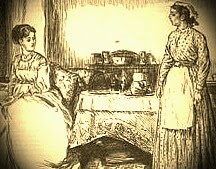
The greatest difficulty in organising a family establishment in Ohio, is getting servants, or, as it is there called, "getting help," for it is more than petty treason to the Republic, to call a free citizen a servant. The whole class of young women, whose bread depends upon their labour, are taught to believe that the most abject poverty is preferable to domestic service. Hundreds of half-naked girls work in the paper-mills, or in any other manufactory, for less than half the wages they would receive in service; but they think their equality is compromised by the latter, and nothing but the wish to obtain some particular article of finery will ever induce them to submit to it. A kind friend, however, exerted herself so effectually for me, that a tall stately lass soon presented herself, saying, "I be come to help you." The intelligence was very agreeable, and I welcomed her in the most gracious manner possible, and asked what I should give her by the year.


"Oh Gimini!" exclaimed the damsel, with a loud laugh, "you be a downright Englisher, sure enough. I should like to see a young lady engage by the year in America! I hope I shall get a husband before many months, or I expect I shall be an outright old maid, for I be most seventeen already; besides, mayhap I may want to go to school. You must just give me a dollar and half a week, and mother's slave, Phillis, must come over once a week, I expect, from t'other side the water, to help me clean." I agreed to the bargain, of course, with all dutiful submission; and seeing she was preparing to set to work in a yellow dress parseme with red roses, I gently hinted, that I thought it was a pity to spoil so fine a gown, and that she had better change it. "'Tis just my best and my worst," she answered, "for I've got no other."


And in truth I found that this young lady had left the paternal mansion with no more clothes of any kind than what she had on. I immediately gave her money to purchase what was necessary for cleanliness and decency, and set to work with my daughters to make her a gown. She grinned applause when our labour was completed, but never uttered the slightest expression of gratitude for that, or for any thing else we could do for her. She was constantly asking us to lend her different articles of dress, and when we declined it, she said, "Well, I never seed such grumpy folks as you be; there is several young ladies of my acquaintance what goes to live out now and then with the old women about the town, and they and their gurls always lends them what they asks for; I guess you Inglish thinks we should poison your things, just as bad as if we was Negurs." And here I beg to assure the reader, that whenever I give conversations they were not made À LOISIR, but were written down immediately after they occurred, with all the verbal fidelity my memory permitted.
                               
"I fear it may be called bad taste to say so much concerning my domestics, but, nevertheless, the circumstances are so characteristic of America that I must recount another history relating to them." Fanny Trollope, in her book "Domestic Manners of the Americans" 

This young lady left me at the end of two months, because I refused to lend her money enough to buy a silk dress to go to a ball, saying, "Then 'tis not worth my while to stay any longer." I cannot imagine it possible that such a state of things can be desirable, or beneficial to any of the parties concerned. I might occupy a hundred pages on the subject, and yet fail to give an adequate idea of the sore, angry, ever wakeful pride that seemed to torment these poor wretches. In many of them it was so excessive, that all feeling of displeasure, or even of ridicule, was lost in pity. One of these was a pretty girl, whose natural disposition must have been gentle and kind; but her good feelings were soured, and her gentleness turned to morbid sensitiveness, by having heard a thousand and a thousand times that she was as good as any other lady, that all men were equal, and women too, and that it was a sin and a shame for a free-born American to be treated like a servant.


When she found she was to dine in the kitchen, she turned up her pretty lip, and said, "I guess that's 'cause you don't think I'm good enough to eat with you. You'll find that won't do here." I found afterwards that she rarely ate any dinner at all, and generally passed the time in tears. I did every thing in my power to conciliate and make her happy, but I am sure she hated me. I gave her very high wages, and she staid till she had obtained several expensive articles of dress, and then, UN BEAU MATIN, she came to me full dressed, and said, "I must go." "When shall you return, Charlotte?" "I expect you'll see no more of me." And so we parted. Her sister was also living with me, but her wardrobe was not yet completed, and she remained some weeks longer, till it was.
             
The famous Georgian era painting, "Heads of Six of Hogarth's Servants," was seen as almost subversive in its day. It is unique among other paintings of the time, as the artist William Hogarth, chose to depict 5 servants of his household, in a manner more like those of the wealthier classes in the mid to late 1700s.  With the butler, closely surrounded by the others in the center of the painting, it depicts a close knit group. And it is just their heads depicted, as opposed to the servants performing their routine household duties. Thus, the artwork not only dignifies them, but humanizes them as well. The painting was displayed conspicuously in his estate home in full view of Hogarth's somewhat bemused guests, while at the same time the servants' facial expressions were purposely painted to convey all of the sincerity and deference expected of servant-class members of the era.
                   
I fear it may be called bad taste to say so much concerning my domestics, but, nevertheless, the circumstances are so characteristic of America that I must recount another history relating to them. A few days after the departure of my ambitious belle, my cries for "Help" had been so effectual that another young lady presented herself, with the usual preface "I'm come to help you." I had been cautioned never to ask for a reference for character, as it would not only rob me of that help, but entirely prevent my ever getting another; so, five minutes after she entered she was installed, bundle and all, as a member of the family. She was by no means handsome, but there was an air of simple frankness in her manner that won us all. 

For my own part, I thought I had got a second Jeanie Deans; for she recounted to me histories of her early youth, wherein her plain good sense and strong mind had enabled her to win her way through a host of cruel step-mothers, faithless lovers, and cheating brothers. Among other things, she told me, with the appearance of much emotion, that she had found, since she came to town, a cure for all her sorrows, "Thanks and praise for it, I have got religion!" and then she asked if I would spare her to go to Meeting every Tuesday and Thursday evening; "You shall not have to want me, Mrs. Trollope, for our minister knows that we have all our duties to perform to man, as well as to God, and he makes the Meeting late in the evening that they may not cross one another." Who could refuse? Not I, and Nancy had leave to go to Meeting two evenings in the week, besides Sundays.


One night, that the mosquitoes had found their way under my net, and prevented my sleeping, I heard some one enter the house very late; I got up, went to the top of the stairs, and, by the help of a bright moon, recognised Nancy's best bonnet. I called to her: "You are very late." said I. "what is the reason of it?" "Oh, Mrs. Trollope," she replied, "I am late, indeed! We have this night had seventeen souls added to our flock. May they live to bless this night! But it has been a long sitting, and very warm; I'll just take a drink of water, and get to bed; you shan't find me later in the morning for it." Nor did I. She was an excellent servant, and performed more than was expected from her; moreover, she always found time to read the Bible several times in the day, and I seldom saw her occupied about any thing without observing that she had placed it near her.


At last she fell sick with the cholera, and her life was despaired of. I nursed her with great care, and sat up the greatest part of two nights with her. She was often delirious, and all her wandering thoughts seemed to ramble to heaven. "I have been a sinner," she said, "but I am safe in the Lord Jesus." When she recovered, she asked me to let her go into the country for a few days, to change the air, and begged me to lend her three dollars. While she was absent a lady called on me, and enquired, with some agitation, if my servant, Nancy Fletcher, were at home. I replied that she was gone into the country. "Thank God," she exclaimed, "never let her enter your doors again, she is the most abandoned woman in the town: a gentleman who knows you, has been told that she lives with you, and that she boasts of having the power of entering your house at any hour of night." She told me many other circumstances, unnecessary to repeat, but all tending to prove that she was a very dangerous inmate. 


I expected her home the next evening, and I believe I passed the interval in meditating how to get rid of her without an eclaircissement. At length she arrived, and all my study having failed to supply me with any other reason than the real one for dismissing her, I stated it at once. Not the slightest change passed over her countenance, but she looked steadily at me, and said, in a very civil tone, "I should like to know who told you." I replied that it could be of no advantage to her to know, and that I wished her to go immediately. "I am ready to go," she said, in the same quiet tone, "but what will you do for your three dollars?" "I must do without them, Nancy; good morning to you." "I must just put up my things," she said, and left the room. About half an hour afterwards, when we were all assembled at dinner, she entered with her usual civil composed air, "Well, I am come to wish you all goodbye," and with a friendly good-humoured smile she left us.


This adventure frightened me so heartily, that, notwithstanding I had the dread of cooking my own dinner before my eyes, I would not take any more young ladies into my family without receiving some slight sketch of their former history. At length I met with a very worthy French woman, and soon after with a tidy English girl to assist her; and I had the good fortune to keep them till a short time before my departure: so, happily, I have no more misfortunes of this nature to relate.
 
          
Such being the difficulties respecting domestic arrangements, it is obvious, that the ladies who are brought up amongst them cannot have leisure for any great development of the mind: it is, in fact, out of the question; and, remembering this, it is more surprising that some among them should be very pleasing, than that none should be highly instructed. 

Had I passed as many evenings in company in any other town that I ever visited as I did in Cincinnati, I should have been able to give some little account of the conversations I had listened to; but, upon reading over my notes, and then taxing my memory to the utmost to supply the deficiency, I can scarcely find a trace of any thing that deserves the name. Such as I have, shall be given in their place. But, whatever may be the talents of the persons who meet together in society, the very shape, form, and arrangement of the meeting is sufficient to paralyze conversation. The women invariably herd together at one part of the room, and the men at the other; but, in justice to Cincinnati, I must acknowledge that this arrangement is by no means peculiar to that city, or to the western side of the Alleghanies.

Sometimes a small attempt at music produces a partial reunion; a few of the most daring youths, animated by the consciousness of curled hair and smart waistcoats, approach the piano forte, and begin to mutter a little to the half-grown pretty things, who are comparing with one another "how many quarters' music they have had." Where the mansion is of sufficient dignity to have two drawing-rooms, the piano, the little ladies, and the slender gentlemen are left to themselves, and on such occasions the sound of laughter is often heard to issue from among them. But the fate of the more dignified personages, who are left in the other room, is extremely dismal.

The gentlemen spit, talk of elections and the price of produce, and spit again. The ladies look at each other's dresses till they know every pin by heart; talk of Parson Somebody's last sermon on the day of judgment, on Dr. T'otherbody's new pills for dyspepsia, till the "tea" is announced, when they all console themselves together for whatever they may have suffered in keeping awake, by taking more tea, coffee, hot cake and custard, hoe cake, johny cake, waffle cake, and dodger cake, pickled peaches, and preserved cucumbers, ham, turkey, hung beef, apple sauce, and pickled oysters than ever were prepared in any other country of the known world. After this massive meal is over, they return to the drawing-room, and it always appeared to me that they remained together as long as they could bear it, and then they rise EN MASSE, cloak, bonnet, shawl, and exit.


From "Domestic Manners of the Americans," first published in 1832, by Frances 'Fanny' Trollope, 1780—1863 (Mother of the author Anthony Trollope)


Etiquette Enthusiast, Maura J. Graber, is the Site Editor for the Etiquipedia © Etiquette Encyclopedia