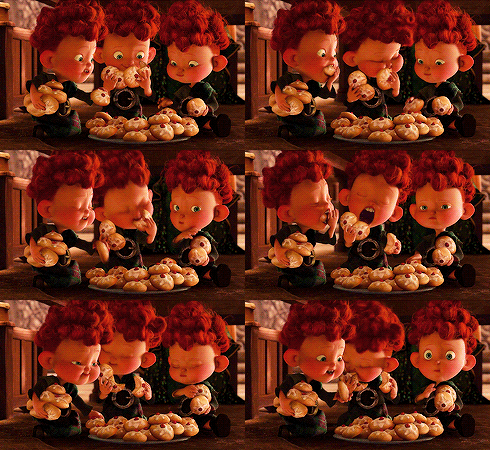
Showing posts with label Eating vs Dining. Show all posts

Monday, June 2, 2025

Gilded Age Etiquette of Eating

In taking your place at the table you should not get too close nor to far away. Some authorities say a foot is about the proper distance, but you may not desire to wait to have the measure taken, it is best to make sure that you get in reach of it. If you do not drink wine it is best not to deliver a temperance lecture to those who do. In partaking of fruits, such as oranges, cut them into small morsels before eating and never swallow them whole. – Above, 2 different types of gilded age silver “orange holders” from the book, What Have We Here?: The Etiquette and Essentials of Lives Once Lived, from the Georgian Era through the Gilded Age and Beyond... 

Almost any one can eat, but to eat according to the established rules of good society is another story. If you happen to discover that a great man eats pie with his knife, do not follow his example in the hope of acquiring greatness, for ten to one that is not how he came to be great.

The first thing to be considered is how to get to the table. In the rush it is considered bad form to get ahead of the ladies. Give them a chance. In taking your place at the table you should not get too close nor to far away. Some authorities say a foot is about the proper distance, but you may not desire to wait to have the measure taken, it is best to make sure that you get in reach of it. If you do not drink wine it is best not to deliver a temperance lecture to those who do. In partaking of fruits, such as oranges, cut them into small morsels before eating and never swallow them whole.

Never attempt to talk when the mouth is full If you are spoken to when in such a predicament it is best - provided you are not familiar with the deaf and dumb alphabet - to quietly and unostentatiously slip the morsel from your mouth and drop it under the table; but in case it be something you are loath to surrender, you might place it in charge of some reliable person till you have finished your discourse. In matters of this kind you will have to depend largely argely upon your own tact, as no iron-bound rules can be given.

Remember that you are not supposed to quit eating simply because you have gotten enough. You must have sufficient regard for the feelings of others to go on making a pretense at eating till all have finished. I have this from good authority. and though it may seem that if all adhere to this rule there would be no end to the feast - that it would result in an endless chain that would reach into the misty realms of futurity - yet experience has proved that there will always be one ill-bred person present who has no more sense than to quit when he gets enough, and so furnish a pretext for those of gentle breeding to bring the agony to a close. – Marysville Daily Appeal, 1898


🍽️Etiquette Enthusiast, Maura J. Graber, is the Site Editor for the Etiquipedia© Etiquette Encyclopedia 

Wednesday, March 17, 2021

Flatware for Informal Place Settings


“A few of the people you'll meet at every party. It will pay you to get along with them.” — It will also pay to know their names and primary uses so that you can easily “read” your place settings at luncheons and dinner parties.

Informal Place Setting Diagram —Only a luncheon or a very informal dinner setting will feature a cup, saucer and teaspoon. At formal dinner parties, coffee or tea are served away from the dining table. The service for coffee, tea or after dinner liqueurs, is brought out after the meal and usually served away from the table.


Eating is the one social activity common to everyone around the globe, but eating and dining are two different things. Practice dining when you are not in public and it will help you to avoid merely eating when among others.
“Table manners grew out of the fact that unless he is eating in a room empty of all but himself, a man eats in company and food is less appetizing if the other fellow's table manners are sloppy and disgusting. It matters little what sort of food is being served, whether the table is loaded with priceless silver and china or tin and graniteware; the simplest meal is made more attractive by the use of good table etiquette.”— From “Manners for Moderns,” 1938


Etiquette Enthusiast, Maura J. Graber, is the Site Editor for the Etiquipedia© Etiquette Encyclopedia


Tuesday, August 11, 2020

19th C. Washington Social Gluttons

Etiquette entitles any person who calls at an afternoon reception in an official household to any evening reception that may be afterward given therein, so that any shrewd gormandizer may make the rounds of Cabinet receptions at least once during the season, and thus obtain a good deal of gratuitous sustenance. I know a certain woman who, from motives of economy, lived off mush and milk last winter, but made up for plain living at home by eating her fill of dainties at cabinet receptions. She understood “the ropes” well enough to get plenty of invitations, and could tell exactly which delicacy each house was noted for.


Gourmandizing at Receptions

Overeating and overdrinking at receptions and parties are among the most common forms of ill-breeding, and the way in which some “swell” people gorge themselves at the supper table would make a cannibal blush. “Please get me another ice and some more wine jelly,” said a pretty girl sitting at my elbow the other night. Her escort looked at her empty plate in astonishment “Really, my dear,” he began, “I should think you would scarcely need anything more after eating four sandwiches, two salads, four creams, and—.” He didn’t finish the list for she checked him with a warning “hush-sh-sh!” Nevertheless he went over to the sideboard and swallowed in succession six glasses of wine, which had been poured out for somebody else. 

It is a fact that some people attack their host’s banquet board with the avidity of free-lunch fiends elbowing each other in the scramble for eatables, as if they were eating at a railway station instead of in a fashionable dining room, where time is no object. There are men and women in Washington who go to public receptions for the express purpose of stuffing themselves to their utmost capacity, and who think it a smart thing to fatten at other people’s expense. Indeed this abuse of hospitality has been carried to such excess by vulgar people that some of the Cabinet ladies last year dispensed altogether with refreshments at their afternoon receptions in order to keep out a crowd of hungry strangers who only called to eat and sup. 

Etiquette, however, entitles any person who calls at an afternoon reception in an official household to any evening reception that may be afterward given therein, so that any shrewd gormandizer may make the rounds of Cabinet receptions at least once during the season, and thus obtain a good deal of gratuitous sustenance. I know a certain woman who, from motives of economy, lived off mush and milk last winter, but made up for plain living at home by eating her fill of dainties at cabinet receptions. She understood “the ropes” well enough to get plenty of invitations, and could tell exactly which delicacy each house was noted for. “I must go to Secretary L—— ’s next week.” she would say, “he always has terrapin for suppers.” Or, “I do love to attend Secretary F—’s receptions; his cook makes the best salad I ever tasted.” — Weekly Calistoga, 1882


Etiquette Enthusiast, Maura J Graber, is the Site Editor for the Etiquipedia© Etiquette Encyclopedia

Sunday, June 7, 2020

Cannibalism in Polite Society

Now you can't help liking X.Y. when you first meet him, he is such a big, jolly, generous chap, always ready for any prank or amusement. But when, X.Y. eats, poetry and romance vanish and so does your appetite, owing to his almost ghoulish enjoyment of food and his utter absorption in the pursuit of it... If I dared I would tell this man that he is a cannibal; that his gross way of eating is an offense to society; that if he must gorge in such fashion, he should do so in private. If I dared, I would also warn him that any girl who thought of marrying him would think again if she sat opposite him at the table.
  
— Image source T&C Magazine


“A Glutton Is a Bore!” 
(and he’s eating up his social and dating life)
—————————————
What I Would  Tell A Man If I Dared
By A Pretty Girl


Now you can't help liking X.Y. when you first meet him, he is such a big, jolly, generous chap, always ready for any prank or amusement. But when, X.Y. eats, poetry and romance vanish and so does your appetite, owing to his almost ghoulish enjoyment of food and his utter absorption in the pursuit of it. “Isn't this soup just grand?” he would sputter, with his face, now suffused with a deep red, almost buried in the plate — and not a word of general conversation can be had out of him until every viand has been commented upon and consumed and the last sip of cordial swallowed. 

And X. Y. has made a science of restaurants. None of the cheaper ones ever know his presence, but his sighs of disappointment or explosions of anger over dishes that fail to bring back the first “fine careless rapture” of tasting them make you play never to be around when the “eats” are poor. He will surely burst with rage. The amount consumed equals the enthusiasm of the attack. An enormous beef-steak dinner before the play, signifies nothing. He will go to supper afterward with the zest of a starving man. If a dish is declined by any one, he growls: “Get into the game! Get into the game!”

If I dared I would tell this man that he is a cannibal; that his gross way of eating is an offense to society; that if he must gorge in such fashion, he should do so in private. If I dared, I would also warn him that any girl who thought of marrying him would think again if she sat opposite him at the table. X.Y. took a trip to Europe last summer, and, of course, rained picture-postals on his friends, as all travelers do. One of the girls wagered that they would be all restaurant scenes, and they were. He might be said to have eaten, his way over Europe. 

Out of him, on his return, could be pried no word pictures such as the others of his party painted, of wonderful snow-clad mountains, of quaint village scenes, of glimpses of royal splendor. Instead, he dwelt lingeringly on the vast “eats” he had encompassed. Venice was remembered as the place where he had chanced upon his favorite brew of beer. If I dared, I would say to this man, and to all others like him: “Don't think for a minute that anybody else cares what you ate or are going to eat, so if you want to be popular you’d better lift your eyes above your plate and see what there is in the world.”

I was taught, as most girls are, to regard eating, as a rite to be celebrated with conversation and laughter and with the utmost possible concealment of animal zest for food. Sometimes, when the humorous side of it strikes me, I feel like saying to my gourmandizing friend: “Oh, why do you show such spite against the little lamb in his bed of green peas or the little chicken smothered in gravy? I fear that some time you may devour me if dinner happens to be delayed or the meal turns out a failure, as meals sometimes will. In your passionate regard for food I scent a victorious rival. Adieu, Monsieur X.Y. Return to your muttons — alone.”— San Francisco Call, 1909


Etiquette Enthusiast, Maura J Graber, is the Site Editor for the Etiquipedia© Etiquette Encyclopedia

Tuesday, August 9, 2016

Etiquette and Dining vs Gobbling

There is a big difference between eating and dining. Eating ones food quickly, or gobbling ones food, causes much to be lost, not only in health, but in good manners and the companionship at the table. Dining is a way of leisurely savoring ones food, and enjoying ones company.

To eat fast is one of the bad habits of American people which we ought to avoid. If acquired in childhood, it will be hard to overcome, and will cause us much mortification when, later in life, we find ourselves with empty plates long before well-bred people in the company have finished theirs. 

Since we do not leave the table before others, there is nothing gained, even in time, while much is lost in health and in good manners. – From Edith E. Wiggin's 1884, “Lessons on Manners / For School and Home Use.”


Etiquette Enthusiast, Maura J Graber, is the Site Moderator and Editor for the Etiquipedia© Etiquette Encyclopedia