Showing posts with label Etiquette for Eggs. Show all posts

Tuesday, July 23, 2024

A Bone Egg Spoon?

While it’s true that silver spoons could leave a metallic taste in the mouth when mixed with eggs, there was always a gilded option. These two gilded sterling eggs spoons had been available for many years, however, they were very pricey. Bone egg spoons, on the other hand, at eight cents each were quite reasonable for the time period. — Pictured above are two European egg toppers, or egg cutters, an 
Ivy pattern, Gorham gilded sterling egg spoon, a Whiting sterling egg spoon with a gilded, engraved bowl in the Lily of the Valley pattern and a lovely, Herend egg cup. 
I am indebted to a Scotch friend for something that has become well-nigh indispensable to me-my EGG-SPOON. It is made of bone and was brought to me from Scotland. Its advantages are, first, that one gets no taste of metal in eating eggs, as is the case with a silver spoon; second, that there is no discolored silver to be cleaned afterward. Since it was given to me, I have bought others for my family at one of the New York department stores for eight cents each, so they are within the reach of anyone who is interested. - B. F. S., New Jersey in Good Housekeeping, 1912


🍽Etiquette Enthusiast, Maura J. Graber, is the Site Editor for the Etiquipedia© Etiquette Encyclopedia


Saturday, June 11, 2022

Egg Spoons and Egg Etiquette


Erasmus, in his treatise on manners, de civilitate morum puerilium (On the Civility of the Behavior of Boys), 1530, warned against cleaning out the shell's contents with the fingers or tongue.— Figure 74 from the Tiffany Silver Flatware book—A selection of egg spoons with gilded bowls in Tiffany full-line patterns. Left to right: Vine (iris), 4in.; Lap Over Edge, 4 in.; Persian, 4 in. The egg-shaped bowl of the Lap Over Edge specimen is standard. The shield-shaped bowl of the other two examples is unusual.


The soft-boiled egg has been a favorite food for a long time but before the appearance of egg cups and spoons presented problems as to how it should be eaten. Erasmus, in his treatise on manners, de civilitate morum puerilium (On the Civility of the Behavior of Boys), 1530, warned against cleaning out the shell's contents with the fingers or tongue. Apparently the use of a small knife was acceptable, as was dipping small pieces of bread into the egg. 

Italians at one time were given to drinking a barely heated egg right out of its shell. At first, egg spoons were used not to eat the egg directly but to transfer the semi-liquid contents to a plate, where it was mashed with butter, or to a glass, from which it was drunk.

Egg spoons have always been appropriately small, usually about 4 to 5in. in length, but the shape of the bowl has varied. Some bowls are very slightly oblong, others almost pear-shaped. Still others are shield shaped. 

The most commonly-observed Tiffany egg spoon bowl is egg-shaped, but the bowl of what we think is the egg spoon in some of the early patterns has a shield shape. Bowls of egg spoons are usually gilded to protect against discoloration from the sulfur in yolks. The handle on Tiffany's egg spoon is that of a large coffee spoon.

In the eighteenth and nineteenth centuries, egg spoons and cups were often part of an egg cruet, or egg stand, sometimes surmounted by a salt cellar. Tiffany made these, along with silver or silver-plated egg boilers, or coddlers.— Tiffany Silver Flatware- 1845-1905- When Dining Was an Art, 1999


🍽Etiquette Enthusiast, Maura J. Graber, is the Site Editor for the Etiquipedia© Etiquette Encyclopedia

Saturday, August 1, 2020

More Gilded Age Etiquette Humor

During the Gilded Age, much humor was made in newspapers and magazines regarding the niceties of fine dining and wealth. Especially, those in the royal palaces and grand manor houses of the aristocracy and monarchies in Great Britain and Europe, all while a sham aristocracy was growing among the titans of industry in America.
—————
“The custom of drinking out of the finger bowl, though not entirely obsolete, has been limited to the extent that good breeding does not permit the guest to quaff the water from his finger bowl unless he does so prior to using it as a finger bowl. Thus, it will be seen that social customs are slowly but surely cutting down and circumscribing the rights and privileges of the masses.”


Valuable Suggestions as to the Use of the Napkin and Finger Bowl

It has been stated, and very truly, too, that the law of the napkin is but vaguely understood. It may be said, however, on the start, that customs and good breeding have uttered the decree that it is in poor taste to put the napkin in the pocket and carry it away. The rule of etiquette is becoming more and more thoroughly established, that the napkin should be left at the house of the host or hostess after dinner. There has been a good deal of discussion, also, upon the matter of folding the napkin after dinner, and whether it should be so disposed of, or negligently tossed into the gravy boat. 

If, however, it can be folded easily, and without attracting too much attention and prolonging the session for several hours, it should be so arranged, and placed beside the plate, where it may be easily found by the hostess, and returned to her neighbor from whom she borrowed it for the occasion. If, however, the lady of the house is not doing her own work, the napkin may he carefully jammed into a globular wad and fired under the table, to convey the idea of utter recklessness and pampered abandon. The use of the finger bowl is also a subject of much importance to the bon ton guest who gorges himself at the expense of his friends.

The custom of drinking out of the finger bowl, though not entirely obsolete, has been limited to the extent that good breeding does not permit the guest to quaff the water from his finger bowl unless he does so prior to using it as a finger bowl. Thus, it will be seen that social customs are slowly but surely cutting down and circumscribing the rights and privileges of the masses. At the Court of Eugenie, the customs of the table were very rigid, and the most prominent guest of H. R. H. was liable to get the G.B. if he spread his napkin on his lap and cut his egg in two with a carving knife. The custom was that the napkin should he hung on one knee and the egg busted at the big end and scooped out with a spoon. 

A prominent American at her table one day, in an unguarded moment, shattered the shell of a soft boiled egg with his knife, and while prying it apart, both thumbs were erroneously jammed into the true inwardness of the fruit with so much momentum, that the juice took him in the eye, thus blinding him and maddening him to such a degree that he got up and threw the remnants into the bosom of the hired man plenipotentiary, who stood near the table, scratching his ear with a tray. As may readily be supposed, there was a painful interim, during which it was hard to tell for five or six minutes whether the prominent American or the hired man would come out on top, but at last the American with the egg in his eye got the ear of the high priced hired man in among his back teeth, and the honor of our beloved flag was vindicated. —Bill Nye’s Boomerang, 1882


Etiquette Enthusiast, Maura J Graber, is the Site Editor for the Etiquipedia© Etiquette Encyclopedia

Friday, September 15, 2017

Table Etiquette of 1899


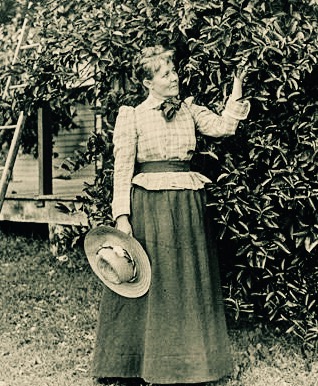
Mary Barr Munroe was a Miami pioneer who contributed much to the community life of Coconut Grove. Mrs. Munroe founded the southern Tropical Audubon Society. As a member of the Florida Federation of Women's Clubs, she was instrumental in the establishment Royal Palm Park (later the Everglades National Park.) Mrs. Munroe also started the Coconut Grove Library in 1895 and taught many children in Coconut Grove how to read. She strongly believed, and proved, that women can make a great difference.
Helpful Hints on the Uses of Knives, Forks, Spoons and Fingers
Those who are very particular, hold the large end of a spear of asparagus with a fork, while with the tip end of a knife they daintily separate the tender green tops from the white end, which is then put aside. Others take the white end between the fingers and carry it to the mouth. Both are correct, but the former is much more dainty and easily done. 

The etiquette of eating a soft boiled egg has been the subject of more than one clever essay. The English custom is to eat it directly from the shell, when of course a small egg cup and egg spoon are necessary. The American way is to break the egg into a cup or glass by striking the egg in the center and turning the contents into the glass. In this case it is usually eaten with a teaspoon, as an egg spoon, unless extra large, would be too small, and we have seen the egg held by a corner of the napkin, but this is not only tiresome but difficult to do nicely without soiling the napkin. 

Celery is always taken from the dish and carried to the mouth by the fingers. If individual salts are not provided, it is etiquette to use one half of the butter plate for salt. If salt shakers are used, hold the celery in the left hand just over the rim of your plate and gently sprinkle it with salt, and the old custom of putting a spoonful of salt on the cloth is still in practice. 

When corn is served on the cob it must be taken in the fingers, only managed very daintily. We have seen pretty little doylies for the purpose of holding it, but it is a question if that is not carrying table linen too far. Many housekeepers, and especially in the south, serve corn as a separate course, when finger bowls are placed by each plate and removed with the course. 

Lettuce when served without dressing is always pulled to pieces with the fingers. This is usually the lady’s duty and there is no prettier picture than that of a young lady preparing a plate of fiesh, crisp lettuce leaves in this way, for the tender green shows off to perfection her dainty white hands and she may be as exquisitely neat about it as she likes, and it is one of the most fascinating and becoming of table duties that a hostess can possibly provide for her lady guests, to assist in helping the gentlemen at a social or informal meal. 

Watercress is also taken in the fingers and the prettiest way of serving it is to obtain a long low sided basket or dish, in the bottom of which lay a folded napkin, then heap the cress so as to fill the basket and you have not only an enjoyable, but a very ornamental dish for the breakfast table. 

When a slice of lemon is served with fish or meat it is much more correct to take the slice in the fingers, double the ends together and gently squeeze the juice over the article than to use a knife for that purpose, as is sometimes done. It is always proper to help one's self to bread, cheese and lump sugar, if tongs arc not provided, with the fingers. 

Never use your own knife, fork or spoon to take from the dish. It is also correct if a plate of hot, unbroken biscuits is passed, to not only break off for yourself with your fingers, but for your neighbor also. When things are passed, help yourself as quickly as possible, for you must not keep others waiting and never insist on some one else being served before you, if the host or hostess has honored you first. —Mary Barr Munroe in Good Housekeeping, 1899

Etiquette Enthusiast, Maura J. Graber, is the Site Editor for the Etiquipedia© Etiquette Encyclopedia 
Friday, June 17, 2016

A Fateful Breach of Etiquette

Charles Augustin Sainte-Beuve was a literary critic of French literature, but evidently not a student of Tuileries' exacting etiquette.


Under the French Third Republic, Charles Augustin Sainte–Beuve brought disgrace upon himself because at breakfast at the Tuileries, he carelessly opened his napkin and placed it over his two knees. To this, he added the crime of cutting his egg in two, at the middle.

Court etiquette prescribed that the half-folded napkin should be on the left knee, and the top of the egg was to be merely broken with the edge of the spoon and drained with the tip of the spoon. For his failings in these respects, Sainte–Beuve's name was struck off the Imperial visiting list. — London Chronicle, 1909


Etiquette Enthusiast, Maura J Graber, is the Site Editor for the Etiquipedia© Etiquette Encyclopedia 

Saturday, July 4, 2015

Etiquette Advice from 1910

True courtesy consists not in forms alone, but in forms made living by the spirit of goodwill, are facts that we have much lost sight of in our admiration of fashion and wealth... ~ Gilded age table top silver and gilt fashions for the serving of eggs at breakfast, from 1910

The Morning “Chit-Chat”

When the question of a certain point of etiquette arose among a group of us the other night the lady who always knows somehow, spoke up: “This is the way it looks to me," she said, and we all listened, as we always do when this sweet oracle speaks. “This is the way it looks to me. I think you should go first because that's the common sense way, and a teacher I had once told me that if I were ever in doubt about any point of etiquette to think ‘which is the common sense’ way, and let that decide it. ‘For every point of etiquette,’ he said, ‘No matter how foolish it seems, is built originally on some good reason, and often you can find out the proper thing to do by looking for the reason.’”

Doesn't that appeal to you as a pretty good test to apply when you are in an etiquette quandary? It does to me. And here's another. When you are in doubt as to which of the two things is proper to do, do the kinder and it's 10 to 1 you will be doing the right one. I know a little country girl who, when she dined for the first time at a stylish city home, was very much puzzled as to whether she ought to say, "Thank you" when the maid bought the serving of soup around to her place.

She decided that it would seem countryfied to do so, and received her plate in silence. She says she will never forget the flush of shame that swept over her when the mistress of the home thanked the maid, as she received her plate. If the little girl had done the kinder thing, she would have done the right thing, and she says she will never again depart from that criterion.

Speaking of that incident reminds me, by the way, of a home at which I visit, where it is the invariable custom for the master of the house, no matter what guests are present to serve the mistress of the house first. In this way she sets the example when there's any doubtful point of table etiquette, so that all her guests need to do is watch her. Isn't that an exquisite bit of thoughtfulness? To me, it seems a custom that ought to be adopted everywhere.

That there can be no really good manners without the goodness of heart, and that true courtesy consists not in forms alone, but in forms made living by the spirit of goodwill, are facts that we have much lost sight of in our admiration of fashion and wealth, but they are sterling facts just the same.

Let me commend to the young person who wants to be well-bred. Lord Chesterfield's most excellent definition of good breeding: “Good breeding is a combination of much sense: some good nature, and a little self-denial for the sake of others, with a view to obtain the same indulgence from them.” —Ruth Cameron, 1910


🍽️Etiquette Enthusiast, Maura J. Graber, is the Site Editor for the Etiquipedia© Etiquette Encyclopedia