Showing posts with label Alcohol and Etiquette. Show all posts

Monday, March 2, 2026

How to Handle a Date with a Lush

When your date overdoes it on his alcohol consumption, to the point that you are steaming and seething at the table, you still have an obligation to be polite and mind your table manners while in public. (Take those elbows off the table) You are not required, however, to be a doormat or put your life in peril by accepting a ride home with him driving!

An Etiquipedia Q & A

As the Etiquipedia Site Editor I get many questions from readers. Here is a recent question from one disappointed young woman:

Q. I hope you have etiquette advice that can help me. I’m a fairly successful young woman. I pride myself on my figure and have worked hard to be a nicely dressed and pleasant date. I have had a few long term relationships, but have not found anyone yet I would like to really form a stronger and longer bond with until recently. A guy I know from my job (not a co-worker) asked me out to a very nice restaurant that I have long wanted to eat at. The date was really great until he started drinking before our dinner arrived. He must’ve had 3 or 4 drinks while I was still sipping my one glass of wine. I was trying to be a pleasant date despite his boozing throughout the meal, but I became embarrassed by his behavior and without him realizing it, called for an Uber to take me home. Did I handle this properly? My friends all tell me I over reacted and was rude. Was I? What should I do if this happens again?

A. Sadly, I understand and can empathize with your predicament, as I found myself on a few similar dates many years ago when I was single. Did you overreact? No. Especially if your date was very noticeably drunk. He was out on a date with his drink of choice, not with you. If he offers an apology, it’s your obligation to accept the apology politely, but think twice before accepting a second date. 

Now, regarding your Cinderella vanishing act… Were you rude? Yes. You get points for trying to make the most of a crummy situation, but to not in some way let your date know that you were seeking alternate transportation home was a faux pas. Whether or not he would have remembered you told him is immaterial. But, it was a social obligation on your part only to notify him. It was not, however, an obligation to ride home in a car being driven by someone drunk. 

If there is ever a next time, perhaps you can tip a restaurant employee on your way out, and ask him or her to inform your date of your sudden exit. It is the polite thing to do and your behavior cannot then be called into question.


🍽️Etiquette Enthusiast, Maura J. Graber of The RSVP Institute of Etiquette, is the Site Editor of the Etiquipedia© Etiquette Encyclopedia

Monday, January 22, 2024

Enjoying Faux-Champagne Taste

“If you must drink with repeal, here’s how!” – A lovely friend, Lorrie, found this news clipping in with her late-mother’s belongings. The Repeal of Prohibition in the United States was official on December 5, 1933. If during those long, supposedly dry years of Prohibition you had forgotten the proper etiquette for serving a variety of alcoholic beverages, or had never learned how in the first place due to your youth, this handy guide was available to help. – Image source, @dish_diva on Instagram

 “Wise” New York of 1926

Professedly worldly-wise residents of New York have been paying from $15 to $80 a quart for a mixture of bicarbonate of soda and cheap wine, according to an exposure which is carried on the first page of the New York World. In the belief that champagne is the only drink which has defied the bootlegging chemists, habitues of the night clubs have spent huge sums to make wealthy a crew that works in the cellars of Mulberry street turning out a very cheap imitation, “From the moment the short, eagle-beaked wine master, imported from Bordeaux to a cellar In the Bronx, dips his finger into his mixture pf bicarbonate of soda and Mulberry street wine, tastes it, and finds it good or good enough – until it passes down the throat of the salve night club patron,” says the World, “but a few days have intervened.”
The stuff must be sold quick or the cork would not pop and the bubbles would have disappeared. The sophisticates pay $30 a bottle for pop and bubble done up with a French label and dated 1911. “At least four cellar plants,” continues the World in its exposure, “protected by heavy steel doors and the apparent indifference of the authorities, are producing champagne.” There may well be more. The four alone have a capacity production of 550,000 gallons a year, or half again as much as was imported from France before prohibition. – The Tribune, 1926


🍽Etiquette Enthusiast, Maura J. Graber, is the Site Editor for the Etiquipedia© Etiquette Encyclopedia

Sunday, January 21, 2024

Prohibition Glassware Etiquette


This beer glass flair seems to represent the only outstanding novelty in the Christmas trade. The fancier stores have devoted their purchasing attention to this department to the exclusion of all others which probably provides a commentary on current modes, manners and thought.
“The Prohibition Era began in 1920 when the 18th Amendment to the U.S. Constitution, which banned the manufacture, transportation and sale of intoxicating liquors, went into effect with the passage of the Volstead Act. Despite the new legislation, Prohibition was difficult to enforce. The increase of the illegal production and sale of liquor (known as “bootlegging”), the proliferation of speakeasies (illegal drinking spots) and the accompanying rise in gang violence and organized crime led to waning support for Prohibition by the end of the 1920s. In early 1933, Congress adopted a resolution proposing a 21st Amendment to the Constitution that would repeal the 18th. The 21st Amendment was ratified on December 5, 1933, ending Prohibition.” -History.com

The Trend In Gifts, Manners and Modes of 1932


IN THE PRE-PROHIBITION days, the old saw about the man with the beer salary and the champagne appetite, had a point that appears to have been lost in the dry years. Certainly, the lowly juice of the malt that was once content to rest in a growler or a thick-bottomed glass mug wouldn't be able to understand what this old world has come to, were it to return to earth by grace of Congress, I took a turn around the stores last week and discovered that most of them had well equipped bars featuring glasses for beer and that the majority of the novelty sales were taking place in these nooks. And what beer glasses! 

Ornate tumblers in many colors and styles, representative of the highest art of the glass blowers, objects of art that made the once swagger steins look tawdry and cheap by contrast. And the prices being asked! Some of us old-timers gathered around one synthetic bar and reminisced on the situation and it was the consensus that time was when a barrel of beer could have been purchased for the price of two of the 1932 serving glasses, Curiously enough, this beer glass flair seems to represent the only outstanding novelty in the Christmas trade. The fancier stores have devoted their purchasing attention to this department to the exclusion of all others which probably provides a commentary on current modes, manners and thought. 

It was something of a contrast to leave these emporiums and go ont to the auction rooms where the Hill Smith treasures were being sold to the elite of San Francisco and the pick of the dealers. Those who had the good fortune to be Smith guests up Rio Vista way before the crash, remember well the fine dining room equipment. The Smith collection of glassware and coffee cups was noted throughout the district. Few were able to set a table more complete in detail. Yet the collection brought virtually nothing on the auction block. 

I saw handsome gold spun coffee cups, masterpieces of the art of china decoration, that cost as much as $40 apiece, go for $2. Oriental rugs that retailed at $6500. having difficulty reaching a $300. mark and imported furnishings selling for a song. I think the chief lesson to be learned from the auction rooms is not that there is a dearth of money in the community but that we have learned to become hard bargainers and our Yankee thrift is finally finding its way to the surface.– Oakland Tribune, December, 1932


🍽Etiquette Enthusiast, Maura J. Graber, is the Site Editor for the Etiquipedia© Etiquette Encyclopedia

Saturday, April 16, 2022

Etiquette and “The Wine Question”


“The hostess who simply does not offer wine to any guest under any circumstances, is using her influence effectively and courageously in the cause of temperance…” — The temperance movement began in the U.S. in the early 1800s. It was created in an attempt to limit drinking alcohol. The movement combined the concern for general social ills with religion and practical health concerns. Done in this manner, temperance was appealing to many in the middle-class who were interested in reform.

The wine question is one that disturbs many a dinner-giving family. Shall wine be served or not, is a growing problem. Society has at last reached the point where it is not considered a breach of good form to serve a dinner without wine. Such a course is sanctioned by the example of many high social leaders; and when it is the result of a temperance principle it has the respect of every diner-out. 

No lady or gentleman will find fault with the absence of wine at his host’s table. It is good form for a host to serve or not serve wine, just as he chooses. Apollinaris can be made to take the place of stronger waters, and no embarrassment follow. The hostess who simply does not offer wine to any guest under any circumstances, is using her influence effectively and courageously in the cause of temperance and in support of Christian principles.— G. H. Sandison in How to Behave and How to Amuse, 1895


Etiquette Enthusiast, Maura J Graber, is the Site Editor for the Etiquipedia© Etiquette Encyclopedia

Wednesday, March 23, 2022

Etiquette for Cocktail Parties

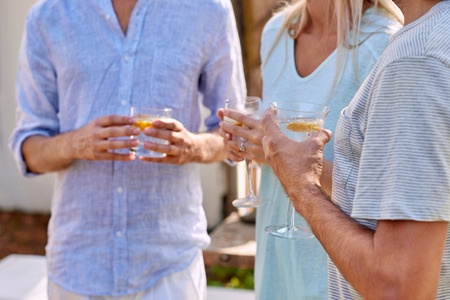
 Be the Best Cocktail Party Guest

Casual Cocktails

A cocktail party is the classic social gathering.  At what other time, in a single location, is it plausible to find a sparkle of romance, business deals made, and social standing elevated - or plummeted?

But no matter the goings on, there is always one constant:  the level of decorum expected from each guest.

It begins with your arrival.  Since cocktail hour isn't a sit-down affair, it is fine to arrive after it begins, but never early.  A host is usually fine-tuning food, drinks, and set-up well into the last minute.  Your early arrival will only escalate the frenzy.

Remember Your Limit

Just because it's a party doesn't mean you can totally cut loose.  Know your drink limit before you arrive.  If you're attending primarily for networking purposes, one or two drinks is an appropriate maximum.  

Over-indulging is a good way to invite trouble to any gathering.  A host's nightmare!
No one wants a drunk guest falling down a staircase, hitting on a VIP - or any guest for that matter, or falling asleep in the onion dip.

If you find yourself sipping a little too hurriedly, switch to water or soda.  

And if you don't drink, having water or a non-alcoholic beverage in your glass works perfectly well as you go about the party mingling and meeting new people.  After all, isn't that why you came? 

Cocktail Party Boundaries

For some people, cocktails are like truth serum with a permission slip to talk to anyone who will listen.  

Be very careful here!  People remember more than you may think, and you never know which sober guest may overhear you and spread the word.  

Keep all cocktail party conversations civil and never divulge anything you wouldn't be willing to place on a billboard.

Also, keep courtesy intact when mingling with V.I.P.'s:

  • Avoid monopolizing a VIP's time.  If you engage in one-on-one conversation, invite others to join in after a few minutes.
  • Address with respect at all times.  If you call him Mr. Mayor at Chamber of Commerce meetings, don't call him Bill at your neighbor's party.
  • You're treating everyone as a VIP if you respect their time!

Time to Leave

If you arrived a bit late to the party, don't assume it's okay to stay late as well.  
When guests begin to filter out, it's probably time for you to go, too.  

But no matter what time you leave, thank your host and follow up with a thank you note, or an email if that feels appropriate. 

The Best Guest

The best guest on any occasion is mindful, helpful, and cheerful.  The "etiquette-ful" guest practices the art of putting others first while being true to personal values. 


She notices when a newcomer needs to be introduced around and is happy to meet the challenge.  

If ice is running low, or the hors d'oeuvre tray needs refilling, he takes care of it - or offers to.

There is never a lack of good cheer when an ideal guest is in attendance.  Conversation is always positive and smiles abound.


 Contributor, Candace Smith is a retired, national award-winning secondary school educator, Candace Smith teaches university students and professionals the soft skills of etiquette and protocol. She found these skills necessary in her own life after her husband received international recognition in 2002. Plunged into a new “normal” of travel and formal social gatherings with global leaders, she discovered how uncomfortable she was in many important social situations. After extensive training in etiquette and protocol, Candace realized a markedly increased confidence level in meeting and greeting and dining skills and was inspired to share these skills that will help others gain comfort and confidence in dining and networking situations. Learn more at http://www.candacesmithetiquette.com/

Etiquette. Enthusiast, Maura J Graber, is the Site Editor for the Etiquipedia© Etiquette Encyclopedia 


Tuesday, November 12, 2019

Cocktails and Being Well Bred

The guests consumed a great deal more liquor than the hostess expected. After the last guest left, she found three cigarette holes in the carpeting and one bad burn the length of a cigar on the fireplace mantel. – On a side note, the gloved woman to the far right should not be gloved while drinking. That is simply “tacky.” – photo source Pinterest


Agony Aunt, Ann Landers, Gives Her Thoughts on Being “Well Bred” vs Being Polite
Dear Ann: I know your column does not deal with problems of etiquette, but this falls in the category of human relations. Please suggest what I should do. We gave a party last evening for fifty friends. It was a cocktail affair with an informal buffet. Everyone seemed to be having a fine time, although I must say they consumed a great deal more liquor than we expected. After the last guest left, I found three cigarette holes in the carpeting and one bad burn the length of a cigar on the fireplace mantel.  
Only one man could have burned the mantel and I know very well who he is. I have a hunch about the holes in the rug, too. Shall I phone these people and suggest they do something about “making, this right”? Bear in mind, our friends are all people of means who have had good upbringings. In fact, they are considered very well bred. –Upset Hostess

Ann’s Answer: Don’t call your friends and suggest that they pay for damages done during a party. This is just further proof that even the “well-bred” have a tendency to get crumby when they drink too much. When you invite guests to your home, you naturally assume they will not devalue the property. When “well-bred’’ people do damage, they offer to pay for it. Why don’t you review your guest list for next time. – Ann Landers, 1958


Etiquette Enthusiast, Maura J Graber, is the Site Editor for the Etiquipedia© Etiquette Encyclopedia

Wednesday, September 11, 2019

Etiquette in Post-Prohibition America

The dinners that used to call for long wine lists are also “out.” If you were to serve hors d’oeuvres, oysters, soup, fish, entree, salad, roast, sorbet, game, compote, cheese, pudding, fruit and nuts, each course with the appropriate accompaniment, how many of your guests would eat it all? In these days of dieting, nobody! We have simplified eating. The truly sophisticated long ago simplified drinking, also. 

Some Thoughts on the New Rules After Prohibition 

Don't believe all they tell you about the etiquette of serving a large variety of wines at the same meal. That was already “out” long before prohibition. In fact, the dinners themselves that used to call for long wine lists are also “out.” If you were to serve hors d’oeuvres, oysters, soup, fish, entree, salad, roast, sorbet, game, compote, cheese, pudding, fruit and nuts, each course with the appropriate accompaniment, how many of your guests would eat it all? In these days of dieting, nobody! We have simplified eating. The truly sophisticated long ago simplified drinking, also.

Instructors in alleged etiquette are urging you now not to serve more than two cocktails before dinner. Why two? If the purpose is an appetizer and a preliminary ceremonial, one will serve that better than two. If the purpose is to “tank up” why do that at a civilized meal in a civilized friend's house? That crudity should be relegated to the memories of the bootleg era. There are rougher places to do it, where you will offend nobody but yourself.

Also, since wine is now legal and legitimate, and California has a monopoly of the production of true wine in America, why not civilize our wine business, and teach the American people the civilized consumption of our wines. That means first producing some superfine wines, and popularizing them. No country can have more than a relatively small fraction of wines of the highest grade, but it is on these that the reputation of the rest depends. French wines stand high, not because all of them are good – most of them are ordinary, but because the best are the finest in the world. California can, and does produce some fine wines, also. Let us make them known.

And let us rid the American people of the inferiority complex, which makes us think the only wines to serve with pride are foreign ones. Germans prefer to serve German wines; French, French ones, and Italians, Spaniards, Greeks and South Africans their own wines. It is from England, where all the wines have to be imported, that we copy the idea of using only imported wine America, so long as California is in it, does not need to depend on the outside world. French wines, like French perfumes and French silks, have their luxury place. But let the wines of America hold the place in America which the wines of Italy have always held in Italy.

Let there, too, be a larger production of well-aged standard wine not the commercialized quick turnover, for the cheapest market, but something which, without being a luxury in price, can take its place as a standard article of American consumption, in whose quality and reputation we may take a just pride. And let there be places, all over the country, where good California wines are sold as such, and lists on every first-class hotel menu of the finer California wines. If Americans are going to drink, let them drink our product.

Finally, let the vulgarity be eliminated from American manners of thinking that “buying wine” is the way to splurge, and that “wine,” for that purpose, means champagne. Champagne has its place, to be sure though, to the sophisticated wine drinker it is a secondary one but wine, as the most civilized of alcoholic beverages, and the one whose chief function is social, is made neither for intoxication nor for display. If you must get drunk, do it on booze but not in a civilized house. If you must splurge, buy orchids. If you would make a good dinner better, do it with the Scriptural “a little wine, for thy stomach's sake” and make it “little.” This is all about drink. Since nearly all the other columns in all the papers are full of it, why not this one? - Philadelphia Evening Bulletin, Dec. 7, 1933

Etiquette Enthusiast, Maura J Graber, is the Site Editor for the Etiquipedia© Etiquette Encyclopedia

Sunday, December 27, 2015

Etiquette Outside of Prohibition

Partying like it's 1922


Imbibing Outside US' 18th Amendment

From the alcoholic beverages of the chafing-dish supper to those of the dinner is a natural transition. At the formal dinner wines often accompany the courses and, as already mentioned, liqueurs and cordials supply the final liquid note after the coffee. The theory of alcoholic beverages at the formal dinner is a simple one. Certain fixed and definite rules obtain and are generally observed. Three wines may be served, though the best social form prefers one or two.

Sherry or Madeira

Sherry or Madeira may accompany the soup course. They should be poured after the soup has been placed, and served from a decanter. In general wine should always be poured slowly, and glasses should be filled only two-thirds. The etiquette is for the waitress to pour a little wine into the host's glass, then filling the glasses beginning at the host's right. Sherry should always be served cold, at a temperature of 40° Fahrenheit; the Madeira may be served at a temperature of 65°F, or that of the room.

Sauterne or Rhine Wine

Sauterne or Rhine Wine go with the fish course. They are poured, like the Claret, at the end of the preceding course, before the next course comes on. They (like Sparkling Burgundy and Champagne) are served from the bottle, and the bottle should be held in a folded napkin or bottle holder. The mean average temperature of Sauterne should be 50°F. Some prefer it decidedly cold (chilled in the icebox), others only slightly cold. Rhine Wine should always be cold: 40°F.

Claret

Claret is the wine for the entree and, as a rule, is served from a claret pitcher. Being a light wine, it may be served with the Champagne and instead of it to those who do not prefer the Mumm. Claret should be poured at the end of the course immediately before the one with which it is served. The room temperature or one of 65°F is the proper one for Claret.

Champagne, Burgundy or Port

These wines are served with the meat courses. In order that Champagne or Sparkling Burgundy may come on the table at the proper temperature (Champagne 35° and Burgundy 70° F) it must be ice-packed for several hours before serving. Care must be taken, however, that it does not frappe when, if required at short notice, it is salt-and-ice packed half an hour before serving. 

Sweet Champagne, on the other hand, is improved in flavor if slightly frappeed. It should always be served very cold. Like Sauterne, Champagne and Burgundy are served from the bottle. In serving them the wire should be cut, and the cork carefully worked out of the bottle by pressing it up with the thumbs. It is wise to work out the cork under the edge of the table, since it is sometimes projected with much power. The temperature for Port is 55° F.

Cordials and Liqueurs

Cordial glasses holding a small quantity are used for serving these sweet, aromatic beverages. Cordials are served plain, with crushed ice or with cream. In serving Creme de Menthe the straw is unusual in private home service, though customary in some hotels. Creme de Menthe glasses should be filled two-thirds full with fine crushed ice, then a little of the cordial poured over it. Chartreuse (green or yellow), Benedictine, Grenadine, Apricot Brandy, Curacoa, and Dantzig Eau de Vie arc usually served without additions or ice. 

Benedictine or Creme de Cacoa, however, may be served with a dash of plain or whipped cream. The exceedingly sweet Creme Yvette should he served with cracked ice, like Creme de Menthe. Noyau, Kirschwasser, Maraschino and Grenadine may be served as cordials, or reserved for the flavoring of puddings, ices and sauces.—From Lillian B. Lansdown's, 1922 “How to Prepare and Serve a Meal; and Interior Decoration” 


🍽Etiquette Enthusiast, Maura J. Graber, is the Site Editor for the Etiquipedia Etiquette Encyclopedia