Showing posts with label Etiquette for Dessert. Show all posts

Tuesday, May 3, 2022

Gilded Age Savories and Desserts

 It has always been poor manners for a guest to take more than his or her share of the foods offered.– “One American young woman, given the honor of dining at the Tsar’s table, was very embarrassed when she clipped off a grape stem with some ten or twelve grapes. Everyone else was careful to take only two or three. She received many hard looks from the other ladies for her greed.” -Above is shown an 1880’s butterfly design pair of grape shears. These were also marketed as “flower shears.” 


The Savory Course

The savory was seen as the last chance to whip up the jaded appetite for the end of the meal. It consisted of some extremely tasty food served as a sort of appetizer before the last course of the meal— the dessert course.

This course was normally dropped from American Victorian meals, which instead featured two types of sweet foods. The sweet course was often a pudding or cake. Then ice cream was served as the savory. The English moved this course to the end of the meal, following the dessert. They often served anchovies, which seems very odd to Americans today who are used to ending a meal on a sweet note. The French often served cheese as their savory course, or would combine the cheese with the fruit of the dessert course.

The Dessert Course

Dessert in the French tradition meant “fruit.” Fruit for many years was one of the few sources of a sweet taste. By the seventeenth century sugar from sugarcane was available, although at a high price, but the tradition of serving fruit at the end of the meal remained common.

With fruit becoming more common and less important as a source of sugar, the method of showing status in the dessert course changed. Upper-class Victorians gloried in serving fruit in winter. This serving of fruit out of season showed that the host had gone to the expense of buying fruit shipped in from southern areas (which in the early days before refrigerated box cars and ships bespoke expense because of the large waste due to spoilage) or grown in local hot houses. 

To serve grapes, oranges, and so on while the snow laid high on the ground outside was a sign of wealth and taste. The Tsars often showed their wealth and power in this way. But, even the wealth of the tsars had limits. One American young woman, given the honor of dining at the Tsar’s table, was very embarrassed when she clipped off a grape stem with some ten or twelve grapes. Everyone else was careful to take only two or three. She received many hard looks from the other ladies for her greed. – From Forgotten Elegance, 2002


Etiquette Enthusiast, Maura J. Graber, is the Site Editor for the Etiquipedia© Etiquette Encyclopedia

Tuesday, October 29, 2019

Etiquette for the Dessert Course

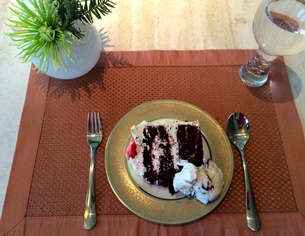
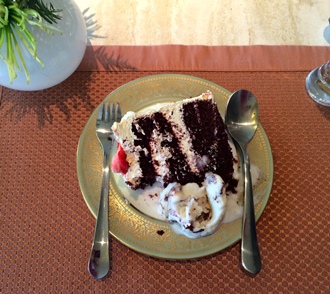
When your dessert consists of both harder and softer textures, a fork and spoon will be included and both will be used. (Tip: The spoon is not for your coffee or tea.)

How to Eat Dessert Gracefully and Properly

For many of us, dessert is the favorite course of the meal. There's always something to love about dessert!

The dessert utensils are at the top of your place setting.

When your dessert consists of both harder and softer textures, a fork and spoon will be included and both will be used.
(Tip: The spoon is not for your coffee or tea.) 


Here's how it's done.

The meal has ended, and dessert has been served.


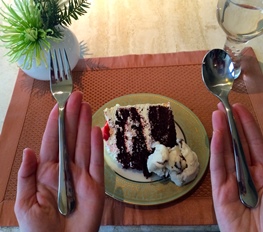
Once dessert is served, move the spoon and fork down to either side of the plate - fork on the left and spoon on the right.
(Sometimes, a server will do this for you.)


The fork is placed in the palm of the left hand and the spoon is placed in the palm of the right hand.


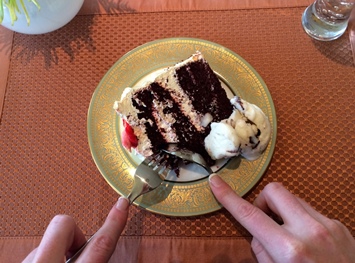
The spoon first serves as a knife and the fork is used to steady the solid portion of the dessert.


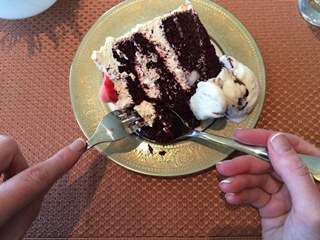
The spoon is then re-positioned in the right hand, holding in ‘pencil’ position. The fork becomes a ‘mover’ assisting in positioning both the cake and the ice cream on the spoon.


The fork as a helper tool will remain steady in the left hand, and the spoon is loaded with a delicious bite.   (In other words, only the spoon will come to your mouth. The fork remains in your left hand.)

As with other courses, there are resting and close-out positions for your utensils.

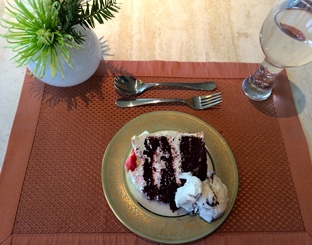
The dessert resting position is your fork on the left side of the plate, and your spoon on the right as shown here.


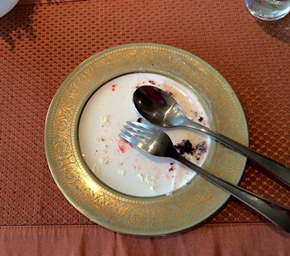
The close-out position is the same as other courses, with fork and spoon diagonal on the plate, or in the 6 o'clock position.


Serve cake and ice cream or pie a la mode at your next family meal, and practice using both a fork and a spoon to enjoy your dessert.

Other times, if your dessert is solid, you only need a fork. If your dessert is liquid or soft, you only need a spoon.

If you are setting the table, include only the utensils that are needed to eat the particular dessert that is to be served.


A retired, national award-winning secondary school educator, Candace Smith teaches university students and professionals the soft skills of etiquette and protocol. She found these skills necessary in her own life after her husband received international recognition in 2002. Plunged into a new “normal” of travel and formal social gatherings with global leaders, she discovered how uncomfortable she was in many important social situations. After extensive training in etiquette and protocol, Candace realized a markedly increased confidence level in meeting and greeting and dining skills and was inspired to share these skills that will help others gain comfort and confidence in dining and networking situations. Learn more at http://www.candacesmithetiquette.com/


Etiquette Enthusiast, Maura J Graber, is the Site Editor for the Etiquipedia Etiquette Encyclopedia

Wednesday, August 7, 2019

Etiquette of British Food–French Style

In England, a fish knife is always served with fish. You will take it for a butter knife, but as you will look in vain for the butter, you are safe in using it for fish. Bread is served as an article of food and is not used as a pusher. The fork is always kept in the left hand, not juggled from one hand to the other. Vegetables, including peas, are mashed on the back of it with a knife. Small knives and forks are served with all fruits. Under no circumstances is fruit desecrated by a touch of the fingers. A fork and dessert spoon are served with all desserts. You push the confection on the spoon with the fork and proceed as usual. - Above, an early 1900’s British-made, individual fish knife and fish fork. The fish knife blade is designed so that anyone unfamiliar with this set otherwise, would understand it is for eating fish.


To Be a Gentleman Abroad...
The Way One Must Eat in England and Dress in France 

In polite society in England, a fish knife is always served with fish. You will take it for a butter knife, but as you will look in vain for the butter, you are safe in using it for fish. Bread is served as an article of food and is not used as a pusher. The fork is always kept in the left hand, not juggled from one hand to the other. Vegetables, including peas, are mashed on the back of it with a knife. Small knives and forks are served with all fruits. Under no circumstances is fruit desecrated by a touch of the fingers. A fork and dessert spoon are served with all desserts. You push the confection on the spoon with the fork and proceed as usual. Tea, coffee and cocoa are not sipped with a spoon. A teaspoon is to stir with. After it has served that purpose, its little mission is over, and it reposes placidly on the saucer. 
When you have finished with them, the knife and fork are placed on the plate directly in front of you. While dining, under no circumstances allow them to rest half on the plate and half on the table. You may be called a ‘‘rower” if you do. 

Bread is broken with one hand only, the left one usually. All vegetables, excepting asparagus, are served on the dinner plate. You will look for the birds bath tubs in vain. You may break all the Ten Commandments, but by observing the above and taking a daily tub you will pass for a gentleman. By failure in any one of these details you will find yourself utterly déclassé. In England all social etiquette that is not English, is vulgar. When you reach France, however, you may relapse into all your little home comforts. You may pick your teeth and manicure your nails in a restaurant, and you can eat anything you like with your fingers. You may omit your daily tub and patronize the “parfumerie.” But if you wish to be a gentleman you must wear smart clothes, smart clothes consisting chiefly of gayly colored waistcoats, socks and ties. The most important man in France is the hotel concierge. He possesses the “open sesame” of all things. After you have paid your respects to him in due form, you may consider yourself one of the initiated. – New York Sun, 1913


Etiquette Enthusiast, is the Site Editor for the Etiquipedia© Etiquette Encyclopedia 

Saturday, August 4, 2018

Pies, Forks and Etiquette

An American pie fork, along with a pastry, or cake, fork. – For years, pie was eaten properly with a knife and a fork, until savvy manufacturers designed special 3-timed forks with one wide tine (mimicking the knife) to assist in eating pie, thus eliminating the need for a knife. Four-tined cake forks soon followed.


A Question of Etiquette Settled

In a Bowery museum, there is a “congress of lady pie eaters,” and they are depicted on the “oil painting” outside as eagerly devouring great segments of pie, without the aid of either knife or fork, a fact that ought to settle the vexed question of etiquette, how a lady should eat pie.—New York Tribune, 1892


Etiquette Enthusiast, Maura J. Graber, is the Site Editor for the Etiquipedia© Etiquette Encyclopedia 
Saturday, March 18, 2017

A Pie Etiquette Plea

"All we insist upon in the name of true etiquette, is that the knife should do its share of the labor, and that the fork should not be compelled unassisted to bear the heat and burden of dissection." — Did some folks not get the memo about the dual utensil? In the mid-19th century, silver companies decided on a combination of forks and knives, to create "Pie Forks" 

A Plea for the Knife

We are not too​ enamored of the knife, and to favor its use in preference to the fork as a means of conveying one'e food to one's month. On the contrary, we are as much opposed to this use of the knife as any one possibly could be. But we hold, nevertheless, that the knife should not be utterly ignored at the table. Where, for instance, the pie crust set before you is excessively inflexible, there is a sort of constructive insult to your hostess in your vain attempts to cut throngh it with a fork. Its toughness is made obvious by your exertions, and in endeavoring to cut the pie crust you enly succeed in cutting into the sensibilities of your hostess. 

By using your knife, on the contrary, your pie crust is divided into eatable portions with neatness and dispatch, and its firmness of texture is remarked by no one. We are sure that no genuine pie lover will deny that in cutting one's pie with one's knife and carrying it piece by piece to the mouth by aid of the fork, ample recognition is accorded to the demands of etiquette; for to thoroughly enjoy one's pie, neither knife nor fork is necessary. As a matter of fact, either is an impertinence. 

The true and only satisfying way to eat pie is to take it up in one's hand, and by gently but firmly pressing the pointed end of the wedge in one's mouth to slough off its beneficence with grateful teeth until its richness is all your own. This is the way to enjoy pie. But we are not talking of enjoyment. Our business is with etiquette. Therefore, we will relegate the true form of pie eating to the privacy of the cupboard, where the hasty snack is taken. All we insist upon in the name of true etiquette, is that the knife should do its share of the labor, and that the fork should not be compelled unassisted to bear the heat and burden of dissection.—Boston Transcript, 1891


Etiquette Enthusiast, Maura J. Graber, is the Site Editor for the Etiquette© Etiquette Encyclopedia

Monday, September 14, 2015

Gilded Age Dinner Etiquette "Extras"

Fruit-knives are required, and ice-spoons, orange spoons, and other unique conceits in silver utensils may be provided with the dessert, if one happens to own them...

Miscellaneous Points of the Gilded Age Dinner

Extra knives and forks are brought in with any course that requires them. The preliminary lay-out is usually meant to provide all that the scheme of the dinner will call for; but one must have a goodly supply of silver and cutlery to avoid altogether the necessity for having some of it washed and returned to the table during the progress of the dinner. It is very desirable to be amply equipped, as it facilitates the prompt and orderly serving of the courses.

Fruit-knives are required, and ice-spoons, orange spoons, and other unique conceits in silver utensils may be provided with the dessert, if one happens to own them; otherwise, plain forks and spoons do duty as required. The fork bears the chief burden of responsibility, being used for everything solid or semi-solid, leaving the spoon to the limited realm of soft custards and fruits that are so juicy as to elude the tines of the fork.

The knife is held in hand as little as possible, being used only when cutting is actually necessary, the fork easily separating most vegetables, etc. In the fish course, however, the knife is used to assist in removing the troublesome small bones.

In holding the knife the fingers should not touch the blade, except that the forefinger rests upon the upper edge not far below the shank when the cutting requires some firmness of pressure. The dinner knife should be sharp enough to perform its office without too much muscular effort, or the possible accident of a duck's wing flying unexpectedly " from cover" under the ill-directed stress of a despairing carver's hand. I have seen the component parts of a fricasseed chicken leave the table, not untouched— oh! no; every one had been sawing at it for a half an hour—but uneaten it certainly was, for obvious reasons. The cutlery was pretty, but practically unequal to even spring chicken.                               
The fork bears the chief burden of responsibility, being used for everything solid or semi-solid, leaving the spoon to the limited realm of soft custards and fruits that are so juicy as to elude the tines of the fork.
The fork is held with the tines curving downward, that position giving greater security to the morsel, and is raised laterally, the points being turned, as it reaches the mouth, just enough to deposit the morsel between the slightly-parted lips. During this easy movement the elbow scarcely moves from its position at the side, a fact gratefully appreciated by one's next neighbor. What is more awkward than the arm projected, holding the fork pointing backward at a right angle to the lips, the mouth opening wide like an automatic railway gate to an approaching locomotive—the labored and ostentatious way in which food is sometimes transported to its destination? Nor, once in the mouth, is it lost to sight forever. Other people, seated opposite, are compelled to witness it in successive stages of the grinding process, as exhibited by the constant opening and shutting of the mouth during mastication, or laughing and talking with the mouth full—faults of heedless people of energetic but not refined manners.

Liquids are sipped from the side of the spoon, without noise or suction. In serving vegetables the tablespoon is inserted laterally, not " point first."

Celery is held in the fingers, asparagus also, unless the stalks are too tender. Green corn may be eaten from the cob, a good set of natural teeth being the prime requisite. It may be a perfectly graceful performance if daintily managed.

The management of fruits in the dessert is another test of dainty skill. Oranges may be eaten in different ways; they may be cut in half across the sections, and the cells scooped out with a spoon; or they may be peeled and separated. The pegs of a large Florida orange can be skinned with the point of a sharp fruit-knife, and the seeds removed, leaving only the juicy pulp to be conveyed to the mouth. Practice enables one easily to "make way with" an orange. Bananas are peeled and held in the fingers, or, if very mealy, they may be cut into "bites" and eaten with a fork. Juicy pears and peaches may be managed in the same way, at discretion, the rule being that the fingers should touch as little as possible fruits that are decidedly mushy.

The finger-bowl stands ready to repair all damages of the nature suggested. The fingers are dipped in the water and gently rinsed, and then passed lightly over the lips, and both mouth and fingers are wiped upon the napkin.

At a signal from the hostess, the ladies rise and return to the drawing-room. The gentlemen follow immediately, or remain a short time for another glass of wine, when such is the provision of the host.
 – From "Etiquette: An Answer to the Riddle When? Where? How??" By Agnes H. Morton


🍽Etiquette Enthusiast, Maura J. Graber is the Site Editor for Etiquipedia© Etiquette Encyclopedia