Showing posts with label Dining with Fingers. Show all posts

Sunday, March 8, 2026

Etiquette for Eating Shrimp

“A jumbo is about four or five inches long and one could never be put whole into the mouth. Are these eaten in the fingers? The cocktail fork seems so tiny for such a big shrimp.”

A Question for Amy Vanderbilt 

Dear Miss Vanderbilt: In a library recently I read in your excellent etiquette book, “Unshelled shrimp should be conveyed whole to the mouth.” Are you speaking of a dish of shrimp for the person to shell themselves? I have never seen this and was wondering about the “sand vein.” You didn't mention it since cocktail shrimp are deveined in the kitchen, does one do this with the fingernail before eating the shrimp? One would need to wash one’s hands afterward! I saw literally tons of jumbo shrimp being deveined (not in a factory). A jumbo is about four or five inches long and one could never be put whole into the mouth. Are these eaten in the fingers? The cocktail fork seems so tiny for such a big shrimp. – Mrs. Fort Lauderdale, Florida

Dear Mrs. Fort Lauderdale –For aesthetic purposes the sand vein in shrimp should be removed. If the shrimp are eaten cooked, the vein is not removed. If you encounter it in a shrimp cocktail, you should realize that it is harmless. Don't attempt to remove it, certainly not with the fingernail. Cocktail shrimp are served in a variety of ways. They are offered with toothpicks; in which case you spear them. If they are very large, you bite off a manageable mouthful after having dipped me shrimp in the sauce. Then eat the rest of the shrimp. If you dip it again, you should be careful to turn it around so that the part you have bitten is not dipped into a communal sauce bowl. 

When shrimp cocktail is served with a cocktail fork, you use the fork even though it is tiny. You may either put the whole shrimp in your mouth, or take manageable bites. Sometimes shrimp cocktails or shrimps prepared in the Oriental fashion have the tail left on to be used as a handle. If you have an Oriental dish, you may use chopsticks if you are able to do so; in Louisiana and in various Italian dishes, shrimp is often served with the shell on. In this case, you remove the shell with your fingers but you don't bother to remove the vein. When a shrimp dish is served this way, of course, a finger bowl or folded wet towels (Oriental fashion) or scented paper towelettes are essential. –Amy Vanderbilt, 1963


🍽Etiquette Enthusiast, Maura J. Graber, is the Site Editor for the Etiquipedia© Etiquette Encyclopedia

Wednesday, March 19, 2025

Etiquette for Eating Bananas

If you are not given a fruit knife and fruit fork… “one may turn the skin back part of the way and hold the fruit in her fingers if she chooses, without shocking the proprieties.” – What Have We Here?  A sterling, gilded age banana server variation, with a matte gilded finish on the bowl and tines. One may get as formal as one likes when it comes to serving fruits at the table.

Charming Fruit Manners

“She has such charming fruit manners,” said a girl of a famous belle. “She doesn't know it, but she dips her strawberries in the powdered sugar, or holds her banana at breakfast, as if they were roses or violets You forget that eating is a material process, and are sure it is poetry. 
“I had seen so many people eat their bananas with a knife and fork that I looked for banana etiquette. I found that one may turn the skin back part of the way and hold the fruit in her fingers if she chooses, without shocking the proprieties.” – San Diego Union and Daily Bee, 29 May 1904


 🍽️Etiquette Enthusiast, Maura J. Graber, is the Site Editor for the Etiquipedia© Etiquette Encyclopedia 

Saturday, July 1, 2023

Asparagus Etiquette and History

Asparagus “was a favorite of French King Louis XIV, who reintroduced the vegetable to European tables after years of neglect.” — Above: An assortment of asparagus servers and serving tongs, including the French designed and made, gilded flat server and the large filigree tongs in the top middle of the photo. Also, shown on the bottom right, is a pair of American made, individual asparagus tongs to be used instead of one’s fingers. These individual tongs would have been part of each guest’s place setting from the Gilded Age to the 1930’s.
Asparagus is related to the lily, and like the flower it has come to symbolize spring to many a vegophile.

This being the end of its March-to-June growing season, it's still plentiful in the stores right now. And although it is available all year- round although imported and at - a high price nothing beats its - taste when cooked fresh.

There are two kinds of asparagus— white and green. The white variety is much more a delicacy and gets its pale color because it is picked just as the tips break the soil, it was a favorite of French King Louis XIV, who reintroduced the vegetable to European tables after years of neglect.

Asparagus is a treat, and one of the reasons is that it is finger food. Guardians of etiquette have given asparagus a special dispensation when it comes to knives and forks. Only the tips need be speared by a fork, but the correct way is to lift the spear to your mouth and chomp down of course doing your best to avoid getting vinaigrette or hollandaise sauce on your clothes. — By Orlando Ramirez, Copley News Service, 1994


🍽Etiquette Enthusiast, Maura J. Graber, is the Site Editor for the Etiquipedia© Etiquette Encyclopedia

Sunday, August 14, 2022

Dealing with Small Grossnesses

While it was nice of Jared to turn his head and avoid spraying the sampler, he still made two glaring mistakes.

Fingers vs. Forks with Shared Plates of Food

“Let's share an appetizer sampler,” you suggest. Your friends all agree enthusiastically, and soon a large plate of fried calamari, zucchini slices, and other delicious hors d'oeuvres arrives. You start to reach for a piece of calamari when, directly to your right, Jared suddenly turns away from the table and sneezes. He quickly wipes off his nose and hands, and then grabs a calamari with his fingers. You suddenly lose your appetite for good reason. While it was nice of Jared to turn his head and avoid spraying the sampler, he still made two glaring mistakes. First, he failed to excuse himself from the table to wash his hands after sneezing. Second, he used his hands to take items from the sampler plate.

Then you I realize, “I was about to take a calamari with my fingers, too— and nobody saw me picking my nose a few minutes ago.”

You resolve, from now on, to start using a fork or serving utensil whenever you're eating from a shared plate. Score another victory for consideration-based etiquette!

Double Dipping

You're hosting a party, and you decide to make a special effort by serving a big platter of shrimp along with a bowl of cocktail sauce. Everyone gathers around for the feast. The procedure is simple: grab a shrimp, dip it in the sauce, and enjoy.

Then it happens: across from you Dainty Debbie takes a bite and then, to your horror, dips the uneaten portion back into the sauce bowl so she can have a little sauce with her next bite. Several other guests look at you silently speculate: “What's he going to do?” and “Let me see if I can freshen up this plate,” you say to no one in particular. You pick up the platter and go to the kitchen, where you spoon out the area where Debbie double dipped or, better yet, replace the sauce with some you still have left because you were smart enough to buy extra.

P.S. Don't even think about giving the sauce a quick stir. While this may seem to be the easy solution, it’s worse than Debbie’s double dipping.

If you really want to take the bull by the horns, ask Debbie if she can help you in taking the platter out. When you and Debbie get to the kitchen, ask her politely to please not double dip, and explain that by doing so she’s making the shrimp unappetizing for some of the other guests: “Debbie, I'm sure you didn't even know you were doing this, but...” The key is to do this quietly and privately.— From, “Essential Manners for Men,” by Peter Post, 2003


🍽Etiquette Enthusiast, Maura J. Graber, is the Site Editor for the Etiquipedia© Etiquette Encyclopedia

Sunday, March 13, 2022

“Finger-Eating” Etiquette

Even at formal dinners, “finger-eating” is the well-mannered method for certain foods. Glamorous artichokes are properly eaten with the fingers down to the “heart,” which is in the fork territory. – Above, an individual artichoke plate with bowl for butter.


Green Light Shines On ‘Finger-Eating’

Is it ever proper to eat with your fingers? Etiquette experts say “yes!” Even at formal dinners, “finger-eating” is the well-mannered method for certain foods. Glamorous artichokes are properly eaten with the fingers down to the “heart,” which is in the fork territory. Asparagus, when not covered with a sauce,
may be picked up with the fingers in the best of style. There's no need to hesitate to serve guests dishes such as fried chicken or corn on the cob, because they are difficult to eat with knives and forks. Lead the way by picking up the food as a cue to your guests. 

Helpful Deed 

At “sit-down” dinners, the thoughtful hostess provides two large napkins at each place for wiping fingers. Here are some additional socially correct finger foods: 
BACON –If the bacon is crisp, it may be eaten with the fingers. But if you prefer your bacon less than crumble-dry, a knife and fork are required. 
CAKE –Tiny cakes, such as petit-fours, should be eaten with the fingers. Pound cake may be broken into bite-size pieces and also eaten with the fingers. Sticky cake or a larger portion, requires a fork.

 Not in N.Y…

 CHlCKEN— Geography has some effect on chicken manners. According to the experts, fried or broiled chicken may be picked up and eaten with the fingers everywhere, except in New York. In this Eastern area, chicken served at formal dinners calls for knives and forks. Finger eating is for informal occasions only. 

But in other states, it’s considered perfectly acceptable to pick up serving-size pieces of fried or broiled chicken for all occasions. 

RELISHES – Celery and olives should be eaten with the fingers, except when they are a part of a salad or cooked dish. Radishes and small pickles are also finger-food. 

FRUIT – Fresh apricots, cherries, grapes, and plums are always eaten with the fingers. However, when eating fresh apples and pears at the table, peel and quarter with a table knife before eating with the fingers. – Desert Sun, 1963


Etiquette Enthusiast, Maura J. Graber, is the Site Editor for the Etiquipedia© Etiquette Encyclopedia 

Sunday, May 24, 2020

Marie Antoinette’s Etiquette vs Anglomania

“For my own part, I prefer to eat lettuce salad with my fingers rather than with a fork, and Queen Marie Antoinette and other ladies of the Eighteenth century were of my way of thinking. If the ladies could only see how pretty is their gesture when their diaphanous forefinger and thumb grasps a leaf of delicate green lettuce, and raises that leaf from the porcelain plate to their rosy lips, they would all immediately take to eating salad à la Marie Antoinette.”
Photo of Kirsten Dunst as Marie Antoinette from Pinterest 


Anglomania in Eating 
_______________________
Some Plain Talk About the Finicky Ways of “Overly Dainty” People

The Anglo-Saxons are afraid to use their fingers to eat with, especially the English. Thanks to this hesitation, I have seen in the course of my travels in the Old World, many distressing sights. I have seen a lady attempt to eat crawfish (écrevisse) with a knife and fork, and abandon the attempt in despair. I have also seen men in the same fix. I have seen—oh, barbarous and cruel spectacle!—Anglo-Saxons, otherwise apparently civilized, cut off the points of asparagus, and eat these points only with a fork, thus leaving the best part of the vegetable on their plates. As for artichokes, they generally utterly defeat the attacks of those who trust only to the knife and fork. 

Fingers must be used for eating certain things, notably asparagus, artichokes, fruit, olives, radishes, pastry, and even small fried fish; In short, everything which will not dirty or grease the fingers may be eaten with the fingers. For my own part, I prefer to eat lettuce salad with my fingers rather than with a fork, and Queen Marie Antoinette and other ladies of the Eighteenth century were of my way of thinking. If the ladies could only see how pretty is their gesture when their diaphanous forefinger and thumb grasps a leaf of delicate green lettuce, and raises that leaf from the porcelain plate to their rosy lips, they would all immediately take to eating salad à la Marie Antoinette. Only bear in mind, good ladies, that if you do wish to eat lettuce salad with your fingers, you must mix your salad with oil and vinegar, and not with that abominable ready-made, white “salad dressing,” to look upon which is nauseating. 

May heaven preserve us from excessive Anglomania in matters of table service and eating. The English tend to complicate the eating tools far too much. They have too many forks for comfort, and the forms of them are too quaint for practical utility. Certainly silver dessert knives and forks are very good in their way, because they are not susceptible to the action of fruit acids, but it is vain and clumsy to attempt to make too exclusive use of the knife and fork in eating fruit. Don’t imitate, for instance, certain ultra-correct English damsels who eat cherries with a fork and swallow the stones because they are too modest, or rather too asinine, to set them out on to the plate. Eating is not a thing to be ashamed of. 

To thoroughly enjoy a peach you must bite it, and feel the juicy perfumed flesh melt in your mouth. But let the Anglomaniacs say what they please, there is no necessity of sticking a fork into the peach, and peeling it while so impaled, as if it were an ill-favored and foul object. A peach is as beautiful to the touch as it is to the eye; a peach held between human fingers has its beauty enhanced by the beauty of the fingers. However dainty and ornate the silver dessert knife and fork may be, it always irritates me to see people out up their peaches, or pears, or apricots, or what not, into cubes and parallelepipeds, as if dessert were a branch of conic sections. 

Imitate Marie Antoinette, ladies; use your fingers more freely: eat decently, of course, but do not be the slave of silly Anglomania or Newport crazes. To eat a pair or an apple conveniently, cut it into quarters, and peel each quarter in turn as you eat it. The  peach, too, can be cut into quarters, if the eater is timid. Apricots do not need peeling, nor plums either. Would you be bold enough to peel a fresh fig, or to touch such a delicate fruit even with the purest silver instruments? —Theodore Child in Harper’s Bazar, 1890


Etiquette Enthusiast, Maura J Graber, is the Site Editor for the Etiquipedia©️ Etiquette Encyclopedia 

Sunday, November 4, 2018

Chaucer and “Fingers of Courtesy”

From Chaucer’s “Parliament of Fowls,” circa 1381-1382 –In the 14th century, forks were not in use . At the time, those who exhibited good manners at the table, ate with the thumb and first two fingers. These were called, “the fingers of courtesy.”

Table Manners at the Time of Chaucer 
were of a Decidedly Primitive Character

Table manners at the time of Chaucer were described in a lecture by Kenneth Base, author and poet, in “A Holiday in London in the Days of Chaucer.” Etiquette in those days (the latter half of the fourteenth century) demanded that meat should be held between two fingers and a thumb of the left hand, and no more, if one was to be received in polite society. After soup, pike roasted in claret and favored with strange and varied spices was eaten. Then followed partridge, roasted with saffron, cloves and ginger, and jam tarts and jelly. It was the custom to change the cloth with the courses, and one read of one feast in which each new cloth was scented with a perfume appropriate to the dish. In Chaucer's day, the bath in construction was not unlike a miniature pulpit, and a bouquet of sweet scented herbs was hung over it for the stream to draw out their refreshing qualities. -Healdsburg Enterprise, 1922


🍽Etiquette Enthusiast, Maura J Graber, is the Site Editor for the Etiquipedia© Etiquette Encyclopedia

Sunday, November 12, 2017

Finger Bowl Etiquette

“They became ridiculously polite by carving bread with knife and fork, but the climax came when I set two bowls of rosewater before them as finger glasses...” – The finger bowls at Buckingham Palace, fom the book, “Dining at the Palace” 


Staggered by Finger Bowls
A very amusing scene occurred once while I was serving a lady and gentleman of the unmistakable upstart type. They were grossly ignorant of the most elementary rules of table etiquette, shoveling the food into their mouths with their knives, which were constantly loaded half-way up to the handles. They managed to struggle through their dinner, sometimes casting aside knives and forks and attacking game and poultry by cutting them in halves and eating from their hands, holding the leg. Sometimes, too, they became ridiculously polite by carving bread with knife and fork, but the climax came when I set two bowls of rosewater before them as finger glasses.  

They looked at each other, and then cautiously around the room, trying to find some solution of the mysterious dish before them, not having the sense to ignore it altogether. Whispered consultations took place, which presently grew into a suppressed quarrel, the lady reproaching her lord for his ignorance. Suddenly she was seen to shake the water around and around, and finally, with a look of contempt and superior wisdom, she raised the bowl to her lips and drank all the contents. Needless to say, that the hearty laughter of the other diners made them feel the mistake, and they beat a hasty retreat. —London TitBits, 1893


Etiquette Enthusiast, Maura J Graber, is the Site Editor for the Etiquipedia© Etiquette Encyclopedia 

Wednesday, September 20, 2017

Etiquette from Fingers to Forks

Fingers were once used to perform the office now assigned to forks, in the highest and most refined circles of society. — (Above) A rare "bird set" in the Chantilly pattern.


The Duchess of Beaufort, dining once at Mme. de Guise's with King Henri IV of France, extended one hand to receive His Majesty's salutation, while she dipped the fingers of the other hand into a dish to pick out what was to her taste. This incident happened in the year 1598. It demonstrates that less than three hundred years ago the fingers were still used to perform the office now assigned to forks, in the highest and most refined circles of society. 
At about this time, in fact, was the turning point when forks began to be used at the table as they are now. 

When we reflect how nice were the ideas of that refined age on all matters of outer decency and behavior, and how strict was the etiquette of the Courts we may well wonder that the fork was so late in coming into use as a table furnishing. The ladies of the Middle Ages and the Renaissance were not less proud of a delicate, well kept hand than those of our own days, and yet they picked the meat from the platter with their slender white fingers, and in them bore it to their mouths. The fact is all the more remarkable, because the form of the fork was familiar enough, and its application to other uses was not uncommon.—J. Von Folke in Popular Science Monthly, via the Press Democrat, 1899


Etiquette Enthusiast, Maura J.Graber, is the Site Editor for the Etiquipedia© Etiquette Encyclopedia 

Monday, September 18, 2017

The European Etiquette Evolution

For many years after the fork's introduction, they were considered a ridiculous affectation and foppery. Before forks, using the "fingers of courtesy" were the best mannered method of eating.


 Some Curious Table Manners of 
Europe's "Good Old Days"

It was into in the fourteenth century when the first evidences of art in the shape of silver cups were noticeable on the buffet. The dishes were made of pewter or wood, and spoons of bone, wood or silver. Knives were rare, and on that account guests invited to feasts carried their own knives. Forks came in general use still later, and for long years after their introduction they were considered ridiculous affectation and foppery, and not nearly so convenient as one’s own fingers. 


The Lord and his Lady dipped their fingers into the same plate and sipped their wine from the same cup. Even the Queenly Elizabeth, with all her elaborate ideas of etiquette, was content to carry her food to her month with her fingers, and at first despised the newly invented fork as unseemly and awkward. Very gradually the dinning-hall grew in comfort and splendor. Dishes of gold and silver were made, and so eager were the nobles for them that they would sacrifice any thing to possess them. 

The salt-cellar was for a long time the article of highest importance on the board. It was a great affair and stood directly in the center of the table; It was the dividing line; the nobles were seated above the salt, the commoners below; hence grew the proverb: “Below the salt.” The passing of salt was a ceremonious custom, the guest throwing a pinch over his left shoulder and murmuring a blessing. The salt-cellars were of the most curious devices. Sometimes they represented huge animals, sometimes a great, full-blown flower on a long, slender stem, and again they were in the shape of a chariot, mounted on four wheels, on which they were easily run down the table. 

The first glass cups came from Venice during the sixteenth century, and from that time on,  society began to lose many of its primitive ways, and became, in a sense, more refined. Henry VIII was born with luxurious tastes; he had his banquet chairs supplied with velvet cushions, and about this time the parlor or “talking room,” as it was called, was introduced; and here the dames took refuge when the dinner advanced beyond prudent limits, as it invariably did before the finish. 

The cook that presided over the kitchen in those days was not the counterpart of our nineteenth century Bridget, but he was an artist, and generally a man of quality. The ladies of the household, oven those of noble birth, attended to many domestic duties, making the bread, preserving the fruits, while to understand the proper use of starch, was considered a great accomplishment. – The Enterprise and Scimitar, 1888


Etiquette Enthusiast, Maura J. Graber, is the Site Editor for the Etiquipedia© Etiquette Encyclopedia 

Monday, September 21, 2015

Renaissance Etiquette and Manners

Etiquette and manners were a response to the violence and crude behaviors run rampant in burgeoning European cities. They were  the means of reinforcing social order and distinguishing the privileged class from everyone else. It was at the dinner table, that these newly defined codes of conduct were especially important.


Italy was one of the leaders of the 16th century and 17th century cultural revolution, and that included table manners. Italian poet Giovanni della Casa advised in “Galateo,” his 1558 book on manners: “One should not comb his hair nor wash his hands in public... The exception to this is the washing of the hands when done before sitting down to dinner, for then it should be done in full sight of others, even if you do not need to wash them at all, so that whoever dips into the same bowl as you will be certain of your cleanliness.” 

Taking into account that one's hands were also one’s “utensils” for hundreds of years, this advice was truly of utmost importance. In his study on the social customs of this period, sociologist Norbert Elias noted that “In good society one does not put both hands into the dish. It is most refined to use only three fingers of the hand. ... Forks scarcely exist, or at most for taking meat from the dish.”

Some of the earliest known uses of forks with food occurred in Ancient Egypt, where large forks were used as cooking utensils. The personal table fork was most likely invented in the Eastern Roman or Byzantine Empire, where they were in common use by the 4th century, though the origins may even go back to Ancient Greece, before the Roman period. By the 9th century, according to records, a similar utensil known as a barjyn was in limited use in Persia within some elite circles. By the 10th century, the table fork was in common use throughout the Middle East. Forks were originally viewed by most in Western Europe, as excessively refined. Forks were also viewed, in the case of men, as a sign of effeminacy.

The custom of Western Europeans using table forks as dining implements began in Italy. They were at first a hit, but forks were slow to catch on in Northern Europe. The use of forks to get food from plate to mouth, didn't gain wide acceptance in Northern Europe until the 17th century—and even then, only the well-to-do could afford them. 
Spoons were communally used—making the etiquette of eating soups a delicate matter. "If what is given is rather fluid," Dutch theologian Erasmus of Rotterdam writes, "take it on a spoon for tasting and return the spoon after wiping it on a napkin.

Some human behaviors were deemed permissible at the dinner table. On passing gas, Erasmus wrote, “If it is possible to withdraw, it should be done alone. But if not, in accordance with the ancient proverb, let a cough hide the sound.” Most modern etiquette books advise that “civilized folk will protect others from any sounds or smells that may be displeasing.”

This isn't to say that all Renaissance manners are indeed outdated. On respecting fellow diners’ personal space, Giovanni Della Casa wrote, “It is also an unsuitable habit to put one's nose over someone else's glass of wine or food to smell it.” And Erasmus advised, “It is rude to offer someone what you have half eaten yourself; it is boorish to redip half-eaten bread into the soup.” 

Even modern science shows that a great means of spreading bacteria, is re-dipping partially-eaten foods. It certainly gives you an idea of what Renaissance society was trying to improve upon—and how far we've come since that time period. –Some of our sources; Smithsonian.com, 2011 and leitesculinaria.com


Etiquette Enthusiast, Maura J. Graber is the Site Editor for Etiquipedia© Etiquette Encyclopedia

Monday, October 6, 2014

Etiquette for Dining in Ukraine

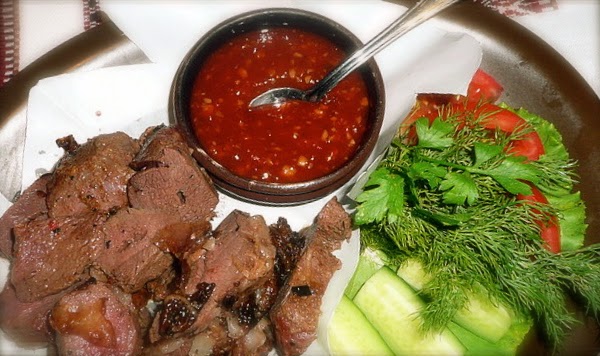
"Dining refinements are key because you never get a second chance to make a first impression, like after spilling shashlik sauce on your pants." A great secret to eating in Ukraine, if you are just visiting the country, is to not ask for a "restaurant," according to ukraine.pacsys.com  "The word restaurant has a different connotation in Ukraine. The Ukrainian word 'restaran' implies a high-class, elegant dining experience, often with live music. They are mostly used for weddings, banquets and big celebrations. For a delicious, inexpensive meal in Ukraine, ask for a cafe. These are the standard places for everyday dining in Ukraine."


Looking Fine, While Fine Dining in Ukraine


Table manners play an important part in making a favorable impression, and are essential to one's personal and professional success. Dining refinements are key because you never get a second chance to make a first impression, like after spilling shashlik sauce on your pants.

Obviously, there is a degree of flexibility involved. It can be hard to project success in certain Kyiv restaurants, where you have to get down on your knees and beg your waitress for a menu, or stand on your chair at the conclusion of your meal and wave your napkin semaphore-style in order to secure the bill. In other words, not every dinner calls for a complete working knowledge of table manners.

     
The goal is to behave with graciousness and poise at the table... Slouching is not approved of, regardless of how good you may look. Remember, your posture silently speaks volumes about you.

“The goal is not, after all, to demonstrate utter mastery of the most arcane details of etiquette,” says an article oncuisinenet.com. “[but] to behave with graciousness and poise at the table.”

Napkin Use


As soon as you are seated, place your napkin on your lap, and use it sparingly and gently throughout the meal. Leaving it loosely folded on your seat when standing up from the table signals you’ll be returning. Leaving it to the right of your dinner plate signals you have concluded your meal.

The Table Setting

Not every dinner calls for a complete working knowledge of table manners, but, again, watch that posture. Good manners means no slouching! And please keep your elbows off of the table too.

Faced with a baffling arsenal of cutlery and dishware, follow two basic rules: Imitate the actions of your host or fellow diners and typically eat from the outside in, proceeding with those forks and knives furthest from the center of your setting and working your way inwards.

On the far left is typically found the salad fork, followed by the fish fork and meat fork. On the far right you may find a small oyster fork, followed by the soup spoon, fish knife and meat knife. Spoons may also accompany a serving of dessert or coffee and tea. Once used, each should be returned to the saucer (but not bowl) on which it arrived, but never to your dinner plate.


Holding On

The guides describe the European style as less formal, since you can use your knife both to cut up your food and load up items like peas on your fork.
Etiquette guides define two styles for holding utensils: the American or “Zig-Zag” style, and the European or Continental style. The first system refers to the habit of cutting at most two bites of meat with the fork in the left hand and knife in the right, and then placing the knife on the rim of the plate and switching the fork to the right hand before taking a bite. The guides describe the European style as less formal, since you can use your knife both to cut up your food and load up items like peas on your fork. In general, however, food should be eaten off of the fork with the tines pointed downward. “The position of the knife and fork when not in use acts as a sort of semaphore,” cuisinenet.com adds.

Soiled utensils should never touch the table, but remain on the plates for which they were designed (salad fork on salad plate, meat/fish fork and meat/fish knife on dinner plate, etc...). Keep the blade of the knife pointed toward you and the fork tines preferably pointed up or down, but never facing another person. When taking a small break in eating, the fork and the knife should balance on the rim of the plate; when receiving a second helping, they should lie parallel on the right side of the plate; and when you’ve finished your meal, they should lie parallel either across the plate or on a diagonal.


Brushing Up

Eaten with the fingers ~ Foods which may be eaten with the fingers include artichokes (until you reach the heart), asparagus (when not covered in sauce), crisp bacon... 
There certainly is no shortage of dining rules. Foods which may be eaten with the fingers include artichokes (until you reach the heart), asparagus (when not covered in sauce), crisp bacon, bread and rolls (always broken, never cut), cookies, corn on the cob, hors d’oeuvres, sandwiches and fruit.

Inedible foods should come out of the mouth the way they went in – olive pits in the hand, chicken bones on the fork. But, to repeat, style and flexibility are all-important.

“When a piece of fat is too big to be removed with the fork, use a napkin discretely to discard the meat,” advises the askmen.com Web site, which clearly hasn’t heard of salo, and doesn’t know it should simply be swallowed.


Main article used was originally published in 2003 in the Kyiv Post

🍽Etiquette Enthusiast, Maura J. Graber of The RSVP Institute of Etiquette, is the Site Editor for the Etiquipedia© Etiquette Encyclopedia