Showing posts with label Debutante Etiquette. Show all posts

Wednesday, July 13, 2022

Etiquette for Debutante Balls

The father of each girl makes a contribution which, even though it is usually quite generous, is not nearly as much as he would have had to spend on an individual party.


Mass Debutante Debuts

In a number of cities there are large cotillions or assemblies at which dozens— or even hundreds— of girls make their debuts at the same time. They are usually charity balls and are managed by a committee which makes the regulations about everything from dress to numbers of escorts.

The father of each girl makes a contribution which, even though it is usually quite generous, is not nearly as much as he would have had to spend on an individual party. At most of these affairs, each girl is expected to subscribe for two escorts. Often private dinner parties are given before the ball to honor each girl separately.

Clothes for guests and parents are the same as they would be at any large dance, but there are sometimes limitations put on the costume of the debutante by the committee. They might require all white, for example, rather than leaving it to the girls whether they wear white or pale pastels.

■Invitations

Personal notes from the mother are usually sent when the party is to be a small one, but for anything large or elaborate, the mother and father would probably send engraved invitations jointly.

■Clothes

Even if she has been going to night clubs since she was fifteen, a debutante at her debut should look young and dewy. She often wears white, though pastels are considered correct these days, and the cut of the dress should never be sophisticated or provocative. At an evening debut, she wears a wide-skirted dance dress. At an afternoon debut, she wears a dress something like a short dress for a bridesmaid. She wears– afternoon or evening– gloves and no hat, but she may wear a flower in her hair.

The mother wears, at a tea, an afternoon dress with no hat, but with gloves. For an evening affair, she would wear a formal evening gown with gloves. She never wears black for any kind of debut.

The father and the guests wear clothes that are appropriate for the time of day and the occasion. — From “McCall’s Book of Everyday Etiquette,” 1960


🍽Etiquette Enthusiast, Maura J. Graber, is the Site Editor for the Etiquipedia© Etiquette Encyclopedia

Friday, May 13, 2016

Tea Etiquette and Debutantes

Certain formalities are observed on a special occasion of the sort for the introducing of a debutante. An engraved card is used, having the name of the daughter beneath that of her mother...


How to Give the Popular Afternoon

Afternoon teas continue to be a great feature among the entertainments of the day. Fashion calls on a mother to introduce her daughter. Certain formalities are observed on a special occasion of the sort for the introducing of a debutante. An engraved card is used, having the name of the daughter beneath that of her mother, with the date, the hours for receiving and the address in the lower left hand corner of the card may be the words, "Fridays in January," too.

Indicate other days during the winter for receiving more informally. Cards are about five inches long, by three and a half wide. The usual style of engraving is script. According to recent fashion the form is: Mrs. Archibald Robinson and Miss Edith Hobinton Will Be At Home on Tuesday, the first of December from four until seven o'clock at Seven East Seventy-third Street. 

Cards for large teas or days at home are sent out two weeks in advance; small teas a week or so in advance. Invitations to teas are in the name of the hostess, not in the united names of husband and wife. At a large tea or reception for a debutante, music for dancing is a feature. An orchestra is in the hall or in a room set apart for dancing. The musicians may be screened off by palms. – The Mariposa Gazette, 1914


🍽Etiquette Enthusiast, Maura J Graber of The RSVP Institute of Etiquette, is the Site Editor for the Etiquipedia© Etiquette Encyclopedia 

Wednesday, June 10, 2015

Etiquette for a Vanderbilt Debutante

“In England, the court circle governs society. Its recognition makes a gentleman or lady out of nobody.”

Throne Room in Buckingham Palace Presentation Day – Where the Money Counts – Getting Into Swell American Society via London

Titled Bankrupts Who Sell Their Court Influence for Round Sums —  Brief Views of Royalty!

From London, May 1896 — This is the particular season of the year when the young American girl whose papa and mamma take her abroad every spring, hopes to acquire the transcendent social distinction of being presented at Court. It gives her something to talk about for the rest of her life, and like an heirloom, she can hand it down to future generations of her family as a badge of greatness.

It means much to an English woman to be presented at court, but to an American it can be scarcely any material value. In England, the Court circle governs society. Its recognition makes a gentleman or lady out of nobody. A Court presentation is an open sesame to society and everything that implies. Naturally it is sought after with great diligence, particularly by people who know that they must overcome mountainous obstacles to reach the acme of their ambition.

London is filled with a class of influential sharks who make a fat income during the season by piloting rich folks into the throne room at Buckingham Palace. It is a sad but true fact that many Americans have permitted themselves to be bitten by these rascals, for the mere pleasure of rubbing shoulders with Royalty for a minute or two and seeing a room full of Princes, Princesses, Dukes and people of lesser titles in gala array.

It is a gorgeous show, and it is generally thought to be worth the price of admission. Even if someone need not be feted for obtaining the rare cards of admission, the function cannot be suitably attended at a cost of much less than one thousand dollars. There are innumerable rules of Court etiquette which must be complied with, and each rule means the expenditure of a goodly some. 

                                                   
“The most notable American presented this spring was the young Duchess of Marlborough, but she did not appear as an American, but as an English Duchess.”
If the presentation function were established for the benefit of the London shopkeepers, it would serve the purpose nobly, as it stimulates trade to a surprisingly healthy degree. The Queen as yet, has not presided at any of the drawing rooms this season, her place generally being taken by the Princess of Wales.

A Notable Presentation


The most notable American presented this spring was the young Duchess of Marlborough, but she did not appear as an American, but as an English Duchess. Socially her position is one of considerable importance, and she's entitled by right to appear at the drawing rooms as often as she pleases. Her influence is also sufficiently great to secure cards of admission for any of her eligible in New York friends, but unfortunately the one whom she would most like to present is debarred by an edict which is seldom waived. This refers to her mother, Mrs. O. H. P. Belmont, who was divorced from the Duchess' father, W. K. Vanderbilt. One of the few divorced women ever admitted to the Royal presence is the Marchioness of Blandford who is divorced from the late Duke of Marlborough. It was she who presented her daughter-in-law, the young Duchess, at Court.
                                           
Mrs. O. H. P. Belmont, mother of Consuelo Vanderbilt, was barred from cards of admission to London's elite drawing rooms, by an edict which is seldom waived, due to her divorce.
It is a well known bit of gossip that has lived for more than three years that an American millionaire paid $10,000 to an influential, but bankrupt leader of society, for drawing room cards for his wife and two daughters. This man had for many years endeavored to enter the fashionable set of New York and had probably spent $100,000.00 in lavish entertainments in an effort to draw the right people to his house. But on reaching home after the presentation of his family, he discovered that it had open the long closed doors. He has never regretted the $10,000, but sees who fixes all these rules, and his assistants see to it that they are rigorously adhered to.


A Powerful Official


All applications for cards are made to the same gentleman. Such applications are invariably accompanied by an endorsement of some person of note and prominence, otherwise they are ignored. Extreme care is taken that no one whose character is at all doubtful is admitted. The most difficult thing to perform is to leave the Royal presence by backing out of the room. A twelve foot train impedes graceful progress. Usually this part of the program is rehearsed several times before the presentation is made. Everything else is in stereotyped form and is of such simple character that few people commit blunders. 

The name is announced, and on entering the drawing room the newcomer makes a bow. She sees a number of ladies standing under a canopy, and group around them sees man in fanciful Court costume.The person presenting the visitor walks up to where the Queen is standing, and after bowing, low kisses her hand. Her protégé does precisely the same thing, and then the two back out of the room as gracefully as they can. That ends the function as far as they are concerned. There is no conversation and no loitering about in the drawing room. Only the elect are permitted those privileges.—The Los Angeles Herald, 1896


Etiquette Enthusiast, Maura J. Graber, is the Site Editor for the Etiquipedia© Etiquette Encyclopedia

Monday, January 26, 2015

Etiquette: More London Season of 1957

A"glamorous guest" from Sweden, above, Mrs Nina Wessel, wife of the Duchess of Bedford's, Danish half-brother, Hugo, attended one of the many balls and functions in 1957. The Queen Charlotte Ball was introduced by King George III in 1780 as a way to celebrate his wife’s birthday. The ball used to see the daughters of some of society's most prestigious families make their social debut. Historically the event was to help the ladies find a suitable husband. The tables alone, at the 2014 Queen Charlotte Ball, started at $2500.00

The Debuts Are Wonderful But Wearing
For English debutantes the round of parties, sporting events and charity flower shows is a grueling but unforgettable three-month grind. There is nothing haphazard about the organization of their time: their mothers met over at luncheon and tea months ahead and planned everything. (Asked if she were going to Henley, one debutante consulted her schedule and said, "I suppose so. What is it?")
A "Tiny Tea Party" given by Miss Tiarks, breaks the tedium and gives friends a chance to rest.
Four and five nights a week there are impressive but exhausting balls like the one at ancient Rockingham Castle.

There the 450 guests of Sir Michael Culme-Seymour arrived about 11 o'clock, consumed champagne (which the debutantes call "poo") and danced until dawn. The round of balls is so tiring that many girls set aside a week for rest just before their own debuts.

The languid look of the socially proper English blade is another hallmark of the season, and some debutantes do complain about seeing the same young men night after night. But the girls insist being a debutante is the greatest fun in the world.

The season is much less fun for the hard-pressed parents, mothers who worry about invitations to events such as the Queen's garden parties and fathers who must pay the bills. "I don't know why we try to do this season anymore," said Mrs. David Lycett Green, mother of Julia Williamson. "Most of us can hardly pay our taxes. But it was done for me and it was a wonderful experience."

The debuts may be wonderful, but these Scottish socialites look either gloomy or bored to tears. –LIFE Magazine, August, 1957

The Etiquette of a Dance
"The master of the house should see that all the ladies dance; he should take notice of those who seem to serve as drapery to the walls of the ball-room, or wall-flowers, as the familiar expression is, and should see that they are invited to dance. He must do this wholly unperceived, in order not to wound the self-esteem of the unfortunate ladies. Gentlemen whom the master of the house requests to dance with these ladies, should be ready to accede to his wish, and even appear pleased at dancing with a person thus recommended to their notice. Ladies who dance much, ought to be very careful not to boast before those who dance but little or not at all, of the great number of dances for which they are engaged in advance. They should also, without being perceived, recommend to these less fortunate ladies, gentlemen of their acquaintance. In giving the hand for ladies' chain or any figures, those dancing should wear a smile, and accompany it with a polite inclination of the head, in the manner of a salutation. At the end of the dance, the gentleman reconducts the lady to her place, bows and thanks her for the honor which she has conferred. She also curtsies in silence, smiling with a gracious air. In these assemblies, we ought to conduct ourselves with reserve and politeness towards all present, although they may be unknown to us." From the Ladies' and Gentlemen's Book of Etiquette 1883


Etiquette Enthusiast, Maura J. Graber, is the Site Editor for Etiquipedia© Etiquette Encyclopedia

Thursday, January 22, 2015

Etiquette and the “London Season”

In 1957, LIFE Magazine readers were taken on "an intimate tour of this rich and various pageant, a magnificent relic of old world society." LIFE Magazine, August 5, 1957

"An elegant old society shows off its granduer... "

The Duke of Bedford's step-daughter, 18 year old Lorna Lyle, danced with Hon. Charles E. Cecil, at her debut in 1957

On the Queen Charlotte Ball

The ball has been running almost every year since 1780, when King George III first organised the Queen Charlotte’s Ball as a way to celebrate his wife’s birthday. 
The ceremony remained unchanged- with debutantes paying respects to a large iced cake at Buckingham Palace, overseen by the monarch- until 1958, when Prince Philip persuaded the Queen to stop receiving each year’s crop at Court.
Philip is said to have complained that the annual Ball, at which girls aged 17 and 18 were expected to meet their suitably-moneyed future husbands, was ‘bloody daft’. 
The Queen’s sister, Princess Margaret, was even more forthright, saying later ‘we had to put a stop to it . . . every tart in London was getting in!’ 
Since 1958 the ball was held sporadically at various exclusive venues in the capital to varying degrees of success before being relaunched in 2009 and held annually since, albeit without its royal seal of approval.  –From the Daily Mail, 2014
Henrietta Tiarks, a banker's daughter, was called by some London papers, the "Deb of the Year" in 1957
For a dozen generations, in and out of wars and austerity, the traditional elegance of British society has been concentrated in a unique institution known as the London season. The season, roughly embracing the months of May, June and July, is the time of debutantes: first their formal presentation at court, then the brilliant world of their coming-out parties.

But the season is even more than this, for it encompasses a series of splendor social functions possible only in England. These gorgeous affairs are climaxed by the Queen's garden party at Buckingham Palace and by the Royal Ascot race meeting, where it is a social must for everybody who is anybody to be bidden to the royal enclosure - or even to that social holy of holies, the Queen's lawn. Other hallowed events include the royal regatta at Henley on the Thames and the Eton- Harrow match at Lord's Cricket Ground.

This year the season has been even more brilliant -and more costly - than any with in recent memory. Well over 100 young ladies like the Duke of Bedford's stepdaughter, are being launched at debut parties costing an average of $4,000 each. In these times of inflation and ruinous taxes such openhanded spending is an expensive privilege reserved for Britain's wealthiest view, and even they must make hard sacrifices to preserve the tradition. - LIFE Magazine


Etiquette Enthusiast, Maura J. Graber, is the Site Editor for Etiquipedia© Etiquette Encyclopedia

Tuesday, February 25, 2014

Etiquette: 300 Years of Australian Debutantes

Australian Etiquette for Debutantes of the 19th Century, 20th Century and Now


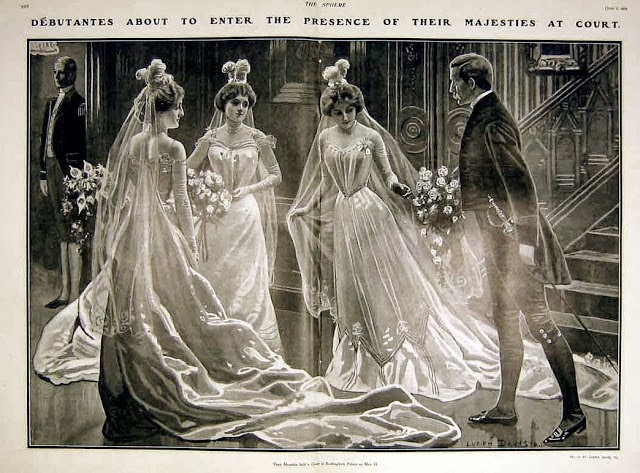
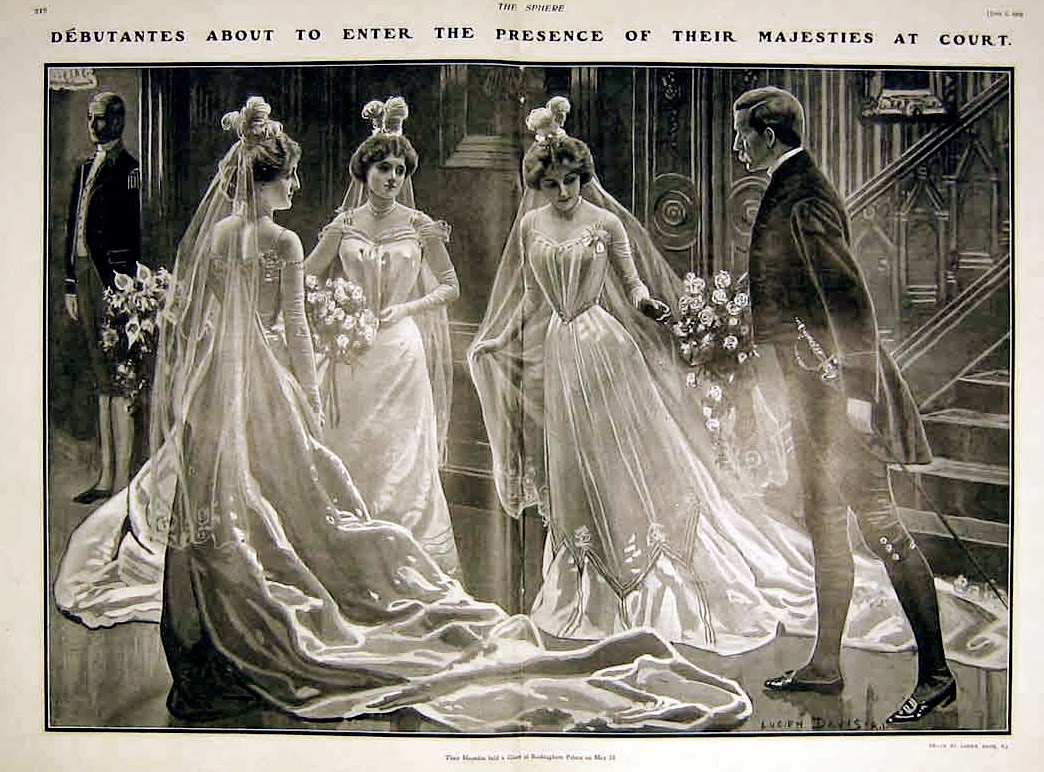
Debutantes Readying to Meet Royalty; To make one's “debut,” or to enter into society, has its roots in the Royal Court of France. By the reign of Britain's King George III (1760-1820), Queen Charlotte started a tradition of introducing and presenting the young aristocratic women of court to society. Known as "debutantes" from Queen Victoria's reign in 1837 and on, there was strict etiquette to follow regarding proper costume for court presentations; Fashionable evening dresses with head-dresses of veiling, feathers and a train trailing the dress from the waist. Long, white kid gloves, pretty fans or fragrant bouquets added to the look and offered a bit of diversity in look for the young debutantes. Since final constitutional ties between Australia and Great Britain were terminated with the passing of the Australia Act 1986, ending any kind of British role in the governing of the Australian States, closing the option of judicial appeals to the Privy Council in London, I am including British debutante history as well, up until that time period.
Debutante Agnes Melanie Dickson, circa 1890. By the end of the 19th century, the main occasions at which Court dresses were worn were those at which debutantes were presented to the Queen.

Debutantes, Circa 1930s, at the Roman Catholic Ball in Mareeba, a town on the Atherton Tableland in Far North Queensland, Australia

∞∞∞∞∞∞∞∞∞∞∞∞∞∞∞∞∞∞∞∞∞∞∞∞∞∞∞∞

        A FEW DON’TS FOR DÉBUTANTES
from Emily Post in 1922

Don’t think that because you have a pretty face, you need neither brains nor manners. Don’t think that you can be rude to anyone and escape being disliked for it.

Whispering is always rude. Whispering and giggling at the same time have no place in good society. Everything that shows lack of courtesy toward others is rude.

If you would be thought a person of refinement, don’t nudge or pat or finger people. Don’t hold hands or walk arm-about-waist in public. Never put your hand on a man, except in dancing and in taking his arm if he is usher at a wedding or your partner for dinner or supper. Don’t allow anyone to paw you. Don’t hang on anyone for support, and don’t stand or walk with your chest held in, and your hips forward, in imitation of a reversed letter S.

Don’t walk across a ballroom floor swinging your arms. Don’t talk or laugh loud enough to attract attention, and on no account force yourself to laugh. Nothing is flatter than laughter that is lacking in mirth. If you only laugh because something is irresistibly funny, the chances are your laugh will be irresistible too. In the same way a smile should be spontaneous, because you feel happy and pleasant; nothing has less allure than a mechanical grimace, as though you were trying to imitate a tooth-paste advertisement.

In the twentieth century (especially following the First World War), occasions for full Court dress diminished. It was still required wear for ladies attending the 1937 Coronation (albeit without trains and veils - and Peeresses were expected to wear tiaras rather than feathers).  The video, "Debutantes" was produced by the BBC is well worth the watch. This is a fascinating look at the last Debutante Ball, prior to WWII.

It includes the Duke and Duchess of Devonshire, the Duke of Wellington and Lady Macmillan, among many others, as they recall the debutante season of 1939. They reveal how the upper classes' diaries were packed with invitations to luncheon parties, dances and social occasions such as Ascot, Henley and the Chelsea Flower Show, as women desperately sought wealthy husbands, all while Europe was steeling itself in the face of fascist aggression. The upper-class marriage market was in full swing, and here the participants talk vividly about the parties, ballgowns and, of course, broken hearts.
 

Debutante Etiquette 1940s-1950s

By 1953, ladies attending the Coronation were directed to wear 'evening dresses or afternoon dresses, with a light veiling falling from the back of the head. Tiaras may be worn ... no hats'. Court presentations continued, except during wartime, but they gradually became less opulent. In the post-war 1940s evening Courts were replaced with afternoon presentations (for which afternoon dresses were worn); and with that, the donning of full Court dress ceased to be a rite of passage for young women taking their place in society.

Preparation of a Debutante

When debutantes are to be presented, the married lady who undertakes the responsibility of presenting them is called the Matron of Honour. Her duties include those of chaperone until after the presentation, and advising the ball committee regarding such matters as arrangements of the dais and floral decorations. In order that each debutante will know the correct procedure for the evening, their asked to attend tuition classes prior to the ball.

Presentation

Debutantes must be punctual so that all is in readiness before the official party arrive.

When the Matron of Honour makes the presentations, each debutante is expected to make a graceful full courtsey (sic).


This presentation marks the official entry of a young lady into society, therefore she is expected to remain dignified throughout the evening and not indulge in smoking.


“Lebanese-Australian” Debutantes of 1945 who worked at Lebanese businesses 

Dress
Conventions states that a debutante should wear either white or cream. However, pale pastel shades of pink or blue are sometimes worn. The style of frocks are not elaborate, and jewelry is not considered correct.
 

The bouquet and flowers worn in the hair are white with perhaps a hint of pink. Gloves are essential, and shoes should be of white satin.
 

Flowers are generously employed for the decoration of the dais, and the lady who received the debutante and the Matron of Honour, each receive a bouquet.
From "Etiquette: A comprehensive handbook for all occasions, setting out the general procedure and formality expected of a well mannered person. Specially compiled to see the average Australian's way of life and for formal occasions."

Debutantes 1960s-1970s

"On a winter evening in 1968, the then Prime Minister, the Rt Hon John Gorton, made history by dancing with a young Aboriginal girl at the first national Aboriginal debutante ball. The ball was held at the Sydney Town Hall to celebrate the symbolic ‘coming of age’ of Aboriginal Australians in the referendum held a year earlier. Twenty-five debutantes were presented to the Prime Minister, and Mr Gorton chose to dance with one of the young women, Miss Pearl Anderson. The event unsettled the prevailing attitude to racial segregation of the time and coincided with the period when the growth in Commonwealth powers was starting to change the administration of Aboriginal affairs."
Prime Minister John Gorton dancing with a young debutante, Pearl Anderson, at the Foundation for Aboriginal Affairs Debutantes Ball, 1968 (Image courtesy of the State Library of New South Wales

Australian Debutantes of Today

 
Aboriginal people in Australia have now been celebrating over 60 years of debutantes' balls. In 2011, twelve teenage girls took part in the ceremony in what is been seen as symbolic first step into adulthood.

Aborigines celebrate debutantes' ball 60th anniversary

The organisers say it gives the girls an experience they would not have in their own often troubled communities and makes them feel more comfortable with who they are.


Another 2011 Debutante Ball, Australia

Casuarina Uniting Church, 2011 Debutante Ball ~
"It was a very enjoyable evening, which included a dinner and the presentation of 12 young ladies and their partners to a large crowd of family and friends. The young people looked stunning and surprised us with their dancing, which they had worked on for many hours during the preceding weeks."


🍽Etiquette Enthusiast, Maura J Graber of The RSVP Institute of Etiquette, is the Site Editor for the Etiquipedia© Etiquette Encyclopedia 
 

Monday, November 18, 2013

Etiquette, Debuts, Debutantes and a "Texas Dip"

Texas debutantes practice the “Texas Dip”

Debutantes and Debuts

Although a debutante is a novice in that worldly wisdom which time imparts, it is presumed that she has been instructed in the best principles of society, and that she is prepared to fulfill its obligations. In the best society everywhere the appearance of an immature school-girl at a party of grown people is unusual, and the only celebrations which are considered of sufficient importance to distract her mind from studious pursuits are those domestic occasions when the immediate kins-people are present. A debut does not necessarily put an end to all grave and intellectual pursuits; but it opens the way for so much gayety that the barrier should not be removed until the mental development has reached a standard that cannot be lowered by the fascinations of the social world. A young girl, whose student life is broken in upon by social diversions that captivate her imagination and interfere with those processes which are indispensable to a well-balanced and active mentality, is not apt, when removed from the circle where her omissions and commissions are rated according to her immaturity, to reflect favorably upon the influences which have shaped her mind and manners; nor can it be expected that such an one will become the superior woman whose social graces are the evidence and the flower of a cultivated mind and a kindly heart. 

No argument in favor of postponing the entree of a girl into society, until she has acquired the requisite training in all ways, is necessary for those wise women who are in the best and fullest sense brilliant society-women. There are, however, localities where no barrier, or at most but a slight one, exists between the social and student life of a young girl whose stature has carried her out of short frocks; and there are matrons whose indulgence leads them to overrule their own sense of what is fitting in favor of their daughter's desire for enjoying before their season the delights of social festivities. It is to such that a protest may be addressed.

When Jacqueline Bouvier made her society debut in 1947, a Hearst columnist, Igor Cassini dubbed her the "debutante of the year." She would later reside in the White House, as the wife of President John F. Kennedy 

A girl's formal presentation to society is rarely made before she is eighteen and sometimes not until she is nineteen or twenty. Previous to the date decided upon for the celebration her mother calls upon those of her acquaintance whom she desires to be present at her daughter's debut, and leaves her husband's card and, if she has grown-up sons, their cards also. The invitations which follow this preliminary are sent out about ten days or two weeks in advance of the date. 

Young men usually decry for themselves the observances which mark the appearance of their sisters in the social world, and their status as members of society usually dates from their appearance at the semi-formal entertainments given by their parents, while their early popularity depends largely upon the effort they have made to be agreeable to the guests of their parents and the friends of their sisters. A young man who graciously does escort duty for his sisters needs no formal announcement of his eighteenth or twenty-first birthday to convince his acquaintance that he may with propriety be invited to participate in the social enjoyments suited to his kind. He may not desire them; indeed, he often shuns them, and it is this masculine shrinking from social intercourse with any but near friends or relatives, in connection with the demands of preparatory scholastic pursuits, college life or an early business training, which tend to defer his appearance in the capacity of a society-man considerably beyond the age when his sisters are launched upon the tide of social gayety. 

It is customary, when a young man has completed his studies away from home or has been traveling abroad, for the ladies of his family to leave his cards with their own upon the members of their social circle at the beginning of the season, and this simple ceremony entitles him to the same formal consideration as the other members of his family in the matter of invitations, and involves the observance of a courteous recognition on his part.

Young girls never wear a profusion of jewelry; debutantes often none at all, though a necklace or dog-collar of pearls is not inappropriate. 

The toilette of a debutante is never elaborate. White is the favorite tint, and when her presentation is made at a ball or party, a diaphanous material is selected, tulle, *grenadine, *lisse, *mull, etc., being suitable. For an afternoon reception or tea she may also wear white, but veiling, fine cashmere, soft *surah and similar fabrics are more suitable than gauzy textures. If she have elder sisters, they may mark the difference in their social ages by wearing somewhat heavier white goods or delicate colored materials. Young girls never wear a profusion of jewelry; debutantes often none at all, though a necklace or dog-collar of pearls is not inappropriate. The dress should be of dancing length and simply made up.

Debutantes Readying to Meet Royalty; To make one's “debut,” or to enter into society, has its roots in the Royal Court of France. By the reign of Britain's King George III (1760-1820), Queen Charlotte started a tradition of introducing and presenting the young aristocratic women of court to society. Known as "debutantes" from Queen Victoria's reign in 1837 and on, there was strict etiquette to follow regarding proper costume for court presentations; Fashionable evening dresses with head-dresses of veiling, feathers and a train trailing the dress from the waist. Long, white kid gloves, pretty fans or fragrant bouquets added to the look and offered a bit of diversity in look for the young debutantes.

THE TEXAS DIP

The "Texas Dip" is a most extreme curtsey. It is performed by Texan debutantes when formally introduced at the International Debutante Ball in the Waldorf-Astoria. Young women slowly lower their foreheads to the floor by crossing their ankles, then bending their knees and sinking. An escort's hand is held by a debutante during the dip. When a debutante's head nears the floor, she turns her head sideways, averting the risk of soiling her dress with her lipstick or make-up.

The International Debutante Ball is an invitation-only formal debutante ball to present young ladies to high society. Founded in 1954, the ball is considered the most prestigious and the most exclusive debutante ball in the world. It occurs every two years at the Waldorf Astoria Hotel in New York City. Young women from around the globe and all over the United States are brought together at the ball and the surrounding parties with daughters of prominent politicians, diplomats, nobility, ambassadors. 

Debutantes with their military escorts 

Over the years the International Debutante Ball has benefited numerous charities from the Ball's own foundation including the Soldiers’, Sailors’, Marines’, Coast Guard and Airmen’s Club of New York, which provides a home away from home for men and women of the United States Armed Services.

How to do the "Texas Dip" when being presented; 
1. Face the audience & hand your bouquet to your escort.
2. Bring your arms forward, level with the floor.
3. Cross your ankles, spread your arms, and bend at the knees.
4. Sink gracefully to the ground while maintaining eye contact with the audience.
5. Lower your forehead to the floor, but avoid soiling your dress with your make-up.

Executing a perfect Texas Dip 

*Surah: A light weight, lustrous twill weave constructed fabric with a silk-like hand

*Lisse: A fine, filmy, lightly crinkled gauze fabric used in strips for making ruching or for finishing garments

*Mull: A soft fine sheer fabric of cotton, silk, or rayon

*Grenadine: A weave characterized by its light, open, gauze-like feel. It is produced on jacquard looms 


 🍽Etiquette Enthusiast, Maura J. Graber of The RSVP Institute of Etiquette, is the Site Editor for the Etiquipedia© Etiquette Encyclopedia