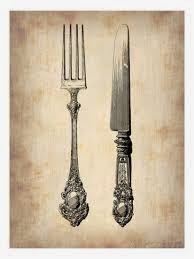
Showing posts with label Antique Forks. Show all posts

Monday, May 25, 2020

How Forks Replaced Knives

The fork was originally, and up to very modern times, used only to hold meat and other pieces of food, while the knife was cutting them. The putting of it into the mouth instead of the knife was only an afterthought, due probably to the unclean appearance of the knife blade after it had been used to shovel into the mouth, gravies, egg yolks, acids, etc... – Photo by site editor Maura J. Graber

Questioning the Fork: 
The Origins of This Very Useful Article and Why it Replaced Eating From Knives


One of those heterodox fellows, who may be found to question everything, asks upon what  sound principle is the law founded that forbids the putting of the knife into the mouth in eating. Why should a plate of steel, he asks, be interdicted from an office that the same steel, bifurcated, trifurcated or quadrafurcated, may properly perform? There is no objection to be made on the score of cutting one’s mouth, for in all ages of the past, when everybody ate with the knife, nobody ever cut his mouth. This heretic asserts that a certain consistency of food can be ‘‘hoisted,” as a western man would say, much more readily by a knife than by a fork. Of course, you can get the bulk of a mashed potato
 or turnip by dexterously fishing with a fork, but you can do it much neater and in better time with a knife, he continues; and thru the knife will secure all the gravy, which is mostly sifted out by the operation of the fork, and one thus loses the richest part of the meal. 

It is a matter of history that knives played an important part in domestic life long before forks were invented, and that when first the latter implements appeared, it was considered a mark of effeminacy or ultra refinement to use them. To such a degree was this prejudice against them indulged in France, that in the Sixteenth century the use of forks was considered sinful in monasteries, and the monks split up into two parties on the question. Forks originally came into use to save the fingers from soiling, and Italy was the first place where they were used. Ben Jonson writes of “the laudable use of forks brought into custom here as they are in Italy, to the sparing of napkins.” Some time later, a writer praises the King of Hungary for eating without a fork without soiling his clothes. An old writer explains why the Italian used the fork by saying that he could not “endure to have his dish touched with his fingers, seeing that all men's fingers are not clean alike.” 

But the fork was originally, and up to very modern times, used only to hold meat and other pieces of food, while the knife was cutting them. The putting of it into the mouth instead of the knife was only an afterthought, due probably to the unclean appearance of the knife blade after it had been used to shovel into the mouth, gravies, egg yolks, acids, etc... For this reason, silver forks were made; they are cleaner than iron and steel forks. Every step, then, from the original use of the fork as a substitute for the fingers, to its more extended use a substitute for the knife, together with the employment of silver in place of iron, has been dictated by cleanliness. —Good Housekeeping, 1880

Etiquette Enthusiast, Maura J Graber, is the Site Editor for the Etiquipedia©️ Etiquette Encyclopedia 

Wednesday, December 6, 2017

Etiquette and “the Right Fork”


Using Your Utensils

Using “first” forks — Cocktail forks, oyster forks, escargot forks, and the like, are used with the right hand only. If snail or escargot tongs are being used, they are held in the left hand to hold the snail shell in place.

All spoons are used with the right hand, including individual caviar spoons and caviar spades.

Using dessert forks alone— Pie forks, ice cream forks, fruit forks can all properly used in the right hand, if no cutting with a knife is involved, with one notable ex-ception being the mango fork. A mango fork is held in the left hand while using a fruit knife or fruit spoon in the right hand.

Using dessert spoons alone — Ice cream, pots de crème, and other soft desserts eaten with spoons in the right hand.

Using a dessert fork and spoon together — Dessert eaten using 2 utensils is nearly always done in the Continental style, except this is done with a fork and spoon as opposed to with a fork and knife. The fork is held in the left hand with tines facing down, and the spoon is held in the right hand. The fork is used to hold or keep a dessert in place as the spoon cuts off small bites. This works well with desserts such as Baked Alaska or certain types of cakes.

An exception to this rule is pie or cake, à la mode. These are both eaten with a dessert fork and spoon. The spoon is used to cut and then place a bite of cake or pie and a bit of ice cream on the fork, which is held in the right hand and used to eat the dessert.

For all other dining with a knife and fork, the fork is in the left hand and the knife in the right when dining in the Continental style.

Fork tines point down for all cutting and eating in Continental dining, save for stringy pasta.

Fork tines point down only for cutting food, in the American style of dining.


Etiquette Enthusiast, Maura J. Graber, is the Site Editor for the Etiquipedia© Etiquette Encyclopedia 


Wednesday, September 20, 2017

Etiquette from Fingers to Forks

Fingers were once used to perform the office now assigned to forks, in the highest and most refined circles of society. — (Above) A rare "bird set" in the Chantilly pattern.


The Duchess of Beaufort, dining once at Mme. de Guise's with King Henri IV of France, extended one hand to receive His Majesty's salutation, while she dipped the fingers of the other hand into a dish to pick out what was to her taste. This incident happened in the year 1598. It demonstrates that less than three hundred years ago the fingers were still used to perform the office now assigned to forks, in the highest and most refined circles of society. 
At about this time, in fact, was the turning point when forks began to be used at the table as they are now. 

When we reflect how nice were the ideas of that refined age on all matters of outer decency and behavior, and how strict was the etiquette of the Courts we may well wonder that the fork was so late in coming into use as a table furnishing. The ladies of the Middle Ages and the Renaissance were not less proud of a delicate, well kept hand than those of our own days, and yet they picked the meat from the platter with their slender white fingers, and in them bore it to their mouths. The fact is all the more remarkable, because the form of the fork was familiar enough, and its application to other uses was not uncommon.—J. Von Folke in Popular Science Monthly, via the Press Democrat, 1899


Etiquette Enthusiast, Maura J.Graber, is the Site Editor for the Etiquipedia© Etiquette Encyclopedia 

Saturday, November 22, 2014

More Victorian Era Dining Etiquette

“Modern cookery is of such a high degree of excellence, modern table-implements so luxurious and varied, that elegant enjoyment and graceful ease may reasonably ‘be expected of those who gather round a well-appointed table.’”
One of the fundamental rules for graceful carriage is, keep your elbows at your sides, and this rule should dominate the movement of the arms while at table. Its workings are felt rather than seen, but they are nevertheless evident in the graceful methods of those who understand the difference between dining elegantly and merely consuming food.

Modern cookery is of such a high degree of excellence, modern table-implements so luxurious and varied, that elegant enjoyment and graceful ease may reasonably “be expected of those who gather round a well-appointed table.” Even if the general verdict falls a little short of this, the standard is sure to grow toward it. It cannot be otherwise where the desire for improvement exists, and it would be false to assume that there are not many who feel the need and seek the means of improvement. Progress is more quickly noticeable in city than in country life for many reasons, first among them being the necessity for quick and ready adaptation to rapidly moving events.

Although the four-pronged silver fork was in use upon the continent of Europe in the first decade of the present century, it is noticeable that the use of the knife in carrying food to the mouth is by no means obsolete among some of the most advanced of the European nations. One can easily draw a mental picture in which the dogmatists of etiquette a half century ago are seated about a tempting board, all eating with their knives, but using them daintily ; and the retrospect need not go back of the times of those whose manners at table, as well as elsewhere, are defined as models of elegance. 

Since then the steel fork has been banished, the knife subjugated and the spoon subdued. The reason for all this is commonly supposed to be the danger of cutting the lips with the knife, but such danger is very slight, unless one be persistently stupid in handling it. It is much more sensible to assume that mankind was not slow to perceive the more agreeable sensation of putting to the lips the delicate tines of a fork, which were close enough to convey all except liquid edibles with comfort and convenience.
   
Then, too, there are many varieties of food which deteriorate from even the slightest contact with steel, a metal still much in use for knives. There is, however, an inclination to force the use of the fork to the point of affectation, and excess in this direction is quite as deplorable as the indiscriminate use of the knife. The proper use of any table implement at a table where one is a guest is no different from what it would be at the most informal meal, except as it may be influenced by the special preparation of an edible.

In seating one’s self at table a comfortable posture is not incompatible with a dignified attitude. The shoulders should not be thrown back too far, nor should they drop forward. It is the latter pose which produces the inclination of the arms suggestive of the " all elbows" idea which some people give of themselves.
“Of course, the right hand is most frequently used, because it is the best trained for such service; but those who believe it to be an oversight not to train both hands to do our bidding with equal skill are not slaves to the dictum of never raising the fork with the left hand, nor is it supposable that in such a minor matter personal opinion should cause one to relinquish a carefully considered habit or adopt a new one. Etiquette only advises that, if the fork is used in the left hand, it be carried to the mouth with the tines pointing downward.” ~Beautifully stylized oyster forks with one lobster claw fork from a silver catalog

When oysters on the shell are served, at the beginning of a dinner, oyster forks are provided, and in eating such shell-fish the right or left hand may be employed to carry them to the mouth. Of course, the right hand is most frequently used, because it is the best trained for such service; but those who believe it to be an oversight not to train both hands to do our bidding with equal skill are not slaves to the dictum of never raising the fork with the left hand, nor is it supposable that in such a minor matter personal opinion should cause one to relinquish a carefully considered habit or adopt a new one. Etiquette only advises that, if the fork is used in the left hand, it be carried to the mouth with the tines pointing downward. This applies to its use with all kinds of food and to all varieties of forks, but is emphasized here in its application to the oyster fork, because there are many people for whom the smallest blue-points lose their relish if the eyes are forced to rest upon them as they approach the mouth.
Rolls used to be placed in one's napkin, prior to seating the guests, on each guest's plate.
The bread or dinner roll is removed from the napkin on which it is found and placed at the left side, but aside from doing this and placing the napkin the diner does not interfere with the arrangement of the cover until the servant removes the plate. Fingering the glasses, etc., is evidence of a vacuous state of mind.

The servant, if well trained, omits no one in passing such condiments as the various dishes call for, or in replenishing anything of which a first supply may not suffice; consequently, a gentleman's duties in this respect are light, but, trivial as they may be, he should not neglect them.

Even though decanted wines be placed upon the table and the attendant be only a maid, do not offer any kind to a lady until she has finished her soup and do not undertake to assume the duties of the butler, if there be one, in this respect. It is one thing to see that a lady is provided for, and quite another to perform the service in such a way that it interferes with pre-arranged plans.

Soup should be lifted with an outward motion of the spoon and taken from the side of the spoon when possible, and the impossible instances are very rare. A man with a heavy moustache may be excused if he deviates somewhat from this rule, but not until after he has acquired the dexterity necessary to raise his spoon with the end toward him without thrusting his elbow out or making the movement of his arm conspicuous. Such skill can be cultivated, but not so easily as the movement of lifting the spoon sidewise to the mouth. It ought to be unnecessary to add that soup should be taken noiselessly. If the variety served is not agreeable to the palate, let it remain until the servant is ready to remove it.    
An elegant presentation for soup.

It is not good form to refuse soup, even if you do not care for it, it being an easy matter to take up the time of this course with conversation. Indeed, when dinner is served a la Russe, that is, each course placed separately before the diners, it is not judicious to refuse any course unless the list is very long and a menu from which to select is provided. Superabundance in this direction, and the use of the cards as well, are, however, neither fashionable nor refined. No one is obliged to partake of a dish placed before him, and ladies especially are excusable from partaking of richly made dishes and highly seasoned compounds. They may sip their wine and partake of the bread or dinner roll, and if they desire more of this satisfying and healthful food they are entitled to express their desire at the most formal dinner. Their escorts should see that they are provided, and this can best be done by attracting the attention of the waiter in an unostentatious manner. A New Yorker, whose appearance at any dinner, private or public, gives it the cachet of success, and whose delightfully entertaining qualities are recognized both here and abroad, when asked how he preserved his digestion and kept his head clear under pressure of attendance at so many social dinners and formal banquets, replied, "By avoiding made dishes and eating bread while others are partaking of them, and by taking only one variety of wine."

As each course is ended, readiness to have your plate removed may be expressed by placing the knife and fork across it, with the handles to the right, and when the next plate is placed before you, if the knife and fork to be used for the succeeding course be upon it, remove them deftly to the table, placing them at the right side without touching the plate, even though it be the one from which you are to eat.
“Etiquette only advises that, if the fork is used in the left hand, it be carried to the mouth with the tines pointing downward.”

In the use of the knife and fork, daintiness should be cultivated without impairing or interfering with the proper function of either implement. Some varieties of fish do not require the use of the knife, the fork and a piece of bread being sufficient. Others, notably those having many small bones, cannot be properly managed without one, and a small silver knife accompanies their service. Both knife and fork should be held with the handles resting in the palms of the hands when cutting or separating food, but in carrying food to the mouth the handle of the fork should not be kept against the palm, as conveying it in that position gives the effect commonly expressed as “shoveling” the food into the mouth. 

A firm hold upon both knife and fork does not necessitate gripping them as if they were endowed with the ability to fly. It is inelegant to appear busy with both knife and fork all the time. Such foods as require special preparation upon the plate may be prepared neatly and quickly before beginning to eat them, and while it is not desirable to cut one's portion of roast in small bits, as for a child, it may be divided into morsels as wanted without appearing to be incessantly sawing upon it. Whoever is given to "loading up'' a fork or holding upon it a quantity of food pending its deposit in the mouth, had best dine by himself until such gaucheries are overcome.

Eating and drinking at the same time are reprehensible for more than one good reason; but the fact that the practice is contrary to good manners condemns it sufficiently in the minds of the well-bred. Hurry, the bane of our epoch and the foe of self-possession, has implanted the tendency to do everything in the shortest possible time, and the habit of hurrying clings after the necessity has sped. There should be no evidence of haste at a dinner-party, and even the suggestion of it should be guarded against. 

The napkin should be touched to the lips in the interval between partaking of greasy food and drinking; otherwise the rim of the glass will not be inviting to look upon. In eating or drinking, the fork, spoon, glass, or cup is carried to the mouth, but not beyond the lips. Throwing the head far back, thrusting the spoon or fork far into the mouth, turning the bowl of the spoon over in the mouth, draining the glass, emptying it at a single draught, or reversing it so that the stem is inverted, are not merely sins against the social gods — they are coarse and repulsive habits, which should be cured as speedily as possible.
“Crumbing” the table before dessert
It was a pleasing and proper acknowledgment when an invitation to one's table signified the most sacred form of social hospitality, but though an invitation to dine still suggests a desire for some degree of social intimacy, the giving of dinners has grown to be more of a formality since that time.

No more nonsensical statement could be made than that everything eatable should be carried to the lips with a fork. The spoon is the proper medium for conveying many varieties of semi-liquid foods; but methods of preparing certain foods differ according to locality, and to this difference is attributable much of the misunderstanding existing between the use of the fork and spoon. Tomatoes cooked without anything to absorb their liquid contain but little pulp which can be eaten with a spoon, but the delicious manner of thus preparing them, which prevails throughout New England, more than counterbalances the satisfaction that the remnant of solid matter conveyed to the mouth upon a fork would bestow; and those to whom the preparation is agreeable would merely proclaim themselves ridiculously automatic in their ideas by attempting to eat them without the aid of a spoon. On the other hand the same vegetable, prepared so that but little moisture remains, is as easily lifted upon the fork as mashed potato. We have made an every-day selection to illustrate this point, but the rule applies as practically to the daintiest viand that rejoices in a French name, and should be as faithfully adhered to at the table of a king as at the humblest board.

Many people, believing it bad manners to ask for anything not provided by their hosts, inconvenience themselves by refraining from asking for anything which the table equipment does not include. There is, however, no reason why a spoon or any similar implement should not be asked for, if needed; but never on any account should a person signal conspicuously to the waiter nor address him as " waiter." In a restaurant you may ask the usher to send a waiter to you if the service is slow or the attendant negligent, but not even in this public place does a well-bred man call out “waiter,” and he who commits such a blunder beneath a private roof might as well hope for future canonization as for present social success.

Primus, a dinner party pre-supposes enjoyment of the viands; secundus, it does not require that a guest shall express his pleasure by waving his napkin, gesticulating with his knife, fork, or spoon, or talking while his mouth is full of food. Fleeting as is time, there is enough of it for all things, and when conversation is in order, let eating be suspended. Exciting topics may be banished without excluding those which have an exhilarating interest. – By Eliza Lavin, 1889


🍽️Etiquette Enthusiast, Maura J. Graber of The RSVP Institure of Etiquette, is the Site Editor for Etiquipedia© Etiquette Encyclopedia

Friday, October 31, 2014

Etiquette for Lobster and Shellfish

How to Eat a Lobster Boiled or Broiled-

Andy (Andrew) Warhol's artwork added to “Amy Vanderbilt's Complete Book of Etiquette,” as well as her wonderful cookbook

1. Holding the body of the lobster on the plate with the left hand, twist off the claws with the right. Lay on side of plate.

2. Holding the lobster steady on plate, if necessary, lift up tail meat with fork. Cut into manageable segments with knife, dip in melted butter or mayonnaise.
3. Break off small claws and gently suck out meat from severed end.

4. Crack big claws, extract meat with seafood fork or nutpick, dip in melted butter or mayonnaise.

5. With seafood fork, pick out the good meat in the body, including the tamale, the green liver (and in females, the scarlet roe). Real lobster lovers unhinge the back and open the body of the lobster to extract the remaining sweet morsels.


A collection of seafood forks and cocktail forks, along with one splayed-tine lemon fork. 

Seafood 
Steamed Clams -
The steaming process is supposed to open the shell completely but sometimes doesn't. If a shell is not fully open, take it up and bend it back with the fingers. If this doesn't work, forget that one. Do not use a dinner knife or fork as an opener. With shell fully open, take the shell in left hand just over the dish and with the right hand lift out the clam by the neck. Holding the neck with the right hand, pull the body of the clam from it and discard the neck sheath. Holding the clam by the neck with the right hand, place the whole clam first in melted butter or broth, or both alternately, then in the mouth in one bite.

As empty shells collect, remove to butter plate or shell plates provided (and as clam-eating of this kind is always informal, it is an excellent idea for the hostess to provide platters or bowls for empty shells as well as finger bowls with hot soapy water afterward). Do not spoon up remaining liquid in soup plate- it may be sandy, but drink the broth separately provided in a bouillon cup or small bowl (but not if it is in a little dish). If clams are fried, eat with fork after breaking into two pieces if necessary. As these are greasy they should not be taken in the fingers, even by the neck.

Lobster and Hard-Shelled Crabs (Broiled or Boiled)-


Lobster picks, seafood forks and rare, silver, Victorian lobster tongs. 

The claws of both of these require dexterous handling. They should be cracked in the kitchen but further cracking at table (with a nutcracker) may be needed. Then the shells are pulled apart by the fingers and the tender meat extracted carefully so, if possible, it comes out whole. A nut pick is useful for this, but an oyster fork may do it, too. The claw meat, if small and in one piece, is dipped in melted butter or, with cold crab or lobster, in mayonnaise, then put all at once into the mouth. Larger pieces are first cut with a fork. The green material in the stomach cavity, called the "tamale," along with the "coral" or roe in the female, are delicacies and should be eaten with the fork. The small claws are pulled from the body with the fingers, then the body-ends placed between the teeth so the meat may be extracted by chewing (but without a sucking noise). The major portion of meat is found in the stomach cavity and the tail and is first speared, one side at a time, with the fork, then with the help of the knife, if necessary, lifted out and cut as needed into mouthfuls, then dipped in sauce or mayonnaise with the fork.

Mussels-


An odd fact ~ Watch what you serve if you are hosting any of the British monarchy. British Royals are never served shellfish in order to avoid poisoning. 

Served pickled or smoked on toothpicks as cocktail titbits and are thus taken via toothpick directly to the mouth. Served in shells and all in a variety of soup styles, too Moules Marinieres (Mussels mariner style) in a soup dish with a delicate thin soup like sauce redolent with garlic. The mussels may be picked out with a small oyster fork provided, but it is easier and just as correct to use the shells containing the mussels as small scoops. Pick up with the right hand and, placing the tip of the shell in the mouth gently (and silently), suck out mussel and sauce, then discard shell onto butter plate or platter provided. When shells have been cleared from dish, eat balance of sauce with spoon and bits of French bread used to sop up sauce, then conveyed to mouth with fork. The Italian variety of this dish has tomato, and is eaten the same way, often as a main dish with salad. A finger bowl is essential.

Oysters and Clams (Half Shell)-


Antique oyster or seafood fork 

Hold the shell steady with left hand and, using oyster fork, lift oyster or clam whole from shell, detaching, where necessary, with fork. Dip in cocktail sauce in container on plate, if desired. Eat in one mouthful. Oyster crackers may be dropped whole in sauce, extracted with oyster fork and eaten.


E.B. Mallory and Company's oyster advertisement, circa 1880's. Eliada Blakesley Mallory canning company in Gladesville and Baltimore, Maryland produced "Arrow Brand" oysters, thus the arrows being used as oyster forks in the advertisement. 

Shrimps, Scallops, Oysters (Fried)-


Diamond brand oyster advertisement. 

Eaten like fried clams, except that oriental fried shrimp (French fried with the tails on) are to be taken up by the tail and dipped in sauce, then bitten off to the tail, which is then discarded. Unshelled shrimp are lifted in the fingers, shelled, and conveyed whole to the mouth.


From the original "Amy Vanderbilt's Complete Book of Etiquette"


Etiquette Enthusiast, Maura J. Graber, is the Site Editor for the Etiquipedia© Etiquette Encyclopedia

Tuesday, June 24, 2014

Etiquette and the History of Forks

      
An assortment of fork designs, for everything from Victorian green corn, to baked potatoes, bread, butter, ice cream and cheese.

Early Forks and Use in Europe

Thomas Coryat was an English traveller and writer of the late Elizabethan and early Jacobean age (c. 1577 – 1617). He is principally remembered for two volumes of writings he left regarding his travels, often on foot, through Europe and parts of Asia. He is credited with introducing the table fork to England, with “Furcifer” (Latin: fork-bearer, rascal) which then became one of his nicknames. The fork he described had two tines. Since then, forks have been designed with many more than 2 tines. Some forks have up to 7 or 8, depending on what one is serving.
               
Antique melon forks ~ Perfect for cantaloupes, watermelons, honeydew melons, etc. Though the fork’s early history is obscure, the fork as a kitchen and dining utensil is believed by some to have originated in the Roman Empire, or perhaps in Ancient Greece. Others believe the fork’s origins to be in Africa or the Middle East. 

The origins of personal table forks are believed to be in the Eastern Roman, or Byzantine, Empire, when, according to “
1843 Magazine” at the party celebrating her marriage to the son of the doge of Venice in 1004, Byzantine Princess, Maria Argyropoulina, niece to the emperor of Byzantium, scandalized the guests by using a fork to eat. Prior to that, forks were large, two-pronged utensils used for toasting or carving foods, and smaller versions could be used to retrieve food from jars or other containers, but no one had used one to eat with publicly. Her actions were immediately condemned. One priest declared that “‘God in his wisdom has provided man with natural forks – his fingers.’ When Maria died of the plague two years later, it was seen as divine punishment for her decadence.”

Use of the fork spread slowly during the first millennium CE and then spread into southern Europe during the second millennium. Forks did not become common in northern Europe until the 18th century and were not commonly used to eat in North America until the 19th century. By the mid 1800s, forks were being designed for nearly every type of food, and were considered necessary to every proper home's table.

It is common knowledge (and a flattering social myth for us) that our own ancestors used to have very different -- and much cruder -- table manners from those we practice today. We have “come on,” in other words; we have “progressed.” The simplest historical novel or movie can make an exotic effect by presenting a scene in which dinner guests gnaw meat straight off bones gripped in their greasy fists, then hurl the remains into the corners of the room. These, the audience accepts without difficulty, were the manners of the past, before we became modern and civilized. (This sense of superiority does not prevent us from feeling proud, at the same time, of modern simplicity and lack of pomp. We are as capable of despising our ancestors for their tradition-bound complexity as for their rudimentary standards of propriety.) 
Forks had also to be made and sold, then produced in versions which more and more people could afford, as they slowly ceased being merely unnecessary and became the mark of civilized behavior. 

Manners have indeed changed. They were not invented on the spot, but developed into the system to which we now conform. Since manners are rituals and therefore conservative -- part of their purpose is always conservation -- they change slowly if at all, and usually in the face of long and widespread unwillingness. Even when a new way of doing things has been adopted by a powerful elite group -- using forks instead of fingers, for example -- it may take decades, even centuries, for people generally to decide to follow suit. Forks had not only to be seen in use and their advantages successfully argued; they had also to be made and sold, then produced in versions which more and more people could afford, as they slowly ceased being merely unnecessary and became the mark of civilized behaviour. After the eleventh-century date of the first extant document describing (with wonder) the sight of someone using one, the fork took eight centuries to become a utensil employed universally in the West.
—From Margaret Visser’s, “The Rituals of Dinner” 
“It’s a dinglehopper!” Scuttle the seagull, answering an inquisitive mermaid Ariel, after she presents a dinner fork for his expert identification of a human item that she is unfamiliar with, in Disney’s 1989 The Little Mermaid ~ From “Let Them Eat Cake... The Strange Saga of the Mango Fork and the Unique Dining Habits of the Dutch” by Etiquipedia Site Editor, Maura Graber 

Meet Fork In Box. Fork, meet reader. “Meet Fork in Box” was the misspelled listing I found on eBay that allowed me to snag my second Dutch mango fork. Obviously a misspelling, I am sure the German Ebay seller who listed this beauty meant to list a “meat fork in box”. Before I go any further however, I should tell you a bit of my history with this odd utensil. In reality, I have never met a fork I didn’t like. My preoccupation with forks began not too long after Disney’s Ariel made her landing at the box office. Katie, my daughter, was almost three. She was enthralled with the precocious sea maiden who had red hair the color of her own. By the time the VHS tape was running continuously at home, I was starting an etiquette business for children and teens. The majority of the kids I taught were so used to fast foods, they rarely ate at a family dinner table. Showing them interesting and odd looking forks, along with other unusual utensils, was a way I found that kept kids interested when I talked of setting the table at home. I needed to do something to catch their wandering attentions, and strange utensils filled that need. 
Several Dutch mango forks ~ Many Dutch feel these forks are better suited to cake. All of these pictured are Dutch, save the fork on the far right. It was from South America. 

My husband was great at sussing out unique forks for me in the beginning. We stopped in thrift and antiques shops to find odd things for the table that were relatively inexpensive. Utensils over $10.00 seemed pricey. After all, these were props for my students to pass around and examine. Sales of very old used books on silver at the local library were how I did my research on pieces we’d found. Some were sold for only a quarter. I use them for reference still. 

Anything Victorian was popular during the 1990s. Tea rooms were sprouting up in malls, while magazines and books devoted to the subject were readily available. Over the next few years, as my collection of table silver oddities grew, my forays for the rarest of forks became more time consuming. Any weekend outing meant a side trip to a thrift shop or antiques mall. I was asked to give talks and lectures on not just my collection, but how people in America once dined with grace and forethought. At least more forethought than wondering if “... you want fries with that?”, before being handed a bag of fast food through the car window.– From various sources including the book, “Let Them Eat Cake,” by Maura J. Graber


🍽️Etiquette Enthusiast, Maura J Graber of The RSVP Institute of Etiquette, is the Site Editor for the Etiquipedia© Etiquette Encyclopedia