Showing posts with label Etiquette and Good Form. Show all posts

Tuesday, February 27, 2024

Wedding Receiving Line Etiquette

If you are a friend of the bride and unacquainted with the bridegroom she will introduce him to you after you have shaken hands with her. If you have not had an opportunity of congratulating her on her engagement you might say, "I must wish you both every happiness," but it is an old fashioned custom to offer good wishes to a bride at a reception, and therefore it is seldom done. – Image source, Pinterest
The Wedding Reception

Congratulations are usually offered as soon as an engagement is made known, and therefore there is no need to repeat them at the wedding reception. At the reception it suffices to shake hands with the bride and bridegroom after having shaken hands with the bride's mother. If unacquainted with the bride you should not wait to be introduced to her. She will offer to shake hands with you as a matter of course, you being a friend of the bridegroom and a guest in her mother's house. 
If you are a friend of the bride and unacquainted with the bridegroom she will introduce him to you after you have shaken hands with her. If you have not had an opportunity of congratulating her on her engagement you might say, "I must wish you both every happiness," but it is an old fashioned custom to offer good wishes to a bride at a reception, and therefore it is seldom done. 
Guests pass the bride and bridegroom so quickly that to pause and to make polite speeches would occupy too much time and would weary the newly married couple greatly if all the guests were to follow this lead. Handshakes and smiles are all that circumstances admit of on such occasions. 
Oftener than not, the bride has a word or two to say of thanks for a wedding present received on the previous evening, and this calls for a reply on the part of the sender before she can make room for another guest awaiting her turn to shake hands. – From “Good Form,” 1911


 🍽Etiquette Enthusiast, Maura J. Graber, is the Site Editor for the Etiquipedia© Etiquette Encyclopedia

Monday, March 1, 2021

Good Form in Public 1923

Well-bred folk the world over are unostentatious in public. It is a notable fact that in almost all countries of the world, navy blue, gray not too pale in tone, and black, are preferred colors for streetwear. The sole exception to this rule is the hot countries, where on account of the climate, white is worn.
  • In street, ferry, restaurant or theater, a well-bred person will conduct himself so as to draw no attention to himself. Loud voices, noticeable gesticulation, conversation in which absent friends are called by name in tones easily overheard by bystanders, all these are marks of those who “don't belong.”
  • In a crowd, never hail a friend by calling his name, if he is some distance away, for it is not necessary that you should thus inform those who block the way, of your friend's identity. Either you must contrive to pass and join him, or else catch his eye and bow.
  • Jostling and elbowing away through a throng of people is not to be thought of, except by those who do not care how undignified they appear in the eyes of others.
  • In public — as elsewhere —ladies and gentlemen are guided by the principle of consideration for others, and respect for the rights of others.
  • In any line of people waiting for tickets and the like, each person should wait his turn. A woman has no right to place herself ahead of earlier comers —just because she is a woman.
  • Kissing, embracing, and excitable greetings, on the part of two women who spy each other in a public place, is out of place. Neither, in conversation, is it well-bred to clasp the hand of the person to whom you talk. Women should not powder publicly — although this rule of etiquette is so often broken, one wonders who keeps it.
  • Nudging, to attract the attention of the person addressed, is unspeakable.
  • Well-bred folk the world over are unostentatious in public. It is a notable fact that in almost all countries of the world, navy blue, gray not too pale in tone, and black, are preferred colors for streetwear. The sole exception to this rule is the hot countries, where on account of the climate, white is worn. —Virginia Sidney Hale, 1923


Etiquette Enthusiast, Maura J. Graber, is the Site Editor for the Etiquipedia© Etiquette Encyclopedia


Sunday, January 31, 2021

One Definition of Etiquette Enthusiasts

Caricature of Amercian lawyer and socialite Ward McAllister as “Snobbish Society's Schoolmaster.” Library of Congress description: “Caricature of Ward McAllister (1855-1908) as ‘an ass’ telling Uncle Sam he must imitate ‘an English Snob of the 19th Century’ or ‘you will nevah be a gentleman’; Uncle Sam is shown laughing heartily.” 
Public domain image


Etiquette enthusiasts are usually super-sensitive people. “Good form,” in their eyes, is of paramount importance. Ward McAllister is one of these. The extremes of etiquette enthusiasm and of superficiality, usually go hand in hand. Frequently, the less a man knows the more enthusiastic is he over the punctilious observance of what is vulgarly known as “good form.’’ 

Active, intelligent men are too busy with the serious affairs of life to devote much thought to the etiquette of enthusiasts. Official life demands much etiquette and its observance is then as commendable as is a good dinner, such as is served at the Hotel Florence, to a hungry guest. — From “Local Intelligence,” the San Diego Bee, 1896

While we Etiquette Enthusiasts at Etiquipedia agree we can at times be super-sensitive, we disagree with the rest of this 19th century take on “Etiquette Enthusiasts.” We think this describes more accurately some working in the field of etiquette who assume the title of “expert,” without having actually attained any expertise.


Etiquette Enthusiast, Maura J Graber, is the Site Editor for the Etiquipedia© Etiquette Encyclopedia


Friday, April 3, 2020

Good Form in Dining of 1894

It is good form to sit erect, to keep the arms off the table, to look pleasant, and to keep room in the mouth for a laugh...


It is good form to break off morsels of bread, toast, biscuits and cake. It is vulgar to bite into a slice. It is good form to train the left hand to use the fork. A gentleman does not lay down his knife and take the fork in his right hand, when the course consists of meat and a salad. 

It is good form to eat slowly and quietly. Only vulgar people are noisy. It is good form to sit erect, to keep the arms off the table, to look pleasant, and to keep room in the mouth for a laugh. People who eat like cattle should be induced to take meals in sheds or vacant lots. Babies and men and women in their “second childhood” can be excused for slobbering at table. – San Jose Herald, 1894


Etiquette Enthusiast, Maura J Graber, is the Site Editor for the Etiquipedia© Etiquette Encyclopedia 

Wednesday, April 1, 2020

Company Table Manners

As soon as a child is old enough to come to the table he should be taught by precept and example what good table manners are... Let it be understood that good manners are not the acquiring of every new wrinkle that fashionable society may prescribe. There is a great difference between good manners and good form. What is good form to-day may be very bad form tomorrow, but good manners are not changeable.

There seems to be an idea among many people that there must be a different set of manners for company from what is observed in everyday life. While it is the proper thing to have for an invited company a more elaborate dinner and a little more ceremony in the service than at the family table, it must be remembered that one should not put on and take off good manners as one would a garment. They are a part of one's self, and whether the family meal consist of many courses, or only a cup of tea and a slice of toast, it should always be served decently and in order, and the manners of the members of the household should be such that one need not blush for them, even in the finest company. As soon as a child is old enough to come to the table he should be taught by precept and example what good table manners are. If the father and mother be so unfortunate as not to have had proper training themselves, they should study to correct any bad habits they may have, for the sake of their children. 


Let it be understood that good manners are not the acquiring of every new wrinkle that fashionable society may prescribe. There is a great difference between good manners and good form. What is good form to-day may be very bad form tomorrow, but good manners are not changeable. Unselfishness, kindly feelings and politeness are the foundation of good manners. Good table manners demand that one shall take soup from the side of a spoon; shall eat with a fork, rather than a knife; shall take small mouthfuls of food and masticate quietly, making no unpleasent sound; shall take in the fingers no food except fruit, confectionary, olives, bread, cake,celery, etc., and that the members of the family shali be as polite to each other as to any guest. Where people rush through their meals there is not much chance fo: table maners or good digestion. If properly managed, the table can be made one of the most refining influences of the home. —Ladies Home Journal, 1892


Etiquette Enthusiast, Maura J Graber, is the Site Editor for the Etiquipedia©️ Etiquette Encyclopedia 

Friday, September 20, 2019

Etiquette and Manners Simplified

The little courtesy of suggesting to an interested acquaintance that you will be glad to see him in your own home, can not be improper. It offers dignified hospitality and suggests friendly good will, so it is kind. It is surely in better taste to meet your friends in your home than at dances or public entertainments of any sort. 


MANNERS are the gracious way of doing things. No better rule for “good form” and “etiquette” can ever be evolved than this simple little statement. Kind hearted people have the first asset toward good manners. If they govern their kindly impulses by good taste and common sense, they are sure to act in a manner that far exceeds “the proper thing” in human value. 

Take the simple question of whether a girl shall ask a man to call on her or not. The little courtesy of suggesting to an interested acquaintance that you will be glad to see him in your own home, can not be improper. It offers dignified hospitality and suggests friendly good will, so it is kind. It is surely in better taste to meet your friends in your home than at dances or public entertainments of any sort. 

And common sense ought to indicate to any girl whether a man is sufficiently interested in her to want the opportunity of seeing her again or not. For most of any question where you doubt the certainty as to what is the proper thing to do, just apply kindness, common sense and good taste. And you will be as well off as if you had studied manners in a finishing school or a book of etiquette. – By Beatrice Fairfax, 1916


Etiquette Enthusiast, Maura J Graber, is the Site Editor for the Etiquipedia© Etiquette Encyclopedia
Tuesday, August 23, 2016

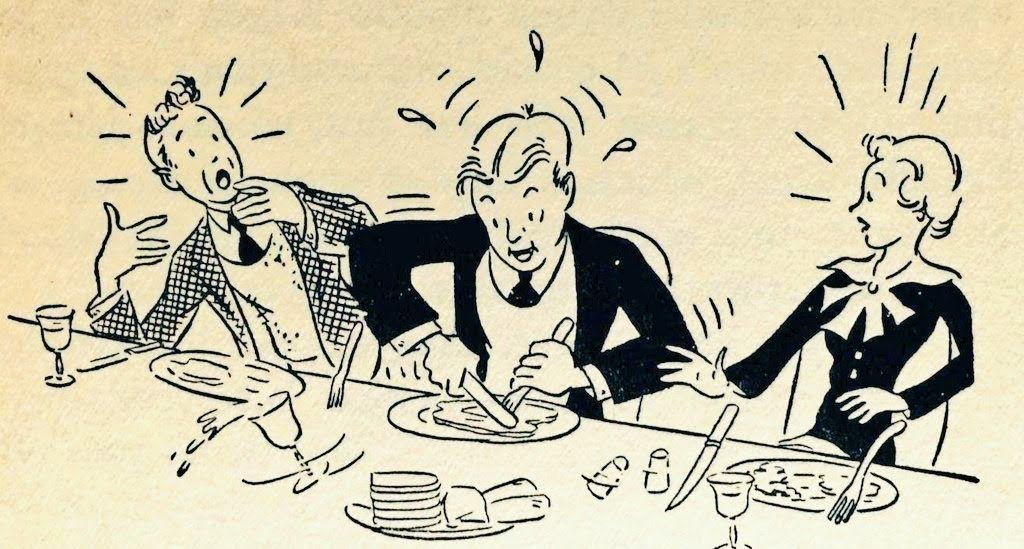
Etiquette and “Good Form”

Among the notable guests at the Constitutional Centennial banquet in the Philadelphia Academy of Music, in September were the Chinese envoys who accompanied Count Mitkiewicz to this country...

What is Good Form? Differing Customs In Different Countries—Etiquette Among Various Peoples

That etiquette is sometimes arbitrary and not covered by the definition of common sense set to rule, is shown by the widely varying customs in different parts of the world. An American going up or down stairs in a public hotel  does not feel it incumbent on him to remove his hat if a lady should see him on the stairs. In Europe it would be considered very rude if a man did not uncover under such circumstance. An American, entering a parlor, expects the lady of the house to rise and greet him. 

In Spain, a lady would seem to forfeit her self-respect should she exhibit so much forwardness. No one ever saw a man and a woman arm in arm in the streets of a Spanish city without knowing they were foreigners. A Spanish husband never takes his wife's arm in public. Nor would a Spanish woman receive a male visitor alone. Such is the system of protection exercised over women by Hidalgo, grandee, tradesman and peasant in the sunny land of romance. 

Among the notable guests at the Constitutional Centennial banquet in the Philadelphia Academy of Music, in September were the Chinese envoys who accompanied Count Mitkiewicz to this country in connection with the concessions to a Philadelphia syndicate. During the evening a note was handed to the chief envoy, a grave looking. elderly man. He was troubled for a moment, and then made an elaborate apology in French for the rudeness of which he was compelled to be guilty, namely, the wearing of his spectacles in company long enough to read the note. It is a gross breach of etiquette for a Chinaman to wear eyeglasses or spectacles in company, and it is equally impolite to enter a room with the hat off. A gentleman of the Celestial Kingdom always remains covered to show his respect.

 Another piece of Chinese etiquette noticeable at the banquet was that, although the evening was fine, the envoys wore rubber overshoes until they readied the Academy cloakroom, and removed them prior to entering the amphitheater. Chinese etiquette forbids a man to enter a room with soiled shoes, and consequently, overshoes are worn until arriving at the house. 

An American would never think of removing his hat prior to speaking to any man on the street. In Holland, before speaking in the most humble individual out of doors a male uncovers. In Holland, too, men and women rarely purchase at the same stores, but in case where they do, if a woman discovers that men are assembled inside, she retires until they leave. A live American store-keeper would probably soon change this feature of Dutch etiquette. 

The Americans, English, Germans and Russians shake hands with a man bidding him welcome. An Arab’s greeting is to rub his cheek against that of the person he salutes and kisses him. A Frenchman welcomes a friend by embracing and kissing him, though by slow degrees this custom is being superseded. The Japanese customs are similar to those of China. It is not an unusual sight to see a number of Japanese remove their sandals, cross their hands and cry “Spare me!” when a great man passes, but the custom is rapidly going out of vogue since the leaven of enlightenment has been spreading through the land. 

A peculiar mark of esteem in Burma is to ask permission to smell a person's face, and then declare the perfume to be as sweet as some choice flower. The custom is confined to Burma and is not likely to spread. In America, politeness goes, as it should, before all else. One rule can be laid down for general observance where a person’s ideas of the proper thing to do are unsettled: let him make himself at home. He should do so in a manner to create some respect for home, unlike a young man who called at the office of a noted Philadelphian, somewhat famous for his straightforward utterances. “Make yourself at home for a few minutes,” said the owner of the office to his visitor. The young man, having seated himself somewhat comfortably, but mistaking a table for a footstool, responded cheerfully; “I always make himself at home." “Then I pity the people at home,” was the quick response.   –The Coronado Mercury, 1890


🍽Etiquette Enthusiast, Maura J. Graber, is the Site Editor for the Etiquipedia© Etiquette Encyclopedia