Showing posts with label Etiquette for Eating Soups. Show all posts

Sunday, December 7, 2025

Spoons for Coffee, Tea and Soups

“In the category of round-bowled soup spoons alone (in contrast to the large oval spoons used at dinner time when soup is served in a soup plate, rather than a bowl), there are large ones for chowder, gumbo and other such messes; medium ones for cream soups; and small for bouillon. And as cream soup cups and bouillon cups are equipped with two handles each, the spoons can properly be ignored while the diner drinks directly from the cup and shocks the uninformed.” - What Have We Here? — A Gilded Age French écuelle. An écuelle is a 2-handled broth bowl, generally with a cover, perfect for a broth or light soup. A small, sterling bullion spoon sits inside in the rest position.
ANTHOLOGY ON SPOONS FROM GENTEEL TIME GONE BY


Dear Miss Manners: I inherited from my grandmother luncheon flatware originally manufactured during the Victorian Age. I have thoroughly enjoyed collecting the pattern, as it has so many pieces that are no longer used, reflecting an age so totally different from our own.

What was the purpose of the five-o’clock spoon? The ones I have are the same shape as a demitasse spoon with a slightly longer handle. Why were bouillon spoons made with such short handles? Granted, the bouillon bowls were quite small, but the handles on my bouillon spoons are so short they are difficult to use. My question does not concern correct behavior, but I believe you might have the answer.

Gentle reader: There is nothing like a good silverware question to distract Miss Manners from caring about who is being incorrect. So would you all kindly behave yourselves while she sinks her teeth, as it were, into this one?

The short answers are that five-o’clock spoons were used to stir tea at 5 o’clock, and your bouillon spoons are short because Victorians used even smaller bowls than are now used for serving bouillon. But to procrastinate from returning to behavior-policing duty, Miss Manners will elaborate.

As you know, silverware was a favorite Victorian sport. Inventing specialized tools and acquiring them before the neighbors knew how to use them was what people did to while away the time and work out their aggressions before they had video games.

Someone probably got a lot of points with the idea of making a distinction between stirring breakfast tea with what we now consider the all-purpose teaspoon, and stirring afternoon tea with a daintier one. There is such a thing as an ever-so-slightly smaller version called the four-o’clock spoon, but Miss Manners awards fewer points for this obvious piggybacking.

The coffee situation is similar — large coffee spoons for breakfast and demitasse spoons for coffee taken after dinner. Or at least it was before someone asked what difference it made whether you were stirring tea or coffee and spoiled the game.

Soup offered even more possibilities. In the category of round-bowled soup spoons alone (in contrast to the large oval spoons used at dinner time when soup is served in a soup plate, rather than a bowl), there are large ones for chowder, gumbo and other such messes; medium ones for cream soups; and small for bouillon. And as cream soup cups and bouillon cups are equipped with two handles each, the spoons can properly be ignored while the diner drinks directly from the cup and shocks the uninformed. That last move is a sport Miss Manners is afraid she still finds amusing.–
 By Miss Manners, Chicago Tribune, October 26, 2000


 🍽Etiquette Enthusiast, Maura J. Graber of The RSVP Institute of Etiquette, is the Site Editor for the Etiquipedia© Etiquette Encyclopedia

Wednesday, May 10, 2023

Onion Soup Etiquette

How to Eat French Onion Soup 
and Other Soup Tips

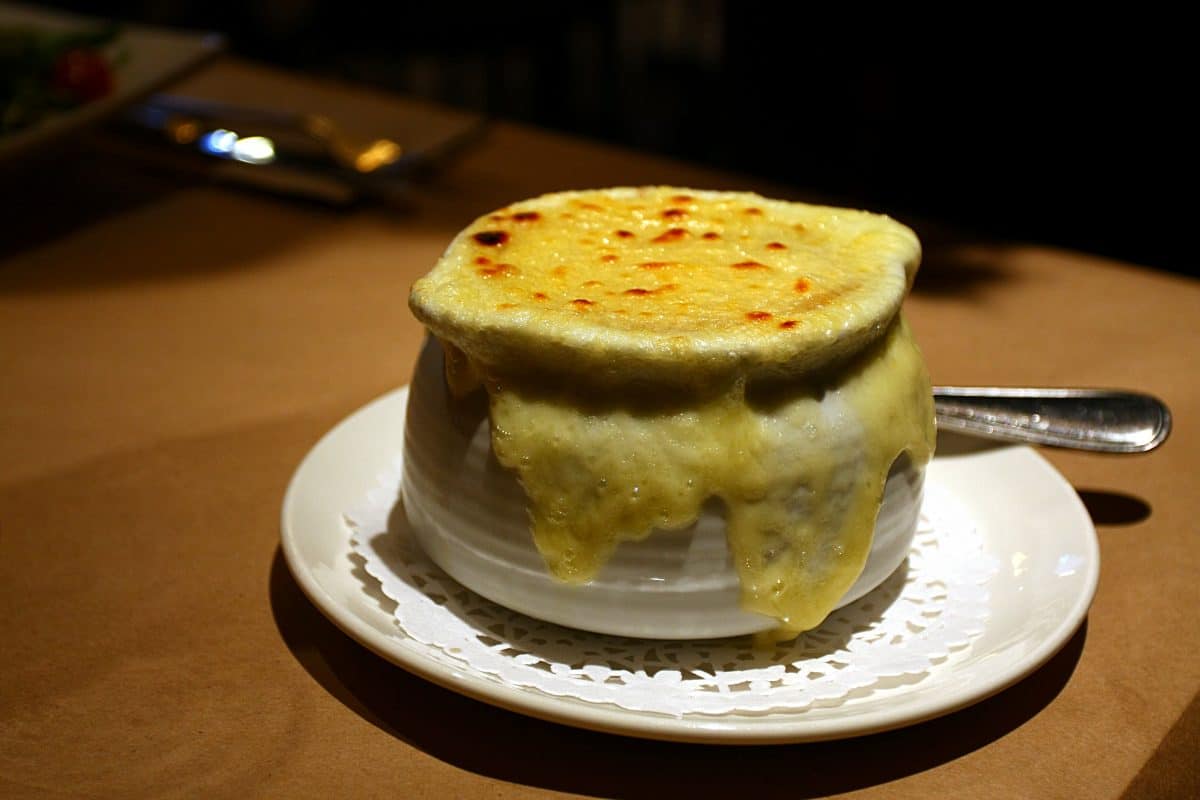
French Onion Soup

A friend recently shared an interview experience with a person who was applying to work at his law firm. The employment offer was off the table after having lunch with the applicant. The person completely blew eating their French Onion soup! (Details left to the reader’s imagination.)

How to Eat French Onion Soup

It’s interesting how one little bowl of soup can bring about the level of anxiety this one does. Although steeped in tradition, served in French market cafés primarily as late-night fare, the bread and cheese hooding the fragrant broth and onions creates confusion for those hoping to eat it with some semblance of decorum. 

So, how DO you eat French Onion Soup with confidence and fewer drips?  Etiquette experts, Emily Post and daughter, Peggy, have shared, “With such a soup, a knife is your friend, not your enemy.” That’s right, it is acceptable to use a knife when eating this soup, especially when it helps avoid your wearing strings of cheese on your face.

  • Much can depend on the soup as prepared by the chef.  If, as in the picture above, cheese has baked down firmly onto the sides of the bowl, the diner must be careful with the first knife move to avoid a possible burst of steam.
  • With the soup spoon in your dominant hand and a knife in the other hand, push the cheese from the middle outward to the rim of the bowl.
  • Use the knife to cut and nudge bits of cheese onto your spoon. In the case of long strands of cheese that are difficult to get into the spoon, you can twist the strand around the wide part of the spoon and then cut it with the knife.
  • You can also switch hands and use the knife to cut the crispy bread, while using the soup spoon to leverage it.
  • It's tricky!

Doing Business During a Meal

If your business includes working with clients, the business lunch is a perfect social occasion with a goal that is professional. On a very small scale it is like a networking event with food and drink involved. And, if you are being interviewed over lunch, know that the potential employer will be imagining how you will interact with their clients. Having good dining skills is paramount. 

When you are dining with a potential employer, it’s no time to be adventurous with food. Make sure your meal is within your skill level comfort zone. If you order soup, make sure that it is creamy or a broth and that can easily be eaten with a soup spoon alone, never requiring the use of any other utensil or bread. 

When you order soup at a business lunch or dinner:

  • Order “easy” to eat soup that will allow you to concentrate on the conversation at hand.
  • Never add salt or pepper without first tasting. 
  • Hold the spoon so that the bowl of the spoon is angled away from you.
  • Do not fill the bowl of the spoon too full or make any slurping sound.

A business or working lunch, like any meal, is meant to nourish you and be enjoyed. But primarily, it is intended to make doing business more convenient and in a social context.

In most gatherings where people are eating, we tend to make food the primary subject. But when business is being conducted during mealtime, business should be the primary subject. Which makes knowing how to eat French onion soup, and many other foods that require special knowledge, worth the time and practice.


 Contributor, Candace Smith is a retired, national award-winning secondary school educator, Candace Smith teaches university students and professionals the soft skills of etiquette and protocol. She found these skills necessary in her own life after her husband received international recognition in 2002. Plunged into a new “normal” of travel and formal social gatherings with global leaders, she discovered how uncomfortable she was in many important social situations. After extensive training in etiquette and protocol, Candace realized a markedly increased confidence level in meeting and greeting and dining skills and was inspired to share these skills that will help others gain comfort and confidence in dining and networking situations. Learn more at http://www.candacesmithetiquette.com/


 🍽Etiquette Enthusiast, Maura J. Graber, is the Site Editor for the Etiquipedia© Etiquette Encyclopedia