Showing posts with label Debut Manners. Show all posts

Wednesday, June 10, 2015

Etiquette for a Vanderbilt Debutante

“In England, the court circle governs society. Its recognition makes a gentleman or lady out of nobody.”

Throne Room in Buckingham Palace Presentation Day – Where the Money Counts – Getting Into Swell American Society via London

Titled Bankrupts Who Sell Their Court Influence for Round Sums —  Brief Views of Royalty!

From London, May 1896 — This is the particular season of the year when the young American girl whose papa and mamma take her abroad every spring, hopes to acquire the transcendent social distinction of being presented at Court. It gives her something to talk about for the rest of her life, and like an heirloom, she can hand it down to future generations of her family as a badge of greatness.

It means much to an English woman to be presented at court, but to an American it can be scarcely any material value. In England, the Court circle governs society. Its recognition makes a gentleman or lady out of nobody. A Court presentation is an open sesame to society and everything that implies. Naturally it is sought after with great diligence, particularly by people who know that they must overcome mountainous obstacles to reach the acme of their ambition.

London is filled with a class of influential sharks who make a fat income during the season by piloting rich folks into the throne room at Buckingham Palace. It is a sad but true fact that many Americans have permitted themselves to be bitten by these rascals, for the mere pleasure of rubbing shoulders with Royalty for a minute or two and seeing a room full of Princes, Princesses, Dukes and people of lesser titles in gala array.

It is a gorgeous show, and it is generally thought to be worth the price of admission. Even if someone need not be feted for obtaining the rare cards of admission, the function cannot be suitably attended at a cost of much less than one thousand dollars. There are innumerable rules of Court etiquette which must be complied with, and each rule means the expenditure of a goodly some. 

                                                   
“The most notable American presented this spring was the young Duchess of Marlborough, but she did not appear as an American, but as an English Duchess.”
If the presentation function were established for the benefit of the London shopkeepers, it would serve the purpose nobly, as it stimulates trade to a surprisingly healthy degree. The Queen as yet, has not presided at any of the drawing rooms this season, her place generally being taken by the Princess of Wales.

A Notable Presentation


The most notable American presented this spring was the young Duchess of Marlborough, but she did not appear as an American, but as an English Duchess. Socially her position is one of considerable importance, and she's entitled by right to appear at the drawing rooms as often as she pleases. Her influence is also sufficiently great to secure cards of admission for any of her eligible in New York friends, but unfortunately the one whom she would most like to present is debarred by an edict which is seldom waived. This refers to her mother, Mrs. O. H. P. Belmont, who was divorced from the Duchess' father, W. K. Vanderbilt. One of the few divorced women ever admitted to the Royal presence is the Marchioness of Blandford who is divorced from the late Duke of Marlborough. It was she who presented her daughter-in-law, the young Duchess, at Court.
                                           
Mrs. O. H. P. Belmont, mother of Consuelo Vanderbilt, was barred from cards of admission to London's elite drawing rooms, by an edict which is seldom waived, due to her divorce.
It is a well known bit of gossip that has lived for more than three years that an American millionaire paid $10,000 to an influential, but bankrupt leader of society, for drawing room cards for his wife and two daughters. This man had for many years endeavored to enter the fashionable set of New York and had probably spent $100,000.00 in lavish entertainments in an effort to draw the right people to his house. But on reaching home after the presentation of his family, he discovered that it had open the long closed doors. He has never regretted the $10,000, but sees who fixes all these rules, and his assistants see to it that they are rigorously adhered to.


A Powerful Official


All applications for cards are made to the same gentleman. Such applications are invariably accompanied by an endorsement of some person of note and prominence, otherwise they are ignored. Extreme care is taken that no one whose character is at all doubtful is admitted. The most difficult thing to perform is to leave the Royal presence by backing out of the room. A twelve foot train impedes graceful progress. Usually this part of the program is rehearsed several times before the presentation is made. Everything else is in stereotyped form and is of such simple character that few people commit blunders. 

The name is announced, and on entering the drawing room the newcomer makes a bow. She sees a number of ladies standing under a canopy, and group around them sees man in fanciful Court costume.The person presenting the visitor walks up to where the Queen is standing, and after bowing, low kisses her hand. Her protégé does precisely the same thing, and then the two back out of the room as gracefully as they can. That ends the function as far as they are concerned. There is no conversation and no loitering about in the drawing room. Only the elect are permitted those privileges.—The Los Angeles Herald, 1896


Etiquette Enthusiast, Maura J. Graber, is the Site Editor for the Etiquipedia© Etiquette Encyclopedia

Tuesday, February 25, 2014

Etiquette: 300 Years of Australian Debutantes

Australian Etiquette for Debutantes of the 19th Century, 20th Century and Now


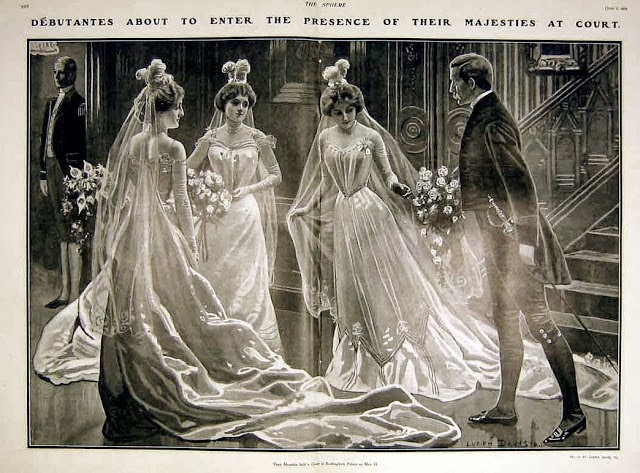
Debutantes Readying to Meet Royalty; To make one's “debut,” or to enter into society, has its roots in the Royal Court of France. By the reign of Britain's King George III (1760-1820), Queen Charlotte started a tradition of introducing and presenting the young aristocratic women of court to society. Known as "debutantes" from Queen Victoria's reign in 1837 and on, there was strict etiquette to follow regarding proper costume for court presentations; Fashionable evening dresses with head-dresses of veiling, feathers and a train trailing the dress from the waist. Long, white kid gloves, pretty fans or fragrant bouquets added to the look and offered a bit of diversity in look for the young debutantes. Since final constitutional ties between Australia and Great Britain were terminated with the passing of the Australia Act 1986, ending any kind of British role in the governing of the Australian States, closing the option of judicial appeals to the Privy Council in London, I am including British debutante history as well, up until that time period.
Debutante Agnes Melanie Dickson, circa 1890. By the end of the 19th century, the main occasions at which Court dresses were worn were those at which debutantes were presented to the Queen.

Debutantes, Circa 1930s, at the Roman Catholic Ball in Mareeba, a town on the Atherton Tableland in Far North Queensland, Australia

∞∞∞∞∞∞∞∞∞∞∞∞∞∞∞∞∞∞∞∞∞∞∞∞∞∞∞∞

        A FEW DON’TS FOR DÉBUTANTES
from Emily Post in 1922

Don’t think that because you have a pretty face, you need neither brains nor manners. Don’t think that you can be rude to anyone and escape being disliked for it.

Whispering is always rude. Whispering and giggling at the same time have no place in good society. Everything that shows lack of courtesy toward others is rude.

If you would be thought a person of refinement, don’t nudge or pat or finger people. Don’t hold hands or walk arm-about-waist in public. Never put your hand on a man, except in dancing and in taking his arm if he is usher at a wedding or your partner for dinner or supper. Don’t allow anyone to paw you. Don’t hang on anyone for support, and don’t stand or walk with your chest held in, and your hips forward, in imitation of a reversed letter S.

Don’t walk across a ballroom floor swinging your arms. Don’t talk or laugh loud enough to attract attention, and on no account force yourself to laugh. Nothing is flatter than laughter that is lacking in mirth. If you only laugh because something is irresistibly funny, the chances are your laugh will be irresistible too. In the same way a smile should be spontaneous, because you feel happy and pleasant; nothing has less allure than a mechanical grimace, as though you were trying to imitate a tooth-paste advertisement.

In the twentieth century (especially following the First World War), occasions for full Court dress diminished. It was still required wear for ladies attending the 1937 Coronation (albeit without trains and veils - and Peeresses were expected to wear tiaras rather than feathers).  The video, "Debutantes" was produced by the BBC is well worth the watch. This is a fascinating look at the last Debutante Ball, prior to WWII.

It includes the Duke and Duchess of Devonshire, the Duke of Wellington and Lady Macmillan, among many others, as they recall the debutante season of 1939. They reveal how the upper classes' diaries were packed with invitations to luncheon parties, dances and social occasions such as Ascot, Henley and the Chelsea Flower Show, as women desperately sought wealthy husbands, all while Europe was steeling itself in the face of fascist aggression. The upper-class marriage market was in full swing, and here the participants talk vividly about the parties, ballgowns and, of course, broken hearts.
 

Debutante Etiquette 1940s-1950s

By 1953, ladies attending the Coronation were directed to wear 'evening dresses or afternoon dresses, with a light veiling falling from the back of the head. Tiaras may be worn ... no hats'. Court presentations continued, except during wartime, but they gradually became less opulent. In the post-war 1940s evening Courts were replaced with afternoon presentations (for which afternoon dresses were worn); and with that, the donning of full Court dress ceased to be a rite of passage for young women taking their place in society.

Preparation of a Debutante

When debutantes are to be presented, the married lady who undertakes the responsibility of presenting them is called the Matron of Honour. Her duties include those of chaperone until after the presentation, and advising the ball committee regarding such matters as arrangements of the dais and floral decorations. In order that each debutante will know the correct procedure for the evening, their asked to attend tuition classes prior to the ball.

Presentation

Debutantes must be punctual so that all is in readiness before the official party arrive.

When the Matron of Honour makes the presentations, each debutante is expected to make a graceful full courtsey (sic).


This presentation marks the official entry of a young lady into society, therefore she is expected to remain dignified throughout the evening and not indulge in smoking.


“Lebanese-Australian” Debutantes of 1945 who worked at Lebanese businesses 

Dress
Conventions states that a debutante should wear either white or cream. However, pale pastel shades of pink or blue are sometimes worn. The style of frocks are not elaborate, and jewelry is not considered correct.
 

The bouquet and flowers worn in the hair are white with perhaps a hint of pink. Gloves are essential, and shoes should be of white satin.
 

Flowers are generously employed for the decoration of the dais, and the lady who received the debutante and the Matron of Honour, each receive a bouquet.
From "Etiquette: A comprehensive handbook for all occasions, setting out the general procedure and formality expected of a well mannered person. Specially compiled to see the average Australian's way of life and for formal occasions."

Debutantes 1960s-1970s

"On a winter evening in 1968, the then Prime Minister, the Rt Hon John Gorton, made history by dancing with a young Aboriginal girl at the first national Aboriginal debutante ball. The ball was held at the Sydney Town Hall to celebrate the symbolic ‘coming of age’ of Aboriginal Australians in the referendum held a year earlier. Twenty-five debutantes were presented to the Prime Minister, and Mr Gorton chose to dance with one of the young women, Miss Pearl Anderson. The event unsettled the prevailing attitude to racial segregation of the time and coincided with the period when the growth in Commonwealth powers was starting to change the administration of Aboriginal affairs."
Prime Minister John Gorton dancing with a young debutante, Pearl Anderson, at the Foundation for Aboriginal Affairs Debutantes Ball, 1968 (Image courtesy of the State Library of New South Wales

Australian Debutantes of Today

 
Aboriginal people in Australia have now been celebrating over 60 years of debutantes' balls. In 2011, twelve teenage girls took part in the ceremony in what is been seen as symbolic first step into adulthood.

Aborigines celebrate debutantes' ball 60th anniversary

The organisers say it gives the girls an experience they would not have in their own often troubled communities and makes them feel more comfortable with who they are.


Another 2011 Debutante Ball, Australia

Casuarina Uniting Church, 2011 Debutante Ball ~
"It was a very enjoyable evening, which included a dinner and the presentation of 12 young ladies and their partners to a large crowd of family and friends. The young people looked stunning and surprised us with their dancing, which they had worked on for many hours during the preceding weeks."


🍽Etiquette Enthusiast, Maura J Graber of The RSVP Institute of Etiquette, is the Site Editor for the Etiquipedia© Etiquette Encyclopedia