|
| The handle of the teacup came from Mediterranean lands. Originally it a was made of thick and strong earthenware and applied to heavy jars and lamps. Its decorative possibilities popularized it with Greek and Roman potters, who extended its use to small amphorae and flagons; but as the word “amphora” indicates, the handle was double. Single handles crept into use by slow degrees and were probably applied to drinking cups about the time that coffee came into vogue in Southern Europe — Shown above, a variety of antique cups and saucers designed for hot chocolate, but appropriate for tea or coffee, as well. |
The First Tea Cups... They Had No Handles, and Saucers Were Used as Covers
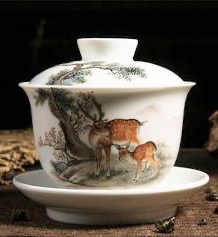
In the middle of the seventeenth century, tea was introduced into England, and with it came the Chinese or “china” tea cup. Strangely enough, the men who imported it from the orient did not themselves understand the method of itsuse. The Chinese put a pinch of tea into a large cup without a handle, filled it with boiling water and then inverted a saucer over the receptacle, within whose rim it closely fitted. The object was partly to retain the heat, but chiefly to prevent the escape of the fragrance of the herb, which the Chinese found most delicious. The infusion was permitted to stand for five minutes, when
it was decanted into a second cup without a saucer and daintily sipped.
John Bull, however, emphatically declined to take his tea in Chinese fashion. He liked the appearance of the ornamental ware upon his table, but be insisted on placing the cup in the saucer, like a miniature flowerpot, and used it exclusively to drink from, preparing the beverage in a common, instead of an individual, receptacle. In course of time, England began the manufacture of cups and saucers, and pictures which have been preserved from the days of the Stuarts show big, flaring cups, four inches across the top, with saucers less than three inches in diameter. By degrees one dwindled and the other expanded, until in the middle of the nineteenth century the opposite extreme was reached, and fashionable tea services had cups only an inch and a half in diameter accompanied by five inch saucers.
The handle of the teacup came from Mediterranean lands. Originally it a was made of thick and strong earthenware and applied to heavy jars and lamps. Its decorative possibilities popularized it with Greek and Roman potters, who extended its use to small amphorae and flagons; but as the word “amphora” indicates, the handle was double. Single handles crept into use by slow degrees and were probably applied to drinking cups about the time that coffee came into vogue in southern Europe, the beverage being taken almost at the boiling point, so that some device for lifting the cup without burning the fingers was found desirable. Traveling slowly northward, the one-handled coffee cup finally reached Great Britain, where its merits were immediately recognized. It was not long before handles were applied to drinking vessels of every description. —London Tatler, 1914
Etiquette Enthusiast, Maura J Graber, is the Site Editor for the Etiquipedia© Etiquette Encyclopedia