Showing posts with label Victorian Era Dining Etiquette. Show all posts

Thursday, May 21, 2020

Etiquette and Eating from Knives

A 19th century fork and knife set, featuring steel tines on the fork and a wide, dull and flat steel knife blade. Many who were unfamiliar with utensils and their expected dining usage, found this type of knife blade ideal for not just cutting with, but eating from.

Unlike contemporary table knives, those of the 18th and 19th century had dull and wide, flat blades. Usually they were steel. Many who were unfamiliar with utensils and their expected dining usage, found the knives ideal for not just cutting with, but for eating from. By the mid-1800’s, etiquette books encouraged diners to stop the practice of eating their food from their knives. As etiquette books are often ignored, small numbers of several generations continued the practice. 

A most popular food with which to show off one’s knife dining skills was peas. Many people practiced lining peas carefully upon a steel knife blade, to “pour” into their mouths, much to the chagrin of spouses and parents. A few uncouth, but industrious people even invented and designed special, “pea knives.” It took, as gentle reminders, repeated news and magazine articles over the years to finally get the practice all but abandoned. Two such articles are below:

Eating With a Knife is Not Insanity

LOS ANGELES, Mar. 4 (AP)—Eating with a knife is not insanity. Mrs. Kathryn Brown contended it was, in contesting the will of her sister, Mrs. Margaret Dillon, who left her $25,000 estate to her 12-year-old grand niece, Margaret Keating, of New York. Mrs. Brown testified Mrs. Dillon, although well reared, had been eating with a knife and suffered from a delusion that she was an experienced driver, despite the fact that she owned no car. A superior court jury yesterday found Mrs. Dillon was not insane and upheld the terms of her will. — San Pedro Pilot News, 1931


Gossip of Railwayman

Frederick Shoup of the Passenger Department of the Southern Pacific is a man of many parts. He is not only said to be good looking, but has so persuasive a tongue that it would enable him to sell gold bricks, even to Hetty Green. “Etiquette and table manners are all based on common sense,” remarked Frederick to Charles Burkhalter and John Ross, with whom he was dining at Fresno. “For instance, the reason why a man does not eat with his knife is because he is afraid of cutting his lips.”
  “Well, that is true,” replied Burkhalter, as he lifted the duck on which Shoup was feasting from Fred’s plate to his own.  “You see how simple it is.” Shoup rambled on, “Why don't we use a fork for our, soup? Why? Because the fork I could not scoop up enough of the soup.” “Well that is an idea,” observed John Ross, the great chocolate expert, as he appropriated Fred’s vegetables. “Everything is based on common sense,” continued the orator. “Why do we have napkins?” “Why?” asked Burkhalter, as he emptied Fred’s pint of Chianti. “To remove the stains of food from our fingers and mouths.” “Well, are you through talking?” said Burkhalter. “It is time to get to work.” “Work,” shouted Shoup, “why, man, I have had nothing to eat.” — San Francisco Call, 1908


Etiquette Enthusiast, Maura J. Graber, is the Site Editor for the Etiquipedia©️ Etiquette Encyclopedia 

Friday, September 15, 2017

Table Etiquette of 1899


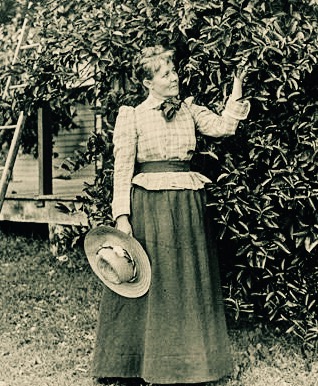
Mary Barr Munroe was a Miami pioneer who contributed much to the community life of Coconut Grove. Mrs. Munroe founded the southern Tropical Audubon Society. As a member of the Florida Federation of Women's Clubs, she was instrumental in the establishment Royal Palm Park (later the Everglades National Park.) Mrs. Munroe also started the Coconut Grove Library in 1895 and taught many children in Coconut Grove how to read. She strongly believed, and proved, that women can make a great difference.
Helpful Hints on the Uses of Knives, Forks, Spoons and Fingers
Those who are very particular, hold the large end of a spear of asparagus with a fork, while with the tip end of a knife they daintily separate the tender green tops from the white end, which is then put aside. Others take the white end between the fingers and carry it to the mouth. Both are correct, but the former is much more dainty and easily done. 

The etiquette of eating a soft boiled egg has been the subject of more than one clever essay. The English custom is to eat it directly from the shell, when of course a small egg cup and egg spoon are necessary. The American way is to break the egg into a cup or glass by striking the egg in the center and turning the contents into the glass. In this case it is usually eaten with a teaspoon, as an egg spoon, unless extra large, would be too small, and we have seen the egg held by a corner of the napkin, but this is not only tiresome but difficult to do nicely without soiling the napkin. 

Celery is always taken from the dish and carried to the mouth by the fingers. If individual salts are not provided, it is etiquette to use one half of the butter plate for salt. If salt shakers are used, hold the celery in the left hand just over the rim of your plate and gently sprinkle it with salt, and the old custom of putting a spoonful of salt on the cloth is still in practice. 

When corn is served on the cob it must be taken in the fingers, only managed very daintily. We have seen pretty little doylies for the purpose of holding it, but it is a question if that is not carrying table linen too far. Many housekeepers, and especially in the south, serve corn as a separate course, when finger bowls are placed by each plate and removed with the course. 

Lettuce when served without dressing is always pulled to pieces with the fingers. This is usually the lady’s duty and there is no prettier picture than that of a young lady preparing a plate of fiesh, crisp lettuce leaves in this way, for the tender green shows off to perfection her dainty white hands and she may be as exquisitely neat about it as she likes, and it is one of the most fascinating and becoming of table duties that a hostess can possibly provide for her lady guests, to assist in helping the gentlemen at a social or informal meal. 

Watercress is also taken in the fingers and the prettiest way of serving it is to obtain a long low sided basket or dish, in the bottom of which lay a folded napkin, then heap the cress so as to fill the basket and you have not only an enjoyable, but a very ornamental dish for the breakfast table. 

When a slice of lemon is served with fish or meat it is much more correct to take the slice in the fingers, double the ends together and gently squeeze the juice over the article than to use a knife for that purpose, as is sometimes done. It is always proper to help one's self to bread, cheese and lump sugar, if tongs arc not provided, with the fingers. 

Never use your own knife, fork or spoon to take from the dish. It is also correct if a plate of hot, unbroken biscuits is passed, to not only break off for yourself with your fingers, but for your neighbor also. When things are passed, help yourself as quickly as possible, for you must not keep others waiting and never insist on some one else being served before you, if the host or hostess has honored you first. —Mary Barr Munroe in Good Housekeeping, 1899

Etiquette Enthusiast, Maura J. Graber, is the Site Editor for the Etiquipedia© Etiquette Encyclopedia 

Friday, December 5, 2014

Pre-Eminent Etiquette Book of 1800’s

… and Dining Dont’s
Professor Thomas E. Hill, author of “Hill’s Manual of Social and Business Forms,” (regarded as the pre-eminent etiquette book of the late Victorian Era in America) had been a teacher, newspaper publisher and served two terms as mayor of Aurora, Illinois.

MIND YOUR MANNERS

Many Americans in the 19th Century were concerned with how to establish order and authority in a society which was becoming increasingly industrialized and urban. Etiquette, in the broad sense of correctness in many facets of both business and personal life, was one way to address this problem. "Hill’s Manual," first published in 1873, presented proper letter-writing, penmanship, legal forms, family records, and “speaking and acting in various relations of life.” 

The section of this popular, comprehensive volume entitled, “The Laws of Etiquette: What to Say and How to Do,” included helpful advice on improving one's manners, the proper use of calling cards, conduct when shopping, how to engage in conversation, traveling, proper behavior in church and school, rules of parties and dances, courtship, marriage, etc...
“Never allow butter, soup or other food to remain on your whiskers. Use the napkin frequently.” Thomas E. Hill
Dining was a popular social pastime, and a meal could be twelve courses or more. "Etiquette of the Table” was prominently featured in "Hill's Manual." Politeness at the table was to be cultivated; ways to achieve it were outlined on one page and illustrated with properly dressed and well-behaved diners.
       
           
“Errors to be Avoided” were presented, along with a comical, numbered depiction of “Bad Manners at the Table,” including:
  1. Tips back his chair.
  2. Eats with his mouth to full.
  3. Feeds a dog at the table.
  4. Holds his knife improperly.
  5. Engages in violent argument at the meal-time.
  6. Lounges upon the table.
  7. Brings a cross child to the table.
  8. Drinks from the saucer, and laps with his tongue the last drop from the plate.
  9. Comes to the table in his shirt-sleeves, and puts his feet beside his chair.
  10. Picks his teeth with his fingers.
  11. Scratches her head and is frequently unnecessarily getting up from the table.
Some of Thomas Hill’s advice may seem overly fussy or ridiculous to the modern reader. However, one must consider that many people in the Victorian Era, both in the U.S. and abroad, were seriously concerned with promoting civility in all aspects of their lives. In an updated “Hill’s Manual,” one writer suggests that “Perhaps we would add: Do not talk on your cell phone or text at the table.”


From a variety of sources and Thomas E. Hill’s, “The New Revised Hill’s Manual of Social and Business Forms: A Guide to Correct Writing,” 1893


🍽Etiquette Enthusiast, Maura J. Graber of The RSVP Institute of Etiquette, is the Site Editor for the Etiquipedia© Etiquette Encyclopedia