Showing posts with label Bernadette Petrotta. Show all posts

Sunday, September 1, 2024

Spotlight on Bernadette Petrotta

Meet our Contributor in the Spotlight for August, Bernadette M. Petrotta, of “The Polite Society of Etiquette.” An author of several books on etiquette and the art of afternoon tea, Bernadette founded The Polite Society School of Etiquette in Southern California, after a lifelong affection for etiquette and social graces led her to attending a 9 course etiquette dinner seminar she had read about in Victoria Magazine in the mid-1990’s. Her love and vast knowledge of  the social history of tea, tea rooms, and the art of hosting an afternoon tea, has made her a sought after speaker on tea throughout the Pacific Northwest, where she has resided for the past 14 years.

Below are links to some of Bernadette’s contributions to Etiquipedia:
The following is a Q. & A. with Bernadette:

1. What was the impetus for starting your Etiquette business?

I have always been interested in everything beautiful. Gracious manners, etiquette, the pleasures of a relaxed afternoon tea and the arts. When I was young, I lived next door to my Aunt Margaret who was the epitome of grace. She set a beautiful table every day and dressed impeccably. Her home was organized, clean, and nothing was out of place. Each time I visited her, she made us a pot of tea and we shared stories and everyday life experiences. I was also very interested in the graceful world of ballet and every year I purchased season tickets to the American Ballet Theatre. One afternoon as I was reading Victoria Magazine (I’m an avid Victoria reader!), I read about a nine course dining etiquette seminar at the home of Maura Graber in the mid-1990’s, I immediately made a reservation and enjoyed all of the aspects of dining. I thought that teaching etiquette would be something I would really enjoy, so I began my training with her.
Speaking on my favorite subject, afternoon tea. I enjoy making my own organic, low sugar scones to enjoy with my favorite teas.
2. Why did you start when you did?
After receiving my degree and working in an administrative position with the City of Los Angeles, I decided to take some time off to raise my son. I also wanted my son to grow up with an appreciation for good manners and etiquette, and the importance of social graces in today’s world. It seemed like a good fit for my life at that time. I eventually went back to work but continued to teach etiquette.
Meeting “Tea Sage,” and author, Norwood Pratt and his wife, along with Julie Rosanoff of the Perennial Tea Room, when I was a guest speaker at the Northwest Tea Festival in Washington, back in 2011. 

3. What do you enjoy teaching the most regarding Etiquette?
I love all of it, really, but I particularly enjoy teaching on the pleasure and art of afternoon tea. It became an integral part of my life many years ago, and I have enjoyed tea rooms around the world. Exploring new tea rooms is one of my favorite things to do. It was an honor to be featured in Tea Time Magazine a few years ago, as I have been a faithful reader for so long.
Teaching how to set up a Tea Table Buffet and Tea Tray etiquette to a gracious audience in Seattle.
4. What do you find rewarding about teaching Etiquette?
I find it rewarding to change peoples’ perspectives on etiquette and manners. People have the idea that good manners mean something stuffy or stiff, when living a well-mannered and etiquette filled life actually offers one a structure and way of doing things that really can help with daily stress. To quote the former First Lady, Barbara Bush, "Protocol is not there to dictate to you. It is there to help you."

Bernadette’s books are available on Amazon. This revised book is Volume V, The Art of Timeless Étiquette, Graceful Dining Manners, & Afternoon Tea is the Revised Edition. It features, “Social Graces, Étiquette History, Introduction Methods, Entertaining Guidelines, Correspondence Protocol, History of Tableware, Dining out Manners, American and Continental Style Dining, Appropriate Dress Attire, Personal Care and Home Management, History of Tea, Types of Tea, Tea Pairings and Tastings, Afternoon Tea in England, Tea Food Dining Instructions, and Formalities for Preparing a “Proper” Afternoon Tea. This revised edition is an updated compilation of Volume I, Volume II, and Volume IV with additional étiquette information and home management guidelines.”
5. What types of classes do you offer?
I offer In-Person and Online Courses for adults and young people. I offer Beginning, Advanced, Business, and Tea Étiquette Courses. I also offer restaurant and hospitality staff training.
Meet Emma the Etiquette Cat… Emma is Bernadette’s Ragdoll cat and though adorable and quite lovable, she can get into trouble around the house. This is Bernadette’s book for young children. It is also available on Amazon.
6. What age group do you enjoy working with most? And why?
I offer classes to all ages, but you most enjoy teaching and working most with adults, as I can relate to them on a common ground. I think a lot of adults are like me, and miss the more pleasant days of their youth. Thirty to 40 years ago, the world seemed much more polite and well-mannered. Airports weren’t filled with people in their pjs. Flights weren’t regularly delayed due to poor behavior by passengers. I think it’s why period dramas like “Downton Abbey” gained such popularity. When I was growing up, people watched their language in and politics didn’t seem so divisive. People dressed more conservatively when going out and being seen in public. I would love to see the world become a more polite place to live for my son, my daughter-in-law and my dear little grandson. I love being a new grandmother and hope my grandson understands and appreciates the importance of manners and etiquette as he grows up.

7. Who are some of the older etiquette authors or authorities you enjoy reading most?
I don’t have any particular favorites. I love reading etiquette books from all over and I enjoy many different authors, though I do have a lot of the books from older authorities in my bookshelf collection for reference.

If you’s like to contact Bernadette, she can be reached through her website Polite Society School of Étiquette and directly via email at BMP@PoliteSocietySchool.com


🍽Etiquette Enthusiast, Maura J. Graber, is the Site Editor for the Etiquipedia© Etiquette Encyclopedia

Thursday, November 8, 2018

Dinner Party Etiquette

A gentleman should seat a lady by standing behind her chair and pulling it back with both hands. When she is half-seated, the chair should gently be pushed forward so that her chair is under her hips. After seating her, the gentleman takes the seat to her left. Good posture is important; do not slouch. Put your back against the back of your chair. Whenever possible, push sleeves up above the elbows before eating.


Say “Hello” to the hostess before you accept any drink.

Taking Your Seat At The Table: Men and women are expected to enter and sit in a chair from their left sides. This prevents bumping the neighbor when seating. The exception is when the chairs are too close to enter from the side and must be pulled out to sit. Exit the chair the same way you entered. Do not forget to push the chair back in when you leave. 


 A gentleman should seat a lady by standing behind her chair and pulling it back with both hands. When she is half-seated, the chair should gently be pushed forward so that her chair is under her hips. After seating her, the gentleman takes the seat to her left. Good posture is important; do not slouch. Put your back against the back of your chair.

Note: Men are seated to the left of the woman so as to have their right hand available to assist the woman.


Sit Up Straight. Push your back against the back of the chair.

Push sweater sleeves up above just to, or above, the elbow before eating.

Rest Your Wrists On The Table. No elbows on the table at any time.

Your Space At the Table: Your space should be confined to the imaginary box around you. If you must move your feet, do so in your own foot space (close to the floor and within the chair legs). If you are not eating, your hands should be on your lap or on the table right in front of you. While you are eating, try to put your non-eating hand on your lap. If you must rest your hands on the table, do so with your wrists only. Place your wrists in front of you on the edge of the table. Do not put your elbows on the table.

Purses, Briefcases, Eyeglasses, And Eyeglass Cases: Do not place any item on the table. A small purse should go on your lap, under the napkin. A large purse, briefcase, and other personal items should go under your chair, out of the way. Never block the path of other guests or the serving staff. An eyeglass case belongs in your purse or pocket. Never put your eyeglasses on the table. Your cell phone should be set to vibrate or switched off and put away. It is extremely rude to make or accept a phone call (or text) during a meal.

Lavatory or Bathroom: Women excuse themselves go to the “powder room” and men go to “freshen up.”

Proper Way To Leave A Dinner Party: The general rule for leaving a dinner party is approximately forty-five minutes after dinner is over


Contributor Bernadette Petrotta is the Director and founder of The Polite Society School of Etiquette. Her book is "The Art and Proper Etiquette of Afternoon Tea," among her others, can be found on Amazon


Etiquette Enthusiast, Maura J. Graber, is the Site Editor for the Etiquipedia© Etiquette Encyclopedia


Monday, August 3, 2015

Etiquette and Tea Styles

High Tea is also sometimes confused with the teas that King Edward VII hosted during his reign from 1901-1910. Edward had so many meals in his daily schedule he had to change everyone else’s schedules. Famous for his huge appetite, Edward ate no less than 12 courses at dinner and is responsible for adding “appetizers” to the dinner menus of British society.


Just Some of the Different Styles Of “Teas” Held, or Given, for the Enjoyment of this Popular Beverage
Around 1800, when tea was very expensive and kept in locked containers called "tea caddy boxes," special tea caddy spoons were designed and kept with the tea. Tea caddy spoons were popular gifts and often engraved for special events. 
·The High Tea:  In the past, "High Tea" was considered the tea of the working-class rather than the tea of the elite. This tea was a hearty affair. Meat pies, rarebit, shepherd's pies, slices of roast, sausage, vegetables, casseroles, puddings, and heavy desserts and other dinner time staples usually made with leftovers were commonly served.  
The term “High” came about because the tea meal was taken at a high dining table, or with high back chairs all around a table. This was to distinguish the meal from the Afternoon Tea that was taken at low tables.  
In recent years, High Tea has become a term for elaborate Afternoon Tea, though this is an American usage and mainly unrecognized in Britain (with the exception of some London hotels, catering to tourists.) It is usually served between 5:00 pm and 8:00 pm.  
High Tea is also sometimes confused with the teas that King Edward VII hosted during his reign from 1901-1910. Edward had so many meals in his daily schedule he had to change everyone else’s schedules. His dinner time was pushed forward another hour or so to 8:30 pm or 9:00 pm. High Tea could now be held even later in the afternoon.
Known for his huge appetite, the King ate no less than 12 courses at dinner and is responsible for adding “appetizers” to the dinner menus of British society. This change brought it closer in line to what most Americans think of as a dinner time (around 5:00 pm). 
·The Formal Afternoon Tea: A "Formal Afternoon Tea" is an elaborate affair with white linens, silver, hats and gloves, bone china, and several different types of tea. Darjeeling and Ceylon varieties are suggested for this teatime. Tea fare consists of scones, at least four varieties of savories, and beautiful finger desserts or petits fours, presented on three-tiered racks, often buffet style. 
Traditional service time is 4:00 pm, however any time between 2:00 pm and 5:00 pm is appropriate. (Please remember that proper etiquette dictates one remove those gloves before eating or drinking anything!) 
Tea fare consists of scones, at least four varieties of savories, and beautiful finger desserts or petits fours, presented on three-tiered racks, often buffet style. 
·The Afternoon Tea or The Low Tea: An Afternoon Tea or "Low Tea" is designed to enhance social skills and usually is served in fine fashion and in several courses. Some believe the term “Low Tea” may come from the fact that hotels have traditionally used low tables in their lobbies to hold the foods and tea service presented at afternoon teas. 
This full-tea service includes scones, savories, and a variety of petits fours. It is traditionally served at 4:00 pm, however, any time between 2:00 pm and 5:00 pm is appropriate.
·The Special Event and/or The Seasonal Tea: These teas are designed for a season, occasion, or personal style for the hostess or honored guest. Although these teas require more planning, they also provide an opportunity for creativity in themes, menus, table settings, favors and invitations. Examples include; bridal teas, sweetheart teas, Christmas teas, harvest teas, baby shower teas, business teas, retirement teas, graduation teas, garden teas, and benefit teas.

·The Cream Tea: These Cream Teas are fondly known as afternoon "sweet-tooth teas" in some circles. They feature heavy, clotted cream from Devonshire, that is slathered on scones, rather than any cream added to the tea. 
Cream is much too rich to accompany tea, as it will curdle; milk is the preferred addition. Besides scones, this tea includes fresh fruits, berries in season, and cake. Cream Teas are traditionally served from 1:00 pm to 4:00 pm.
                          
No pinky finger thrust out here. Perfectly lovely!
·The Brunch Tea: A hearty tea, Brunch Tea is a wonderful way to start the day. A Brunch Tea usually offers an egg dish, fresh fruit, or pasties which are light on sugar content. This is the perfect time to seek a hearty breakfast tea, since the traditional time is from10:00 am to 1:00 pm.

·The Teddy Bear Tea: This special tea, (in actuality, it is hot chocolate), was prepared by nannies for their young charges. The children would scurry off to their quarters to play with their favorite dolls or bears and sip hot chocolate while munching on goodies from the adults’ tea table.

·The “Elevenses”: The term “Elevenses” is a British version of the American office "coffee break," between 10am and 11am in the morning. The coffee break originated from the old "Second Breakfast" of European immigrants to the United States. In Britain, a tea cart with tea, crumpets, scones, or cinnamon toast is wheeled in for the break.

A post script: Remember...  one drinks tea. One does not take tea. During the Victorian era, the term to take tea was used by the under classes and considered a vulgar expression by the upper classes.
Contributor Bernadette Petrotta is the Director and founder of The Polite Society School of Etiquette. Her newest book is "The Art and Proper Etiquette of Afternoon Tea." 


 🍽Etiquette Enthusiast, Maura J. Graber of The RSVP Institute of Etiquette, is the Site Editor for the Etiquipedia© Etiquette Encyclopedia

Saturday, September 6, 2014

Basic Dinner Seating Etiquette

“In seating one's self at table a comfortable posture is not incompatible with a dignified attitude. The shoulders should not be thrown back too far, nor should they drop forward. It is the latter pose which produces the inclination of the arms suggestive of the 'all elbows' idea which some people give of themselves.” – Eliza M. Lavin, 1888

Formal Table Seating For Six, Ten, Fourteen, Or Eighteen People  
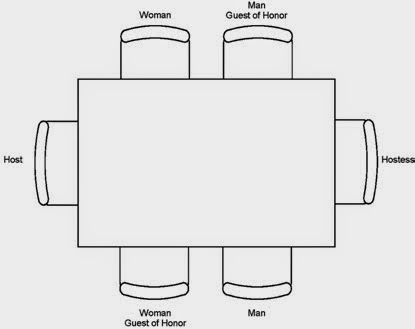
Traditionally at a formal dinner, the Host sits at the head of the table with the Hostess at the other end. This works whenever there are six, ten, fourteen, or eighteen people. Husbands and wives are never seated next to each other.
If the Guest of Honor is a woman, she is seated at the Host's right and her husband at the Hostess' right. The second most important woman is seated across from the Guest of Honor, on the Host's left, and her husband is seated accordingly on the Hostess' left. The remaining guests are seated in between, alternating between male and female guests.
To be fair, the word "important" can be relative to many differing situations and varying cultures. Age may play a factor, especially if there is no Guest of Honor. Giving the eldest member of a group, or the persons who have traveled the farthest distance to the dinner, special places in the seating arrangement, would be an honor. Special accommodations may be also be made for those in wheelchairs, or those using a walker or cane. Guests take note of such matters and will undoubtedly appreciate the kind gestures on a Hosts and Hostess' parts.
Formal Table Seating For Groups Divisible By Four 
When the group of people is divisible by four, it is not possible for the Hostess to sit at the end of the table. In this case, the Hostess moves one place to the left, with the man on her right sitting at the end of the table, opposite the Host. This will keep the tradition of seating guests alternately, male, female, male, female, etc... Again, husbands and wives are never seated next to each other.
For informal dining, the easiest system is to alternate between male and female guests, with the Host and Hostess on either end of the table. 


Contributor Bernadette Petrotta is the Founder and Director of the Polite Society School of Etiquette in Washington State.  She has been teaching etiquette for nearly 20 years and has written The Art of Social Graces and The Art and Proper Etiquette of Afternoon Tea.  She is currently working on her third book and continues to teach and lecture on the art and pleasures of proper etiquette and tea. 


  🍽Etiquette Enthusiast, Maura J. Graber of The RSVP Institute of Etiquette, is the Site Editor for the Etiquipedia© Etiquette Encyclopedia