Showing posts with label Austrian Etiquette History. Show all posts

Friday, November 15, 2024

Etiquette for Austrian Royalty

It was thought highly improper for royalty to carry an umbrella.“Empress Sisi” was someone who had chafed at the Royal Court etiquette of the Austrian Imperial family ever since she married the young Emperor Franz Josef.
Umbrellas… Contrary to Etiquette? 

When the Empress of Austria first married, it was thought highly improper for royalty to carry an umbrella. Consequently, whenever it threatened to rain she was unable to have her accustomed walk. She moped so much that her husband declared that henceforth umbrellas should not be contrary to etiquette. – The San Jose Herald, 1895


🍽Etiquette Enthusiast, Maura J. Graber, is the Site Editor for the Etiquipedia© Etiquette Encyclopedia

Thursday, August 3, 2023

Sisi: Empress of Exploits and Austria


This is just one of many articles featuring Empress Sisi of Austria on Etiquipedia. She was an Empress who had chafed at the Royal Court etiquette of the Austrian Imperial family ever since she married the young Emperor Franz Josef. You can read one article here ~ According to Encyclopedia.com, “Elisabeth, Empress of Austria (1837-1898), was the beloved “Sisi,” one of the most famous royal celebrities of her day. As the consort of the emperor of Austria—a land that dominated the map of Europe at the time—Elisabeth was a well-known figure whose exploits were avidly chronicled in the nineteenth-century press much in the same way that Britain's Diana (1961-1997), Princess of Wales, would be a hundred years later.”

Not as Good as Her “Ma” –
The Opinion of an Austrian Princess on a Circus Rider's Feat

Nearly everybody knows that the eccentric Empress of Austria carries her fondness for hunting to such, a pitch that up to recent years she used to brave the terrible fits of “mal de mer” that are caused by the Irish channel for the sake of enjoying the superb hunting that can still be found in the Emerald Isle– one free joy not yet a hunted out of it by the ubiquitous and iniquitous Sassenach. But it is not generally known, says the New York Journal, that the first lady of the land in Austria is also a fancy rider, used to have a private arena, and when in playful mood would give exhibitions of startling equestrian skill to a select circle of more or less discreet friends. 

One day when her little daughter, Stephanie, was on a visit at the home of a noble in another part of the Empire it occurred to her hosts that perhaps a circus that was performing in the neighborhood would afford the infant princess a novel delight. They took the child, and were astonished at the profound gravity with which her little eyes watched the performers leaping through hoops of colored paper, turning somersaults or riding two horses at once. "Well," said one at last, "what does our little Princess think of it?" "Not much," replied the child, shaking her head sagely. "My ma can do those things a heap better." Then, with an air of profound conviction: "My ma's a born circus rider." Imagine, if you can, Austria's etiquette, and then imagine the thrill of amazement and horror which the child's remark produced. – Bridgeport-Chronicle Union, 1894


🍽Etiquette Enthusiast, Maura J. Graber, is the Site Editor for the Etiquipedia© Etiquette Encyclopedia

Saturday, July 16, 2022

More Austrian Etiquette Expectations

The dinner given to the President of the French Republic at the Austrian Embassy gave sanction to a number of new by-laws in Presidential etiquette. It was the first time that such a dinner had been offered and accepted, and no one knew to whom it was to be announced– whether to M. Carnot or to the Ambassadress. 
Public domain image of French President Sadi Carnot 

 PRESIDENT CARNOT AT DINNER

QUESTIONS OF ETIQUETTE FIND SOLUTION

PARIS, Jan. 28.—The dinner given to the President of the French Republic at the Austrian Embassy gave sanction to a number of new by-laws in Presidential etiquette. It was the first time that such a dinner had been offered and accepted, and no one knew to whom it was to be announced– whether to M. Carnot or to the Ambassadress. The difficulty was managed by the simple opening of the dining room doors, which ceremony told Count Hoyos that the time had come to beg the President to offer his arm to the Ambassadress. This settled comfortably a knotty point in one second, and there was not the least apprehension concerning the place of the President at the table. It was amiably arranged by the position taken by the Austrian Ambassador directly opposite the President, as he entered the dining room with Mme. Carnot after the President.

The dress of the lady President was made of fine black chantilly over white satin. The front of the same was drapod in black tulle, covered with beads and lozenges of dark creon glass, looking like so many emeralds. The same ornamentation covered the corsage. In her hair she wore a diamond crescent, perched on a bouquet of rose geranium. The Countess Hoyos wore white satin with point lace overdress, looped with ostrich plumes and diamond bow knots. A pearl and diamond coronet was placed in her hair. The Countess Zich, wife of the Counselor to the Austrian Embassy, and one of the prettiest women in Paris, wore an Empire dress of white satin trimmed with silver lace and diamonds. The latter studded the under-the-arm belt and made an otherwise simple costume look particularly resplendent. – The New York Times, 1888


🍽Etiquette Enthusiast, Maura J. Graber, is the Site Editor for the Etiquipedia© Etiquette Encyclopedia

Monday, December 6, 2021

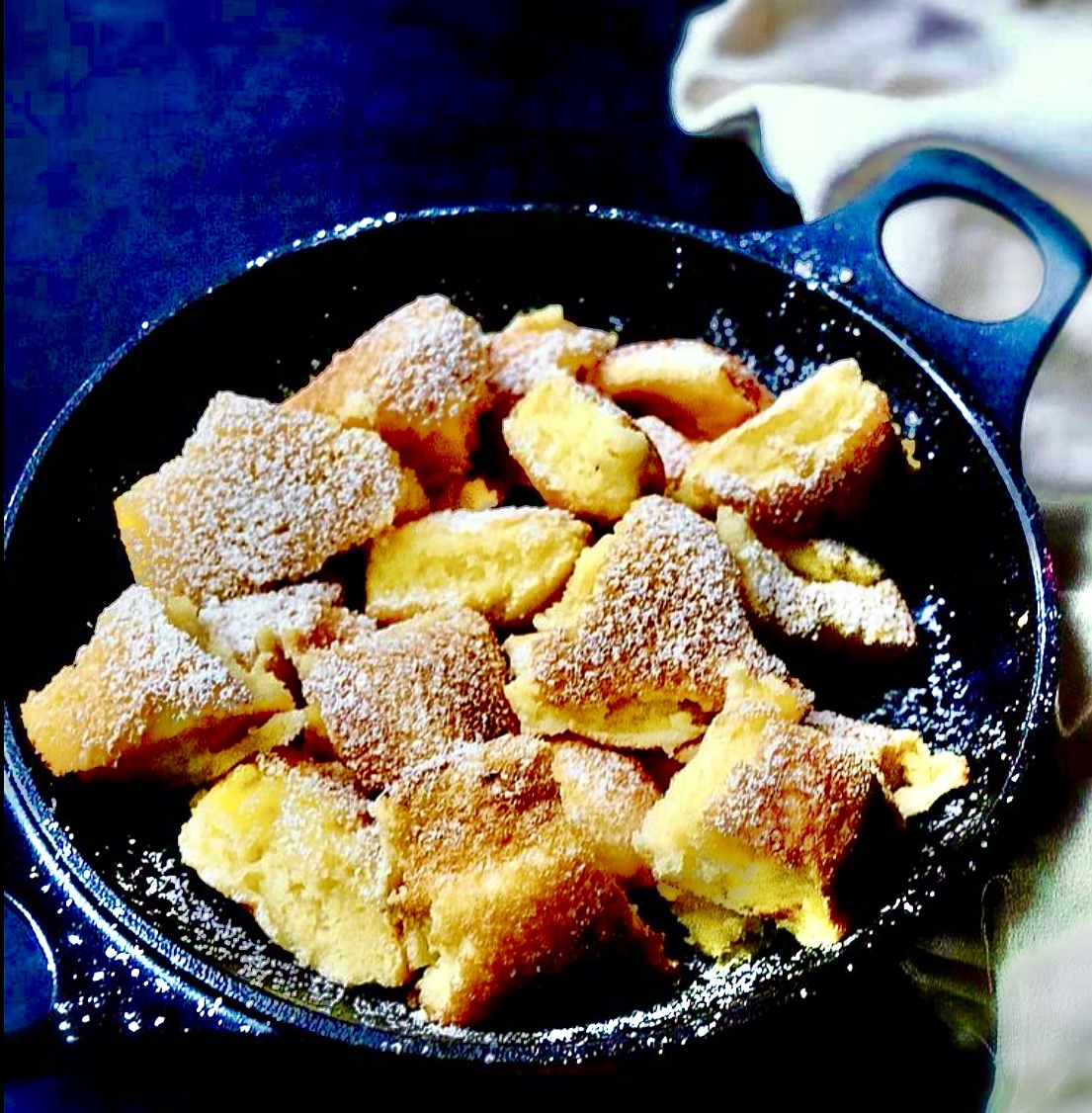
Etiquette and the “Emperor’s Pancake”

It was a lot like eating with Queen Victoria… As you left her table, you were still famished –‘As Royal Court etiquette dictated that everyone stop eating as soon as the Kaiser put down his fork, the young officers at the end of the table often managed no more than a tantalizing smell of the delicious “Kaiserschmarrn.”’


A Famous German Pancake


Near the turn of the century, Austrian Emperor Franz Josef I, reportedly ate the pancake with such relish that he frequently finished eating before the rest of the Royal table had been served.

As Royal Court etiquette dictated that everyone stop eating as soon as the Kaiser put down his fork, the young officers at the end of the table often managed no more than a tantalizing smell of the delicious “Kaiserschmarrn.”

“Schmarrn” soon came to mean “nothing,” as someone is not worth a “schmarrn.” It also translates as “fluff” which accurately describes the golden, souffle-like pancake.


Kaiser’s Pancakes

Truly fit for a King, this oven baked pancake is an easy adaptation of the German-Austrian “Kaiserschmarrn” or Emperor's Pancake. 

Serve the pancake immediately, hot from the oven, dusted with powdered sugar or with a fruit sauce. Divide the pancake into servings by tearing with two forks.

For variation, fresh fruit or raisins soaked in rum may be added as the last ingredient before baking. Pour 2 cup of blueberries, apples or peaches into the center of the batter in the Dutch oven. Stir lightly. Soak raisins in rum 2 hour, drain and add to batter.

Recipe may be doubled. Add 15 minutes to the baking time.

2 tablespoons butter/mar.


garine 2 eggs, beaten


1½ cups milk 1 cup flour


1/4 teaspoon baking powder


1/4 teaspoon salt


1. Preheat oven to 325°.

2. Melt butter in a 5-quart non-stick finished Dutch Oven or a 10-inch skillet over low heat. Combine remaining ingredients and mix until nearly smooth. Pour into Dutch Oven or Skillet. Bake 45 to 50 minutes in preheated oven until golden brown. Slide pancake onto serving plate. Cut or tear into wedges. Garnish with powdered sugar. – Recipe from The
 Desert Sun, 1979


Etiquette Enthusiast, Maura J Graber, is the Site Editor for the Etiquipedia© Etiquette Encyclopedia

Thursday, June 14, 2018

Etiquette of Two Café Societies

Life in Vienna has much of the German phlegmatic trend, plus considerable Parisian elegance, minus the French fussiness in etiquette and manners.

 Parisian “Fussiness” vs Viennese “Calm?” 

The Viennese have for generations been famed for their hospitality and cheerfulness. Stress and strain, agony and pain do not characterize the temperament, natures and states of the Viennese. Life in Vienna has much of the German phlegmatic trend, plus considerable Parisian elegance, minus the French fussiness in etiquette and manners. Like all Europeans, they love the café life. The whole family goes out after the day’s labor. It interests the traveler considerably to study the various types of this European 
café existence. 

In Paris, the keynote seems to be display, style, smart appearance. In Vienna, a good natured, happy sociability after the day’s toll prevails. The family comes much more into view in Vienna than in bright, elegant, wild Paris, the city par excellence of dazzling social events. As the Austrians take things calmly, a certain lovely charm and restfulness mark their public and social life. It is a people that would for its own welfare, need to study somewhat the strenuous life, if the lesson of strenuousness could be learned for good and not to the destruction of that amiable, hearty, easy spirit for which the Austrians are known and the Viennese distinctively.—Vienna Letter in the Omaha Bee, 1910

Etiquette Enthusiast, Maura J. Graber, is the Site Editor for the Etiquipedia© Etiquette Encyclopedia 

Sunday, December 31, 2017

Etiquette and Royal Notes of 1890


“Princess Elizabeth of Austria, the daughter of the late Crown Prince, can't take outings with her mother, Princess Stephani, because, by the will of her father, she must always remain in the immediate neighborhood and under the eye of her grandfather, the Emperor.” — After Prince Rudolf's death, in a murder-suicide, Franz Joseph took over guardianship of Erzsi; by his order, she was forbidden to leave, not only the neighborhood, but Austria, with her mother. At a young age she displayed a strong personality, as well as an opposition to the Viennese court. She eventually became known as “The Red Archduchess” for her Socialist beliefs.

Royal “Goings On”

  • The Empress Frederick has collected $125,000 for the new Children's hospital at Berlin.
  • It is now definitely settled that Prince George is to open the Jamaica exhibition about Christmas time. The Emperor of China has sent the German Emperor a large box of playthings — little dragons and things—for his five littie sons. 
  • Princess Dolgorouki, the morganatic wife of the late Czar, has published her memoirs In Russia, and every available copy was seized immediately by the police. 
  • The Princess Louise, who for the past ten years has presided over on art school In Sloane street, London, West, is the first English woman to employ Irish needlewomen. 
  • Emperor William has contributed 10,000 marks toward the fund which is being collected for the purchase of the famous Sulkowski collection of bric-a-brac and curiosities. 
  • Prince Bismarck, seen striding recently through the groves of Friedrichsruhe park, was manifestly as sound in wind and limb as the toughest of his foresters or the hardiest of his keepers. 
  • The Prince of Wales is a great stickler for court etiquette. No one knows bettor the exact way in which every band and order and medal should be worn. He is very particular about good manners in Princes and Princesses. 
  • Princess Wilhelmina Montleart of Saxony, who has a pretty Castle near Vienna, and is the last of her family, recently invited the mayor of an eastern suburb to dinner, and at dessert gave him 1,000 florins to build a hospital for Bernals, the suburb of which he is mayor. 
  • The little Princess Elizabeth of Austria, the daughter of the late Crown Prince, can't take outings with her mother, Princess Stephani, because, by the will of her father, she must always remain in the immediate neighborhood and under the eye of her grandfather, the Emperor. 
  • Prince Lobanoff, the Russian Ambassador at Vienna, is a man of rare intellectual endowments. The Prince is a perfect type of the grand seigneur. He is a wealthy bachelor and has only had one “grande passion” in his life, namely, that for Mary Stuart, Queen of Scots, of whose letters and relics he possesses a remarkable collection. 
  • Princess Victoria, the Empress Frederick’s youngest and favorite daughter, is rather pretty, having a nice figure, blue eyes and fair hair. She has always been fond of an out-of-door life and enjoys exercise in any form. She is an indefatigable walker, an accomplished rider and lawn tennis player, and can drive four-in-hand in a masterly style. — Press Democrat, 1890
Etiquette Enthusiast, Maura J. Graber, is the Site Editor for the Etiquipedia© Etiquette Encyclopedia

Saturday, May 27, 2017

Austrian Kitchen Etiquette

One of the most famous Viennese culinary specialties, Sachertorte is a specific type of chocolate cake, or torte, invented by Austrian Franz Sacher in 1832 for Prince Wenzel von Metternich in Vienna, Austria.

According to the Motel Mail, every Lady of station in Austria knows how to cook. They do not learn the art at regular cooking clubs or at home, but they go to the house of a Prince, or a rich banker, where there is a famous Chef, and learn from him.

When a Chef engages to cook for any one he reserves the right to receive and instruct as many young ladies as be pleases​. When a banquet is to be given he notifies his pupils, and they come to watch the process, without necessarily knowing the Mistress of the house. At this time it would be a great breach of etiquette for any member of the family to trespass upon the Cook and his department. — Los Angeles Herald, 1881


Etiquette Enthusiast, Maura J Graber, is the Site Editor for the Etiquipedia© Etiquette Encyclopedia

Friday, February 3, 2017

Etiquette and Esterhazy Temper

The Holy Week religious scene  at the Calvary at the Prater was imposing; but it is on record lhat it led to much secular love-making, which was deplored by the clergy.— Esterházy is a Hungarian noble family with origins in the Middle Ages. Since the 17th century, they were among the great landowner magnates of the Kingdom of Hungary during the time it was part of the Habsburg Empire and later Austria-Hungary.

The mania for etiquette and piety which prevailed at Vienna under Maria Theresa and Joseph II was exactly suited to the Esterhazy temper. The Duke of Richelieu complains bitterly that during one Lent when he was Minister at Vienna he spent 100 hours at church with the Emperor; the Esterhazys did not mind that, they rather enjoyed it. They were spared the infliction of dining with his Majesty; no one ever did that. 

The Emperor dined with his hat on in the presence of his wife and her ladies of honor, and at some distance from the table stood the foreign Embassadors, also with their hats on. They remained standing, 'til the Emperor had taken his first draught of wine, when they retired. The Esterhazys and other nobles remained in an anteroom.

They fared better at the "taverns" and "Sledge" parties. Each gentleman sent to the Master of Ceremonies, a card bearing the name of the lady of his choice, and for that evening she belonged to him. She drove with him, danced with him, supped with him; everybody was masked, and naturally there was a good deal of fun. Etiquette required each gentleman to pay for the dress and mask  of his lady. 

In Holy Week it generally devolved on an Esterhazy to conduct the procession illustrating the Passion. The Wise Men of the East, Herod and Pilate, the Virgin Mary and Joseph, the Twelve Apostles, Mary Magdalen, all mounted on asses and led by Esterhazy, journeyed to the Calvary in the Prater, followed by a stream of men with false beards, some flagellating themselves, some carrying a placard on which their sins were enumerated, some bearing crosses. The scene was imposing; but it is on record that it led to much secular love-making, which was deplored by the clergy. — San Francisco Call, 1897


Etiquette Enthusiast, Maura J Graber, is the Site Editor for the Etiquipedia© Etiquette Encyclopedia

Thursday, December 1, 2016

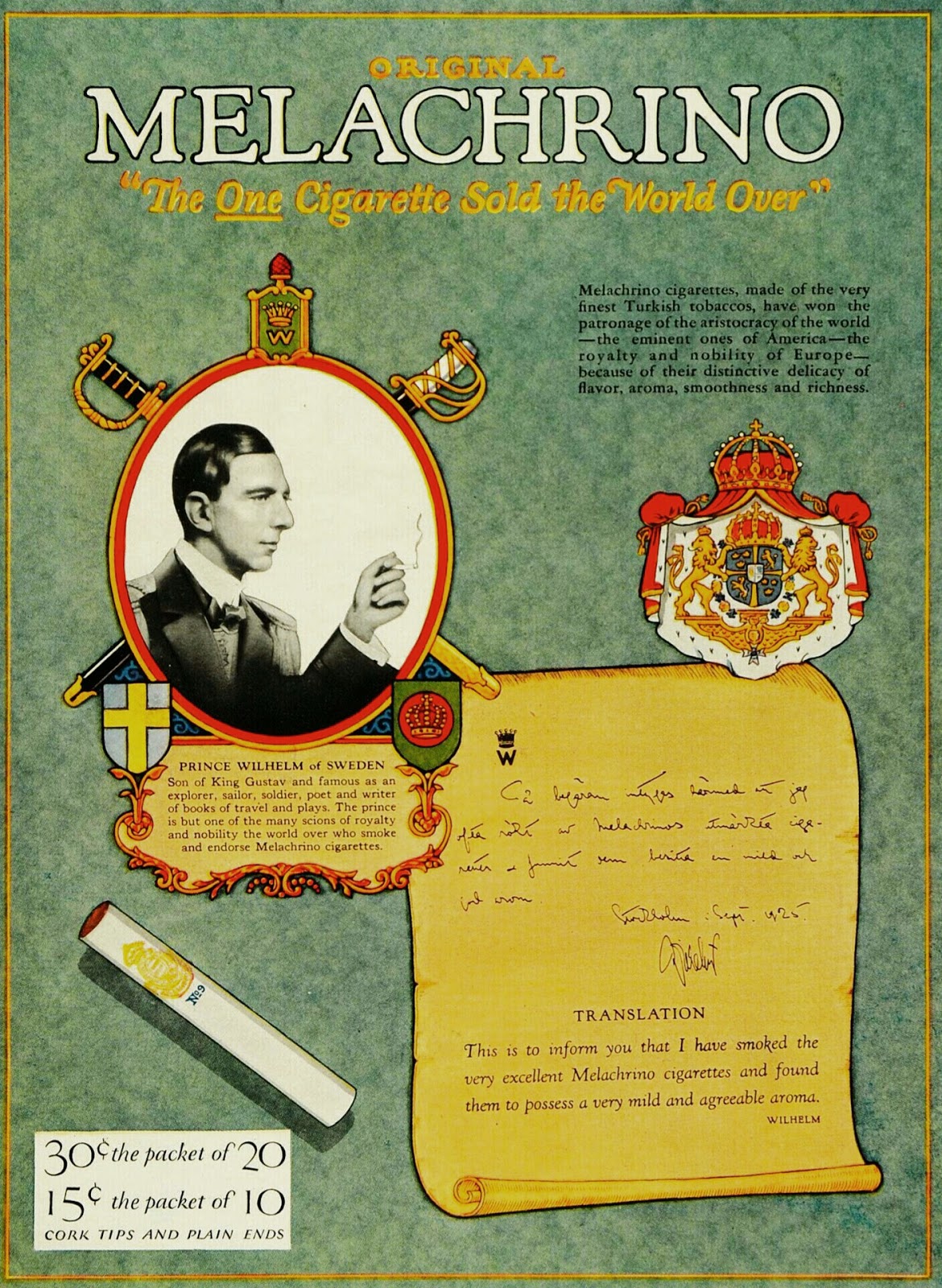
19th C. Global Cigarette Etiquette

The idea is that it is more courteous to allow a comrade the greater length of time. If he is handed the match first he naturally hurries in order to hand it back again. 

There is a fashion even in so small a thing as the lighting of a cigarette. In Cuba it is customary among gentlemen for one to place the cigarette between his lips, light it, take a few puffs and then hand it to his friend. In Spain the same fashion prevails. An Austrian is very punctilious about the etiquette of cigar lighting. He lights his cigarette first and then hands the lighted match to his companion. The idea is that it is more courteous to allow a comrade the greater length of time. If he is handed the match first he naturally hurries in order to hand it back again. 

A Frenchman always hands his companion the match first. An Englishman proffers the cigarette to his friend, lights a match, hands it to him, and then helps himself to another cigarette and match. An American usually hands his friend a lighted match and takes a light from his cigarette afterward. The small boy gets a light wherever he can, generally from some passer-by on the street. The habit of stopping men on the street to ask for a light is looked upon as ill-bred in all countries. In no country is it tolerated to such an extent as in the United States. — The New York Mail and Express, 1887


Etiquette Enthusiast, Maura J Graber, is the Site Editor for the Etiquipedia© Etiquette Encyclopedia

Monday, October 3, 2016

Etiquette When Emperors Meet

The Hohenzollerns have always been distinguished for their contempt of the stage trickeries of royalty. They have from the earliest days been devoting themselves to facts in this world. Not so, however, with the Hapsburgs. They have always been stern defenders of etiquette. There is no ruling family which has been more devoted to the artificialities of the purple than they. 


The Rules for Emperors

"For two men of the ordinary grade to meet for the transaction of business is ordinarily a very simple matter. In that case there is nothing to do but fix the time and place, walk in, shake hands and go to work. With Emperors, however, it is a different thing. Imperious etiquette must be satisfied beforehand on a great many points which to general mankind appear to be not only trivial but absurd. 

Every motion has to be satisfactorily settled before the royal personages can come together. There must be no doubt as to which is to be the host and which the guest — which is to advance to meet the other; the manner in which salutations are to be exchanged; the extent to which personal freedom is to be allowed; how they are to be seated and how they are to be got off the stage when the interview comes to an end. 

Before that extraordinary pageant was enacted at Versailles, in which the King of Prussia assumed the title and insignia of Emperor of Germany, he could have no speech with Francis Joseph unless he had previously kissed his hand in token of submission and inferiority. The two Emperors are now on an equality. Francis Joseph has been expelled from Germany and William reigns there in his stead. It is clear that if there is to be hand-kissing now, the operation will have to be mutual, if such, indeed, be possible — that one cannot sit on a higher seat than the other — that there must be equality in ceremony and equality in general demeanor. 

The telegraph has not informed us of the cause of the delay in the meeting of the two Emperors; or of the secret of the evident coyness of the Austrian Potentate, or of the reason of the change from Gastein to Salsenburg, as the telegraph gives the name, but probably correctly Salzburg, but we have but little doubt that it was something of the weighty character above set forth that was at the bottom of it.

Not that we think that Kaiser William is at all a stickler for such trivialities. Rugged old soldier that he is he probably, if he had his own way, would have preferred to stride into the place designated for the interview, with a military attendant or two, shake Frances Joseph by the hand, deposit his iron helmet on the table and proceed to business without further fencing.

The Hohenzollerns have always been distinguished for their contempt of the stage trickeries of royalty. They have from the earliest days been devoting themselves to facts in this world. Not so, however, with the Hapsburgs. They have always been stern defenders of etiquette. There is no ruling family which has been more devoted to the artificialities of the purple than they. The ceremony at the Austrian Court is as rigid, and unbending as in the palace of the brother of the Sun and the Moon at Pekin, for it not unfrequently happens that when the substance of power has faded away the forms under which it was originally exercised are adhered to with a tenacity all the greater. It is more than likely, therefore, that the coyness which the Austrian Emperor has been exhibiting is to be attributed not so much to any deep political purpose, as to some disagreement in relation to handshaking or bowing.

Be this as it may, it is at least certain that there is some historical significance in the substitution of Salzburg for Gastein. In it is a cave, in the hill in the rear of that city, that old Barbarossa, in German legend, is supposed to have been sitting for centuries past, his red beard grown through the table upon which his elbows rest, sitting there in profound silence waiting for the regeneration of Germany. Can he look down on the strange meeting which is now about to take place and still maintain his stony composure? 


Germany is consolidated now, at least, or nearly so. She will now present as solid a front as when he raised his shield on the Roncalic plains, giving notice to all who passed that way that if aggrieved justice could be obtained by an appeal to him. One thing is certain, if this interview is ever to be transferred to canvas, it is tolerably clear that Kaiser William will be the central figure, no matter how etiquette may now decide, or how rigidly it may provide for Austrian preeminence. It is he who has realized the dream of the red-bearded Emperor, who has so long been waiting for the resurrection of Germany in the gloomy caverns of the hill of Salzburg. (break)" — The Daily Alta, 1871


Etiquette Enthusiast, Maura J Graber, is the Site Editor for the Etiquipedia© Etiquette Encyclopedia

Saturday, September 17, 2016

Etiquette of Royal Courts

Tokay is the name of the wines from the Tokaj wine region in Hungary, or the adjoining Tokaj wine region in Slovakia. The region is noted for its sweet wines made from grapes affected by noble rot, a style of wine which has a long history in this region. The "nectar" comes from the grapes of Tokaj is mentioned in the national anthem of Hungary.

Etiquette of Royal Courts
*************
That It Calls for Some Queer Proceedings Is Here Shown

In the Austrian Court it is contrary to custom for perishable articles to appear twice on the Imperial table. The result is large perquisites for the attendants. To one man fall all the uncorked bottles, to another the joints, and to another still the game or the sweets. Every morning a sort of market is held in the basement of the palace, where the Viennese come readily to purchase the remains. And there is no other means of procuring Imperial Tokay than this.

Long ago in England even the greatest men in the land were pleased to receive such perquisites. In the reign of Henry II, for instance, the Lord Chancellor was entitled to the candle ends of one great, and forty small, candles per day. And the aquarius, who must be a Baron in rank, received 1 penny for drying towels on every ordinary occasion of the King's bathing. 


The ceremonial that the Revolution swept away, the first Emperor Napoleon was careful to revive in a less extreme form, and it is characteristic of the man that he made a special study of it, and went so far as to prescribe the special forms to be used on great occasions. Before his coronation, M. Isabey, the miniature painter, gave seven rehearsals with wooden dolls, appropriately dressed, of the seven ceremonials that were to be enacted. And one ceremony being especially intricate, the functionaries rehearsed it in person in the Gallery of Diana at the Tuileries, a plan having been carefully traced with chalk on the floor. This was the sort of thing in which Napoleon especially rejoiced, and he himself arranged beforehand all the details of the entry of Maria Louisa into France, and of his subsequent marriage with her. 

Among other particulars on reaching what was then French territory, the Archduchess was conducted into the eastward room of a three roomed house near Braunau; the French Commissioner entered westward; while the third room in the middle was occupied by the rest of the party. And M. de Bausset, who gives an account of the proceedings, having bored holes with a gimlet in the door of the middle room, had a splendid view of the unconscious Princess. But, he quaintly adds, it was the ladies who took advantage of his forethought.

The ceremonial of the Chinese Court is somewhat exacting. It used to include, if it does not now, complete prostration before the throne. Last century a Persian envoy refused to go through the degrading ordeal. Directions were given to the officials to compel him by stratagem to do so. On arriving one day at the entrance to the hall of audience, the envoy found no means of going in except by a wicket, which would compel him to stoop very low. With great presence of mind and considerable audacity, the Embassador turned around and entered backward, thus saving the honor of his country. — New York Evening Post, 1895


Etiquette Enthusiast, Maura J Graber, is the Site Moderator and Editor for the Etiquipedia© Etiquette Encyclopedia

Saturday, August 27, 2016

French Court Etiquette Intervened

Henriette as Minerva holding a painting of her husband, Philippe de France

Incidents in the Lives of World-Famous Women —
How the Princess Henriette of England Just Missed Being Queen of France

Among the fair women who made the Court of Louis XIV famous for brilliancy and beauty, there were none lovelier than Henriette, Duchess d’Orleane. She was the daughter of Charles I of England and Henrietta Maria, and the wife of Philllppe, “the little Monsieur,” the King’s brother. 


When misfortune descended upon the royal House of Stuart the Princess Henriette was smuggled into France disguised as a vagabond in a ragged suit of boy’s clothes. She was restored to her mother, and although the exiled Queen was supremely happy to have her little daughter safe under her care, she was often driven to despair by tbeir extreme poverty. The little girl was many times forced to spend the day in bed because there was no fuel to burn. 

Anne of Austria, the Queen-Mother, supplied the English exiles with clothes and money, and, later on, invited them to the French Court. As the little Henriette approached young woman-hood she gave promise of becoming very beautiful. She is described in the following words by a contemporary: "Her air is as noble as her birth. Her hair is of a bright chestnut hue, and her complexion rivals that of the gayest flowers. The snowy whiteness of her skin betrays the lines from which she sprang. Her eyes are blue and brilliant, her lips ruddy, her throat beautiful, her arms and hands well made- Her charms show that she was born on a throne and is destined to return there.” 

She made her first public appearance at a ball given by Anne of Austria at the Louvre. When the gentlemen chose their partners for the opening dance the handsome young Louis of France offered his hand to the Princess of Mercoeur. The Queen-Mother sternly rebuked him for this breach of etiquette, saying: “You must dance first with the Princess Henriette of England.’’ Queen Henrietta Maria saw that the King was not pleased with this interference, and sought to mend matters by answering: "My daughter has hurt her foot and therefore cannot dance.” 

But Anne of Austria was determined that her son should obey the laws of Court etiquette and insisted. “Then Henriette and Louis shall sit out the dance together.” From that moment Louis formed a dislike for his cousin, blasting the fond hopes of the two Queens that he would ask Henriette to share his throne. Later that evening one of the Courtiers remarked upon the charms of the young English Princess. “I do not like little girls. She is much too thin,” was Louis’ reply. 

Though Louis was blind to the beauty of Henriette, his brother. Monsieur, was not. The young dandy determined that he would like to marry and have a Court of his own. The Duke made known his desire to the King, who laughed heartily and said; “You shall wed the Princess of England, for no one else wants her.”

Philippe was well pleased at this promise, and hastened to plead his cause with Henrietta Maria. He fell genuinely in love with his lovely cousin, and having gained the consent of her brother, Charles II, the wedding was celebrated at the Palais Royal without further delay. The young Duchess immediately became the central figure of gay Court life. She captivated all who approached her. “Never was there a Princess so fascinating,” the Abbe de Colsy has written. “Her whole person seemed full of charm. You feel interested in her, you love her without being able to help yourself.” 

Even King Louis fell beneath the spell of her beauty and charm. His sister-in-law became one of his dearest friends. He regretted the days when he had failed to recognize her charms and was all the more attentive because of his previous neglect. Had Louis' anger at having to sit out a dance with the Princess of England not blinded him to the beauty and charm of Henriette she might have been his Queen instead of Marie Therese. — By Eloise Farrington for the Los Angeles Herald, 1917


Etiquette Enthusiast Maura J Graber is the Site Editor for the Etiquipedia© Etiquette Encyclopedia


Tuesday, July 19, 2016

Etiquette and Franz Josef

Franz Josef was the most beloved Emperor of the Habsburg Monarchy in Austria
Mark Twain and the Emperor
—————
How the Humorist Met Franz Josef 

An amusing description of the introduction of the late Samuel Longhorn Clemens—“Mark Twain”—to the Emperor Franz Josef in the later ’90s is given by Dr. Charles Vincent Herdliska, who as Secretary of the United States embassy at Vienna, effected the introduction.

Mr. Clemens was a good deal worried about what he should say to the Emperor. He told Dr. Herdliska that he feared he might be so overcome as to forget his little speech. “Never mind.” replied the Secretary “the Emperor will know what you intend to say. You have to send your speech to the Palace several days before you are presented. Then if his Majesty does not like what you are going to say, he need not receive you.

We shall find the Emperor standing in the center of the large reception hall in the Palace, and together we shall cross the floor to him, and I shall speak the words of presentation. When the Emperor has replied, you will say your say in English, addressing it to me, and I will repeat it to the Emperor in German. His Majesty will then reply to me in German and I will translate it to you.”

“Is that all there will be to it?” asked the humorist, with visible disappointment. “That will be all. And don’t offer to shake hands. That would be an unpardonable breach of Court etiquette. As soon as we have exchanged greetings, we shall withdraw.”

On the appointed day Mr. Clemens and Dr. Herdliska appeared at the Palace. Between double lines of guards, the two Americans were ushered through room after room until they reached the threshold of the audience chamber. The door of the reception hall swung open, and humorist and secretary advanced toward the solitary figure of the aged Monarch.

All three bowed and Dr. Herdliska spoke the formal words of presentation. The Emperor replied. Mr. Clemens then began his speech, but had not repeated more than a sentence or two when the Emperor spoke a few words in German to Dr. Herdliska, and turning on his heel, started across the floor toward a distant door.

The Secretary started to follow; but Mr. Clemens, who understood German imperfectly, clutched his arm, whispering, “Hold on, doctor! This isn’t according to your instructions! Shall I go on with my speech?” Dr. Herdliska explained that the Emperor had said, ‘‘Tell Mr. Clemens he need not finish his speech. I have already read it. Both of you come into my library.” Much relieved. Mr. Clemens followed Dr. Herdliska into the Emperor’s study, where his Majesty put all formality aside and entertained the two Americans for an hour.

The humorist was by this time in quite a mellow mood; his fear of royalty was a thing of the past. The Emperor’s cigars were very much to his liking. As the interview came to an end, the Emperor did a most unusual thing; he extended his hand to Mr. Clemens, who gave it a hearty grasp. And when Dr. Herdliska and his companion reached the latter’s hotel, they found the Emperor had done another unusual thing—he had sent a servant to the author’s apartment with a dozen boxes of the cigars that had given the humorist so much satisfaction. — Los Angeles Herald, 1915


Etiquette Enthusiast, Maura J Graber, is the Site Editor for the Etiquipedia© Etiquette Encyclopedia 

Saturday, January 30, 2016

Royal Parents Defy Etiquette

A “perambulator” or “pram” (and for some odd reason, according to this account, a “Go-Cart.”)

Royal Parents Defy Etiquette 
to Wheel Heir in “Go-Cart”

Being an Archduke and next in succession to two crowns, His Highness Charles Francis Joseph is deprived of one of the high privileges of a papa. Proud as he is of his son, Otto, now a sturdy two-year-old, the Archduke is forhidden by court etiquette from wheeling the young hopeful about the streets of Vienna in a perambulator. 

But royal hearts can be human, and the Archduke and his wife, Archduchess Zita, who is near kinswoman, have devised a way to be real parents without offending court superciliousness. They put baby in the automobile, strap the perambulator on behind and drive out into the country. 

There along secluded roads may be seen a pair of Imperial and Royal Highnesses taking turns in pushing baby's chariot, while Imperial and Royal Highness No. 1, the baby, chatters in fluent German about the rural sights and grounds about him. — From The Sacramento Union, May 1914

 Etiquette Enthusiast, Maura J Graber, is the Site Editor for the Etiquipedia© Etiquette Encyclopedia