Friday, December 15, 2023

Colonial American Wedding Customs

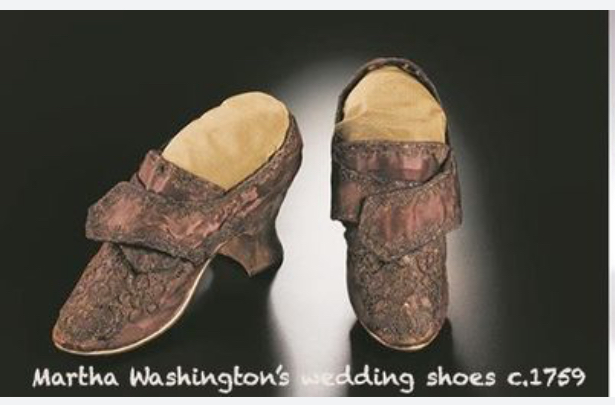
Martha Washington’s bridal shoes were lavender. According to WhiteHouse History. org, as the wife of the nation’s first President, “Martha set important social and political precedents by building the stage of presidential hospitality with her warmth and conviviality.” - Image source, Pinterest


Many weddings in Colonial era America took place close to, and after, the Christmas season. Before brides started wearing white at their weddings, they wore the very best dress they owned and it was regardless of the color, though darker colors were more popular. They were easier to keep clean. For example, Martha Washington wore lavender shoes when she married future U.S. President George. She wore the lavender shoes with a gold-colored dress when the Washingtons were married shortly after Christmas of 1758, on Jan. 6, 1759.


🍽Etiquette Enthusiast, Maura J. Graber, is the Site Editor for the Etiquipedia© Etiquette Encyclopedia
Thursday, December 14, 2023

A Q and A with Nell Drake

In 1943, during WWII  when this was written, the fee for the clergyman, ranged anywhere from $10 to $100 or $200, according to the means of the groom and the importance of the wedding. Whatever the amount, it was enclosed in an envelope and taken in charge by the best man, who handed it to the clergyman in his vestry room, immediately after the ceremony. 

1. – WHEN YOU ARE complimenting a woman friend, how should one do it?-W.Y.A., San Pedro.

Women are very “catty” when complimenting each other. They are always sure to notice the little mistakes of dress rather than notice the many lovely things about a well-groomed woman. They'll take pains to notice an off colored thread, a fractionally “off the beam” hat, a hairpin that's falling or any other similar little item. If you are complimenting another woman on her dress don't say... “Why, I've never seen you look so nice”... but say in a pleasant tone of voice, minus any sarcasm, “That dress is so becoming.”

2. – HOW DO YOUNG people introduce their friends?-J. В.Los Angeles.

A young girl taking her girl friend to the country club would greet a group of her own friends with “Hello everybody, this is Sally.” In the modern fashionable world, the titles Mister, Missus and Miss are never used except to outsiders. If Sally is accepted as a member of a certain group, she is at once called Sally, or quite likely, Sal. To be called Miss Stranger announces that she is not a member of the group.

3. – WHAT ARE detailed directions for perfect dinner giving? A. T., Los Angeles.

The requisites at every dinner of perfection, whether a great one of 200 people or a little one of six, are as follows:
  • Guests, people who are congenial to one another… this is of first importance. 
  • Food, a suitable menu perfectly prepared and served hot food should be hot, and cold, cold. 
  • Table furnishing, faultlessly laundered linen, brilliantly polished silver, and all other table accessories in perfect condition. 
  • There should be of course, a cordial and hospitable host and a hostess of charm. Charm says everything. Tact, sympathy, poise and perfect manners are always proper

4. – WHAT ARE some of the last minute obligations of the bridegroom before the wedding? -L. M., Glendale.

Gifts must be provided for the bridegroom's best man and ushers, as well as their ties, gloves and boutonnieres, a bouquet for his bride, and the fee for the clergyman, which may range anywhere from $10 to $100 or $200, according to the means of the groom and the importance of the wedding. Whatever the amount, it is enclosed in an envelope and taken in charge by the best man, who hands it to the clergyman in his vestry room, immediately after the ceremony. – By Nell Drake, 1943


🍽Etiquette Enthusiast, Maura J. Graber, is the Site Editor for the Etiquipedia© Etiquette Encyclopedia

Wednesday, December 13, 2023

Etiquette and “Dinner Giving”

An invitation to dinner conveys a greater mark of esteem, or friendship and cordiality, towards the guest invited, than is conveyed by an invitation to any other social gathering, it being the highest compliment, socially speaking, that is offered by one person to another.

DINNER giving is perhaps the most important of all social observances, therefore dinner parties rank first amongst all entertainments. Dinner giving is so thoroughly understood to rest upon the principle of an equivalent, that those who do not give dinners hardly come within the category of diners out. This rule, however, is open to many exceptions in favour of privileged individuals, popular and prominent members of society whose presence at dinner parties is appreciated and welcomed in most circles. Dinner parties are of more frequent occurrence, and are of more social significance than any other form of entertainment.

Dinner Invitations:

An invitation to dinner conveys a greater mark of esteem, or friendship and cordiality, towards the guest invited, than is conveyed by an invitation to any other social gathering, it being the highest compliment, socially speaking, that is offered by one person to another. It is also a civility that can be readily interchanged, which in itself gives it an advantage over all other civilities. The orthodox dinner giver must necessarily possess a certain amount of wealth, and wealth and wit do not always go hand in hand. Oftener than not, the former rather overweights the latter; hence, the introduction of a lighter element in the form of amusing people whose métier in life it is to be amusing and to appear amused.

Dinner giving is in itself not only a test of the position occupied in society by the dinner giver, but it is also a direct road to obtaining a recognised place in society. A means of enlarging a limited acquaintance and a reputation for giving good dinners is in itself a passport to fashionable society. Dinner giving in the fullest sense of the word, is a science not easily acquired, so much depending on the talent which the host or hostess may possess for organizing dinner-parties. When a large dinner-party is contemplated, it is usual to give three weeks' notice, but of late this notice has been extended to four, five, and even six weeks.

Diners out are rather inclined to rebel against this innovation, considering that an invitation bearing the date of a month hence pledges them to remain in town, and as it were controls their movements, for the acceptance of an invitation is in the eyes of diners out a binding obligation; only ill-health, family bereavement, or some all-important reason justifies its being set on one side or otherwise evaded. Those inconsiderate enough to make trivial excuses at the last moment are not often retained on the dinner-list of a host or hostess.— From “Manners and Rules of Good Society or Solecisms to be Avoided,” by a member of the Aristocracy, 23rd Edition


🍽Etiquette Enthusiast, Maura J. Graber, is the Site Editor for the Etiquipedia© Etiquette Encyclopedia

Tuesday, December 12, 2023

Nell Drake on Manners, 1943

At a perfectly managed wedding, the bride arrives exactly one minute after the hour to give a last comer time to find a place. 


1. CAN YOU GIVE ME the details of etiquette at lunches?- N.D.G., Eagle Rock

Men leave their coats and hats in the hall; women leave heavy outer wraps in the hall or dressing room, but always go into the drawing room with their hats and gloves on. They wear their fur neckpieces and carry their muffs in their hands, if they choose, or they leave them in the hall or dressing room. 

But women of best taste never take off their hats. Even the hostess herself almost invariably wears a hat at a formal luncheon in her own house, though there is no reason why she should not be hatless if she prefers, or if she thinks she is prettier without! Guests, however, do not take off their hats at a lunch party even in the country. They take off their gloves at the table, or sooner if they choose.

2. WHAT IS CONSIDERED a perfectly managed wedding?- T.C., Santa Monica.

At a perfectly managed wedding, the bride arrives exactly one minute after the hour to give a last comer time to find a place. Two or three servants have been sent ahead to wait in the vestibule to help the bride and bridesmaids off with their wraps and hold them until they are needed after the ceremony.

The groom’s mother and father also are waiting in the vestibule. As the auto of the bride's mother drives up, an usher goes as quickly as he can to tell the groom. Any brothers or sisters of the bride or groom, who are not to take part in the wedding procession and have arrived in their mother’s automobile, are now taken by ushers to their places in the front pews. Then the wedding ceremony begins. 

3. WHAT GOES INTO the making of a really successful saleswoman?-C.B, Los Angeles.

Really great saleswomen have not only cultivated an expert knowledge of the commodities they sell, but an equally expert ability to appraise the customers to whom they sell. It is essential to know, therefore, whether a customer likes to be “dearied” or “madamed,” or chatted to about every topic under the sun to camouflage the sales talk; and whether she is one who likes to have her mind made up for her, or whether she is one who, knowing exactly what she wants, prefers to have her own questions answered intelligently, but does not want any unasked for advice.

But above all saleswomen, the one an intelligent customer is certain to like best... the one in-fact to whom she always returns, is one who listens to what she says and tries to give her what she wants, instead of trying to sell her what the store seems eager to be rid of.– By Nell Drake, L.A. Daily News, 1943


🍽Etiquette Enthusiast, Maura J. Graber, is the Site Editor for the Etiquipedia© Etiquette Encyclopedia

Monday, December 11, 2023

Now Don't Get Snooty About Etiquette Editor


Agony Aunt Anne Singleton on etiquette and correcting one’s grammar. “Why be snooty?”

A LADY who writes to say my English is faulty in spots–whose isn't?– after having objected to the correspondence of another lady and myself on the subject of “if I were” as against “if I was,” further takes me to task for various modes of expression and finally ends by asking: “Why be snooty?”

Why indeed? But what does she consider snooty about my answering a letter to the best of my ability, using the language I was taught to speak? I don't call her snooty for disagreeing with me and trying to set me straight, from her point of view. She thinks I'm wrong. I think she's wrong. But I am not going to characterize her opinions as she does mine. 

I am going to quote Professor Loundsbury to her. Three fundamental principles he lays down. “The first is that usage is the authoritative standard of speech. The second is that it must be good usage. The third is that it must be present good usage.” I admit I'm no grammarian. I couldn't give the rules for employing one combination of words instead of another. But I do know present day usage among the best authors and I am well aware of it among the best speakers of English. 

While answering in the manner objected to (which is a form of expression I wager will be condemned) I imagined I was gossiping with a neighbor, not exchanging gestures of defiance with an enemy and I certainly was not conscious of being proud or vain-glorious. Be that as it may, how will my readers take it if I tell one (who writes to ask) that I pronounce “either” with the sound of “i” rather than “e” because I was so taught, because the better educated of my friends do so and because the Oxford dictionary commends it? Is that snooty?– By Anne Singleton for Vogue, 1931


 🍽Etiquette Enthusiast, Maura J. Graber, is the Site Editor for the Etiquipedia© Etiquette Encyclopedia

Sunday, December 10, 2023

New Lettuce (aka Salad) Forks

A salad fork on the left and gilded lettuce forks (shown with a matching lettuce spoon on the right.) Lettuce forks and spoons soon became attached and were then known as “salad tongs.” The writer clearly had the two confused and also had no idea that salad forks were first introduced to the public in 1885.
Lettuce forks are for serving lettuce, thus the length of up to 9” and longer. Salad forks are a bit shorter than dinner forks. The gilded Towle salad fork above was also marketed as a “pickle fork,” however many salads were pickled up until fresh lettuce and greens, along with other perishable vegetables and fruits, were widely available in markets and as more people acquired refrigerators in their homes. This made fresh, green salads more popular and seen on more tables.


AN EDITORIAL writer in the Los Angeles Times sees a brighter future for Imperial valley lettuce growers as a result of the recent invention of a new table tool designated to simplify the problem of eating lettuce salad.

The Western Growers Protective association is given credit for introducing the new lettuce fork to a public that has been trying for several years to devise a graceful method of devouring lettuce leaves.

Probably our former fellow-townsman, C. B. Moore, had something to do with this. If he did, we ought to erect a monument to C. В.

FOLLOWING is the Times editorial:
"Not content with starting new religions and new architecture and new styles for the flappers, California has invented a new lettuce fork with a blade attachment to cut succulent salads. We are inventing a new etiquette to go with it.

"This naturally cuts the old-timers to the quick. We grow more lettuce in Imperial valley than anywhere else on the globe and something just had to be done so that so much of it would not be left on the plate. The Western Protective Association has taken the heroic initiative in the matter.

"Heretofore it was regarded in good form to twist the salad into a large gob and thrust it into the maw even as the hayfork jams the grass into the mow of the barn. Not even the best circles could see anything pleasant in the struggle to drape one's facial foliage around these large, unwieldy quantities of fodder.

"But with this new trick salad fork, with a combination like the old jackknife with a corkscrew and fifty-seven other varieties of tools, we are able to inhale lettuce with comfort and stimulate another of California's products.

"THE silversmiths are also said to be backing the innovation and that means that the best families will lend themselves to the cause. For many of them have stock in the concern or have mines and will be pleased to have old cutlery out of date.

"California has taken the orange out of the Christ- mas stocking and got it on the breakfast table. For a time it was in peril of being put up in prescriptions like spinach by the doctors; but it has turned the corner and can be gedunked at the soda fountains. The whole country is alkalizing its system by orange juice and we are picking the profits for our purses.

"Once we got the world full of prunes; but it woke up one morning and turned to fruit cocktail instead. It got grapefruit in its eye and hope in its heart. The great question a few years back was how to eat an orange. But now the spiffy are acquiring lettuce forks and the price of sterling silver is about to take a sudden advance."– By R.H. In the Calexico Chronicle, 1930


🍽Etiquette Enthusiast, Maura J. Graber, is the Site Editor for the Etiquipedia© Etiquette Encyclopedia

Saturday, December 9, 2023

Etiquette Tidbits from the 1930’s

       
A gilded age, combination olive serving spoon and fork, circa 1880. – “If there is no olive spoon on the serving plate, the dinner guest may take olives with the fingers.”


Water and beverage glasses at the dinner table should never be more than three-fourths full. – 1937

Never extend or “crook” the little finger when holding a tea or coffee cup. – 1936

The word “personal” should never appear on an envelope. The notation "please forward’’, however. is perfectly correct. – 1937

A young woman who sends flowers to a person who is ill should include her visiting card, writing a brief message above the name-line. – 1937

When a man is not sure whether the occasion calls for a tuxedo or full dress clothes, he should wear the swallow-tail. – 1937

Sport clothes now are considered standard dress for auto travel. – 1938

During bidding, a bridge player should not call his partner’s attention to the score. 
The host or hostess at a bridge party should explain all rules of progression before play is begun – 1938
If there is no olive spoon on the serving plate, the dinner guest may take olives with the fingers. – 1938


🍽Etiquette Enthusiast, Maura J. Graber, is the Site Editor for the Etiquipedia© Etiquette Encyclopedia

Friday, December 8, 2023

Finer Points of Letter Writing

The girls said, “Mother didn’t lick the envelope, Miss Allen, honestly, she didn't.” They seemed to think that the teacher might believe that they had opened the envelope to read the note.
The Children Learn Fine Points Of Letter Etiquette

The two Green sisters had a note for teacher. Mother had sent it with them. As the teacher took it in her hands the girls saw her eyes fall upon the open flap of the envelope before she looked at the address on the envelope itself.
The girls said, “Mother didn’t lick the envelope, Miss Allen, honestly, she didn't.” They seemed to think that the teacher might believe that they had opened the envelope to read the note.

Miss Allen said, “I am sure you did not open this, girls. You see, your mother knows that it is not correct to close the flap when she sends a note by messenger. Suppose we talk about letter writing
when the last bell rings.” During the ensuing discussion the children learned the following things about letter writing:
  • First, that simple, plain letter paper is better than any gaudy or heavily decorated stationery. Correct letter paper is always unlined and certainly not perfumed. 
  • Fashions in monogramming change but rather plain initials, not too large, are always in good taste. 
  • Gold edged cards, monograms heavily embossed or engraved in silver or gold are not as correct as the smaller ones, embossed in a color. 
  • Any note should be enclosed in an envelope, not sent with a corner of the folded paper turned down.But when the note is delivered by anyone other than a professional messenger the flap of the envelope is left unsealed. 
  • The envelope may carry the words, “kindness of,” but this is unnecessary. The recipient will know it has been brought by the bearer, so why state it on the envelope? 
  • It is silly to use colored inks. There is nothing easier to read than black on white or cream. 
  • Lavender ink, green ink, red ink may have their place on invitations for special affairs, such as a Saint Patrick's day party or a Christmas affair, but for every day use there is nothing nicer than black, or a blue so deep it looks black. – By Florence La Ganke, aka “Nancy Page,” 1936


🍽Etiquette Enthusiast, Maura J. Graber, is the Site Editor for the Etiquipedia© Etiquette Encyclopedia